Hello.
This is Daily Stock, providing in-depth analysis of the stock market every day.
Executive Summary
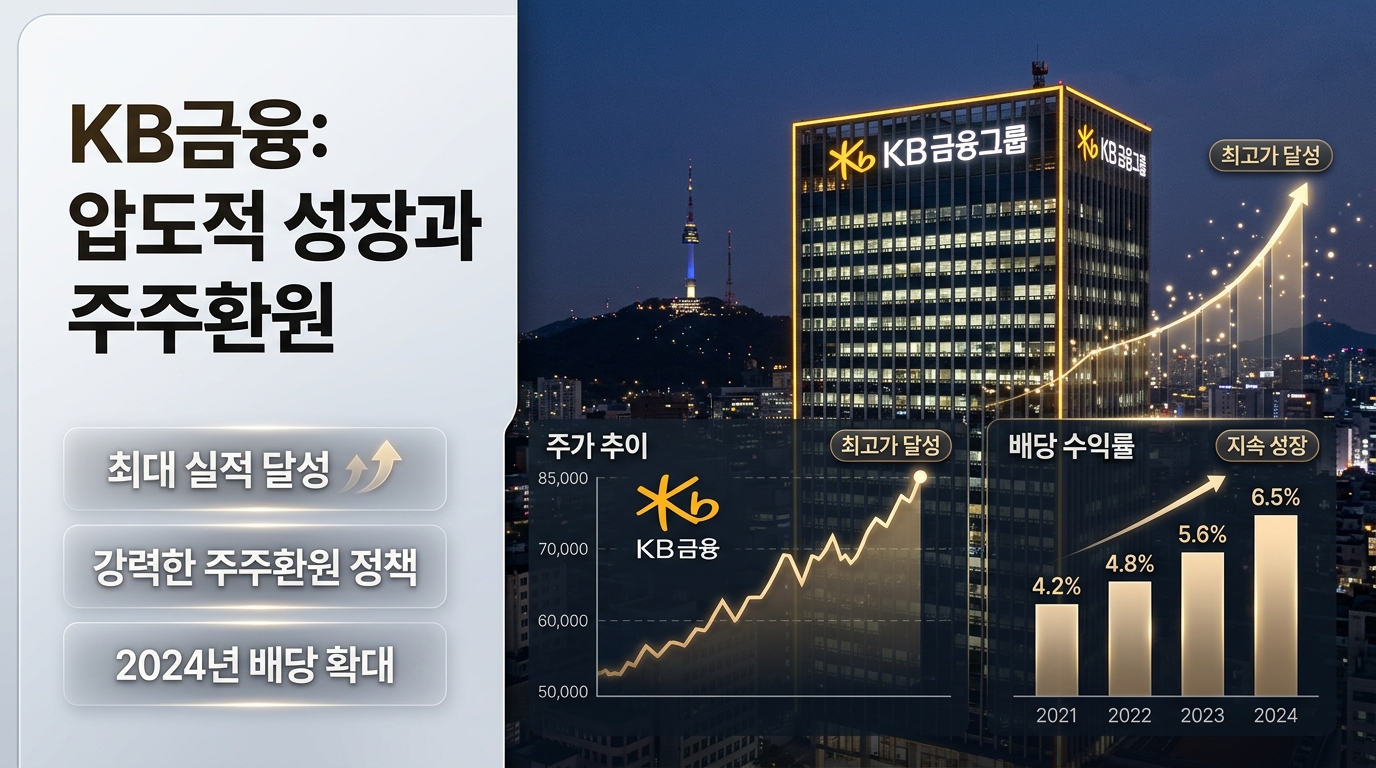
KB Financial Group (KB Financial) solidified its position as the leading financial stock in Korea by delivering record-high earnings for both the first half and the second quarter of this year.
The board's decision to buy back and cancel an additional KRW 700 billion worth of treasury shares in the second half, combined with the tax-free capital-reduction dividend program slated for next year, is highly likely to act as a powerful catalyst to maximize shareholder value.
[Image: /stdaily/uploads/202608/gen_6a6d99de7fa5d2.99717297.png]
Market Overview & Current Status
On July 23, KB Financial disclosed its Q2 earnings, posting a net profit attributable to controlling interests of KRW 1.9922 trillion, up 14.6% year-on-year (YoY).
This easily beat the market consensus of KRW 1.91 trillion, marking its highest quarterly profit ever.
Alongside the robust earnings, its Common Equity Tier 1 (CET1) ratio stood at 13.74% as of late June, comfortably exceeding its shareholder return threshold of 13.5%.
In response, the board approved an additional KRW 700 billion treasury share buyback and cancellation for the second half, signaling a strong commitment to supporting the stock price.
Meanwhile, the KOSPI index closed at 6,595.45 points, and the USD/KRW exchange rate surged to 1,444.30, maintaining pressure on foreign capital flows.
Daily Stock's KOSPI Fear & Greed Index currently sits at the "Fear" level (23.7), a slight improvement from the "Extreme Fear" level (13.5) seen a week ago, though investor anxiety remains elevated.
Amid high exchange rates and market volatility, large-cap financial stocks boasting solid earnings resilience and dividend stability offer a reliable defensive haven for both institutional and foreign investors.
Financial Analysis
The key driver behind the profitability improvement was the rapid growth of fee-based non-interest income from non-banking subsidiaries, such as securities and insurance, moving away from a heavy reliance on interest income from banking.
Notably, KB Securities' H1 net profit surged by 135.0% YoY to KRW 796.3 billion, boosting the non-banking sector's contribution to the group's total net profit to 44.0%.
| Indicator | H1 2026 Cumulative Performance / Ratio | YoY Change | Key Features & Evaluation |
|---|---|---|---|
| **Group Net Profit (Controlling)** | KRW 3.8846 trillion | +13.1% | Broke record for highest-ever half-year performance |
| **Q2 Net Profit** | KRW 1.9922 trillion | +14.6% | Driven by sharp growth in non-interest income |
| **Return on Equity (ROE)** | 14.09% | +1.06%p | Secured undisputed #1 spot among the top 4 financial groups |
| **CET1 Ratio** | 13.74% | Maintained stable level | Active shareholder return using capital exceeding 13.5% |
| **Credit Cost Ratio (CCR)** | 0.38% | -17bp | Excellent risk management despite preemptive provisioning |
| **Bank Net Interest Margin (NIM)** | 1.74% | -3bp (QoQ) | Reflected BOK interest rate policy and funding costs |
Due to the Bank of Korea's monetary easing stance and preemptive rises in funding costs, the bank's Net Interest Margin (NIM) fell by 3 basis points quarter-on-quarter (QoQ) to 1.74%.
Nevertheless, loan growth focusing on high-quality corporate clients and rising brokerage/service fees backed by active capital markets successfully offset the margin squeeze.
Valuation
With its Price-to-Book Ratio (PBR) approaching 1x, KB Financial is shifting the paradigm of its Value-Up program.
Moving beyond the traditional CET1-centric return framework, the group has begun reviewing a new shareholder return model that dynamically links Return on Equity (ROE).
Investors are particularly enthusiastic about the implementation of tax-free capital-reduction dividends next year.
During its annual general meeting in March, KB Financial transferred KRW 7.5 trillion of capital reserves into retained earnings, legally securing the necessary resources for these payouts.
Under the capital-reduction dividend scheme, individual shareholders will be entirely exempt from the 15.4% dividend income tax, and these payments will not be included in the financial income tax consolidation. This tax benefit is expected to drive steady, long-term capital inflows from wealthy individuals and pension funds seeking stable dividend yields.
Expert & Institutional Analysis
Market analysts forecast KB Financial’s total shareholder return rate for 2026 to reach approximately 54.8%.
Combining the first round of shareholder returns announced in February (KRW 2.82 trillion) with this latest resolution, the total shareholder return volume for this year is projected to range from KRW 3.7 trillion to nearly KRW 4 trillion.
[Image: /stdaily/uploads/202608/gen_6a6d99e8864a96.83106221.png]
Furthermore, market attention is shifting to the remaining KRW 180 billion surplus capital from the CET1 excess that was not allocated to the treasury share cancellation.
Many research institutions, including Samsung Securities, predict this leftover capital will either be used for further share buybacks within the year or to boost the year-end dividend, raising the Dividend Per Share (DPS) even higher.
In terms of Total Shareholder Return (TSR)—which combines stock price gains and after-tax dividends—KB Financial achieved approximately 29% in the first half of the year, outperforming rivals Shinhan (26.2%) and Hana (23.8%) to secure the top spot in the sector.
As the group demonstrates an industry-leading ROE (14.09%) powered by high capital efficiency, long-term buying interest from institutional investors remains highly robust.
Risk Factors
The most prominent downside risk is the potential rise in credit costs, driven by a prolonged high USD/KRW exchange rate (around 1,444.30) combined with a slowdown in South Korea's economic growth.
While the credit cost ratio (CCR) is currently well-managed, rising delinquency rates among vulnerable borrowers due to sustained high interest rates could put a cap on profit growth in the latter half of the year.
Additionally, some concerns have been raised regarding a temporary limit on dividend streaming (upstreaming) to the holding company due to capital regulations affecting certain insurance subsidiaries.
Although holding company cash flow remains abundant through bank interim dividends and holding company bond issuances, stable, diversified dividend contributions from subsidiaries are crucial to backing long-term shareholder return resources.
Investment Takeaway
With the KOSPI down to the 6,595.45 level and market sentiment gripped by "Fear" (23.7), KB Financial functions as a dual safety net, offering robust earnings defense alongside highly attractive dividends.
Its upcoming ROE-centered return model and next year's capital-reduction dividend scheme are factors that should fundamentally re-rate its long-term book value, far beyond a temporary high-dividend play.
While keeping an eye on macro variables like the economic slowdown and FX volatility, focusing on the virtuous cycle where capital-reduction dividends and share buybacks (enabled by the industry's highest CET1 ratio) drive up per-share value remains a solid approach.
Investor Q&A Checklist
Q1. What was the primary driver behind the Q2 earnings surprise?
A1. Despite the squeeze on bank margins, non-interest income from non-banking subsidiaries (such as KB Securities) benefited greatly from active capital markets, surging 30.9% YoY to drive the record earnings.
Q2. What is the scale and schedule of the treasury share buyback and cancellation planned for the second half?
A2. The group plans to buy back and cancel KRW 700 billion worth of treasury shares, with the execution window scheduled from July 24 to December 16.
Q3. What exactly is a "capital-reduction dividend," and when will it be applied?
A3. It is a dividend paid by reducing legal capital reserves, which makes it exempt from the 15.4% dividend income tax. KB Financial has officially announced that it will implement this program starting next year (for payments distributed in 2027).
Q4. How does the company plan to use the remaining KRW 180 billion in disposable capital?
A4. It is highly likely to be allocated toward additional share buybacks later this year or to raise the year-end dividend, distributed flexibly in line with the stock's transition toward a 1x PBR.
Q5. Is KB Financial's earnings resilience reliable amid high exchange rates and interest rate cuts?
A5. While there is downward pressure on the Net Interest Margin (NIM), the group possesses a solid defense system backed by top-tier asset quality (CCR of 0.38%) and a highly diversified non-banking portfolio.