Hello, this is the professional editor of Daily Stock.
[Image: /stdaily/uploads/202607/gen_6a6be5db46e304.30468036.png]
Key Summary
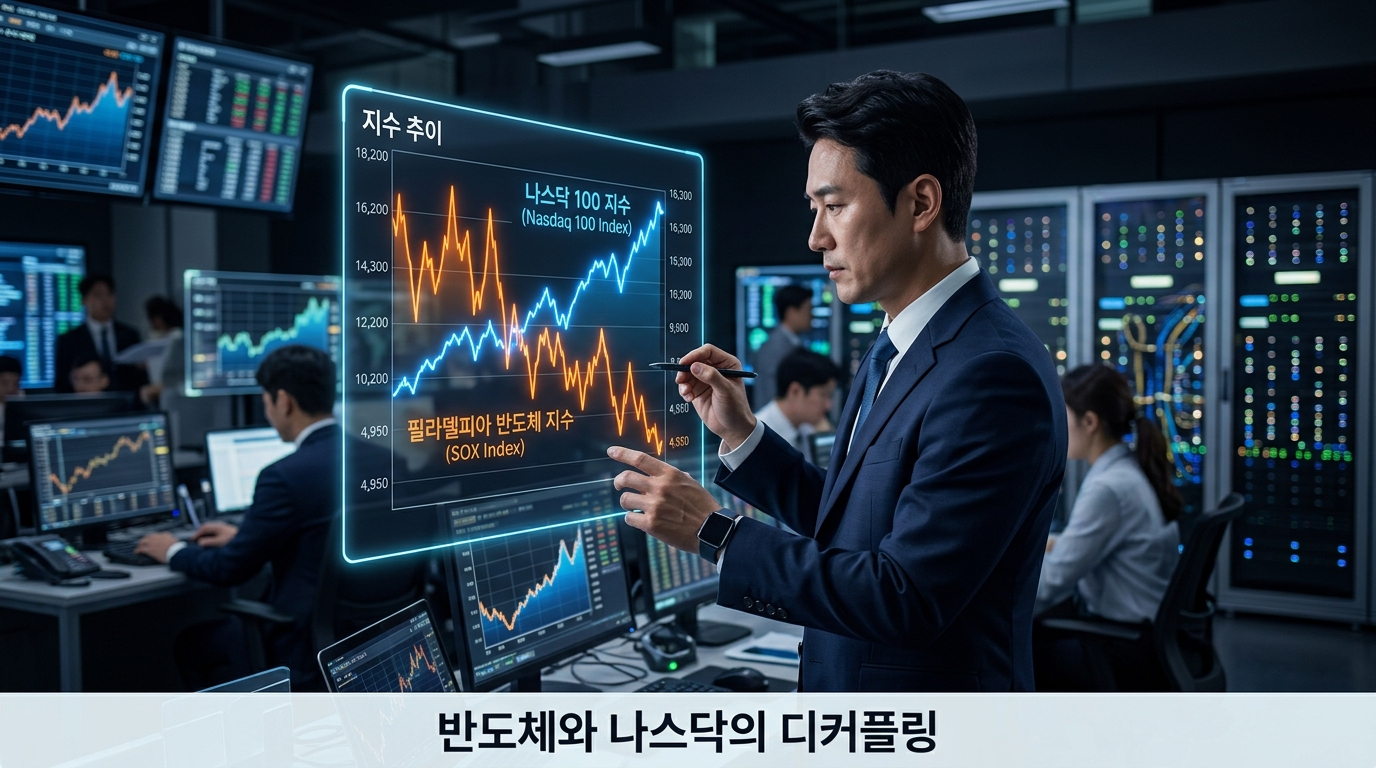
Recently, the global financial market has been observing an intense decoupling between the Philadelphia Semiconductor Index (SOX) and the Nasdaq Composite Index, driven by debate over the scale and efficiency of Big Tech's artificial intelligence (AI) capital expenditure (CapEx).
While key hardware beneficiaries suffer from short-term profit-taking sell-offs, software and platform sectors are facing margin pressure from infrastructure cost pass-throughs, triggering structural shifts within the index.
With macroeconomic conditions, including interest rates and the US dollar index, remaining high, a precise reassessment of the lower support level for multiples applied to technology stocks in general is required.
Current Market Summary
As of intraday on July 31, 2026 (tentative), the Nasdaq Composite Index is engaged in a fierce battle, recording 25,122.18.
During the same period, the domestic financial markets showed KOSPI at 6,402.42 and KOSDAQ at 679.54, with the USD/KRW exchange rate trading around the 1,425.00 won level.
Over the past month, the semiconductor index (SOX) fell more than 20% from its historical high, entering a technical correction territory. However, bolstered by Microsoft's confirmed growth in Azure cloud and AMD's robust data center earnings, it surged 8.19% in a single day, confirming buying demand at lower price points.
Despite this, according to the Daily Stock Fear & Greed Index, investment sentiment in Nasdaq currently sits in the "Fear" stage (38.9), remaining frozen compared to the "Greed" stage (68) three months ago.
The KOSPI Fear & Greed Index, representing the Korean market, also recorded "Extreme Fear" (10.9), following previous levels of 12.8 a week ago and 18.1 a month ago, maintaining a stagnant phase with severely shrunken buying sentiment.
In terms of macro indicators, the US 10-year Treasury yield (US10Y) remains strong at 4.67% to 4.68% due to the Federal Reserve's high-rate freeze, continuing to present unfavorable conditions for tech stock multiples.
Financial Analysis
While the semiconductor index and the Nasdaq index appear to move in tandem on the surface, looking closely at detailed financial metrics reveals a clear structural gap.
The steep AI capital expenditure (CapEx) cycle of hyperscalers has propelled revenues and free cash flows (FCF) of equipment and chip manufacturers like Nvidia and Lam Research to record levels.
However, this massive cost of infrastructure investment translates directly into increased operating cost burdens for SaaS and general software companies that rent and use cloud services.
SaaS companies are forced to raise infrastructure unit prices to offset surging compute costs and GPU depreciation, which is directly reflected in deteriorating operating profit margins.
[Image: /stdaily/uploads/202607/gen_6a6be5e45209d9.66186245.png]
| Classification | Philadelphia Semiconductor (SOX) Value Chain | Nasdaq Software (SaaS) Value Chain | Note |
|---|---|---|---|
| **CapEx Beneficiary** | Direct beneficiary (surge in chip & equipment deliveries) | Indirect cost pass-through (burden of cloud price hikes) | Intensification of hardware monopoly |
| **Operating Margin Trend** | Stable margin defense based on pricing power | Facing rising compute costs and margin pressure | Dilution of software sector profit margins |
| **Free Cash Flow (FCF)** | Robust cash accumulation driven by advance orders | Temporary cash flow slowdown due to high infra costs | Unbalanced transfer of wealth occurs |
|
This margin pressure felt by software companies within the Nasdaq is the root cause of the decoupling that intersects the sole rally of the semiconductor index with the correction of the Nasdaq Composite Index.
Valuation
The price-to-earnings (P/E) ratio of SOXX, a major ETF tracking the Philadelphia Semiconductor Index (SOX), expanded rapidly to around 47 times earlier this year, raising valuation burdens.
The subsequent technical correction of more than 20% from the peak is assessed as a natural process of valuation compression, normalizing growth expectations that were excessively priced in.
In contrast, the average 12-month forward P/E of the Nasdaq 100 Index is testing its downward rigidity around the 35x level, as multiple downward revisions in the software sector and profit growth in the hardware sector diverge.
In addition, the US Dollar Index (DXY), reflecting safety-haven demand and macro anxiety, is forming a base around 100.7, and intermittent spikes in the Volatility Index (VIX) are acting as upper resistance levels that suppress the multiple expansion of highly valued growth stocks.
Expert and Institutional Analysis
Global investment banks diagnose the recent spasmodic plunge in the semiconductor index and the subsequent massive single-day reversal as a combination of "reset expectations and a healthy correction."
Yardeni Research analyzed that "hyperscalers' continued willingness to invest in data centers and solid cloud revenue performance prove that long-term semiconductor demand has not been compromised."
Chris Caso, an analyst at Wolfe Research, pointed out that "the recent correction in the semiconductor sector is merely a repositioning following short-term surges," and that concerns about a serious oversupply in the actual hardware market are still premature.
However, Susquehanna Research added a cautious view, stating that "whether commodity memory prices reverse downward, as in previous cycles, will be the next inflection point," and that maintaining a wait-and-see stance rather than aggressive chasing may be advantageous for the time being.
Risk Factors
[Image: /stdaily/uploads/202607/gen_6a6be5ede2a176.07265268.png]
The primary risk is the possibility of downward guidance revisions by Big Tech companies due to actual "delayed monetization" of AI CapEx.
Even though companies are pouring astronomical funds into data center deployment, if meaningful profit recovery from services used by final consumers is delayed, a domino effect of investment cuts could occur.
The second is the potential resurgence of US Treasury yields (US10Y) due to concerns over sticky inflation.
If interest rates remain higher for longer than expected, the rising discount rate poses a significant risk of continuously dragging down the valuation multiple ceiling for high-growth Nasdaq tech stocks.
Finally, strengthening global antitrust regulations and data privacy restrictions against Big Tech hyperscalers are cited as factors that could add operational inefficiencies and undermine long-term margins.
Investment Perspective Summary
The ultra-gap decoupling between the Philadelphia Semiconductor Index (SOX) and the Nasdaq Composite Index reflects the imbalance in profit distribution between "infrastructure-building companies" and "infrastructure-consuming companies" that inevitably occurs during technological innovation.
Therefore, rather than investing complacently by trusting only the average upward trend of the Nasdaq index, this is a juncture that requires a granular eye to strictly cross-verify the margin trends of individual members within the value chain.
Amid concerns over delayed Fed rate cuts and persistent long-term Treasury yield burdens, wisdom is required to defend against market volatility stemming from hardware concentration through portfolio diversification and thorough guidance analysis.
Investor Checklist Q&A
Q1. What is the core factor behind the deepening decoupling between the SOX Semiconductor Index and the Nasdaq Composite Index recently?
A1. This is because Big Tech's astronomical AI capital expenditures (CapEx) have translated directly into massive earnings for semiconductor equipment and chip manufacturers, whereas they have pressured the software sector with excessive infrastructure lease costs and margin declines, creating asymmetric growth among sectors within the index.
Q2. How specifically does the strength of the US 10-year Treasury yield (US10Y) affect future Nasdaq tech stock valuations?
A2. When the 10-year yield remains in the mid-to-high 4.6% range, it acts as a discount rate hike factor that erodes the future value of Nasdaq stocks that justified high multiples based on long-term growth, thereby capping the upside of stock prices.
Q3. What was the background behind the sharp correction in the semiconductor index from its peak since late June?
A3. As the index surged by tens of percent in a short period, valuation fatigue accumulated. Coupled with skepticism about the speed of securing practical profit models from AI investments, profit-taking sell-offs concentrated on high-beta tech stocks.
Q4. What was the trigger for the semiconductor index's rebound, surging more than 8% in a single day on July 30 (local time)?
A4. Microsoft's Azure cloud business proved robust growth, demonstrating the results of AI investments, and AMD's data center earnings guidance supported strong chip demand, drawing in a massive influx of bargain-hunting buyers in semiconductors.
Q5. What is the current global investor sentiment shown by the Daily Stock Fear & Greed Index?
A5. The current Nasdaq Fear & Greed Index points to the "Fear" (38.9) stage, reflecting widespread guidance uncertainty in the market. The KOSPI index also remains in "Extreme Fear" (10.9), showing that investors' defensive stances have further strengthened amid global tensions.