Hello, this is Daily Stock, delivering sharp analyses of US macro market trends and key ETF developments.
[Image: /stdaily/uploads/202607/gen_6a6a9602c42700.26719244.png]
Key Highlights
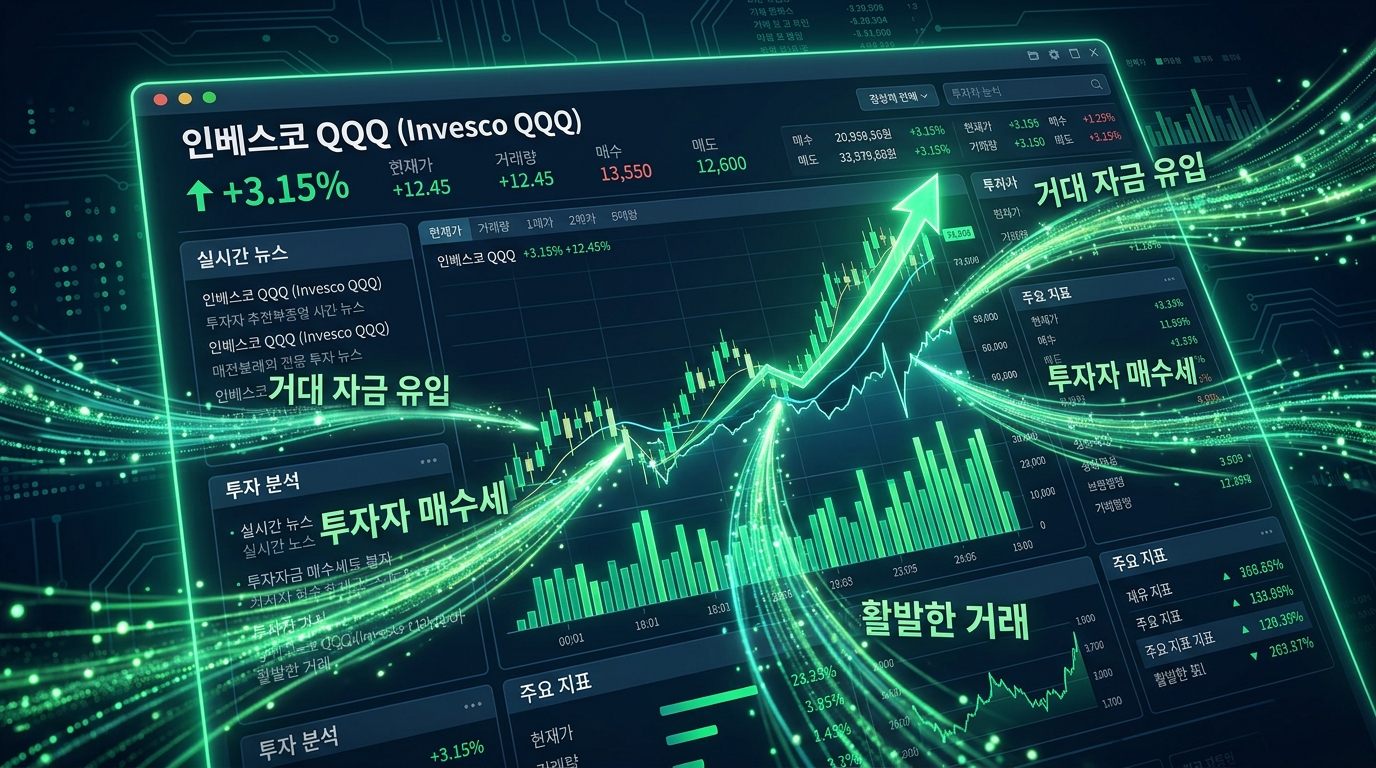
- **Record-Breaking Q2 Net Inflows**: According to Invesco's Q2 2026 earnings release, QQQ, the flagship ETF tracking the Nasdaq 100, attracted approximately $13.8 billion in fresh, long-term capital during the quarter alone.
- **Impact of Structural Overhaul**: The transition from a Unit Investment Trust (UIT) structure to a modern open-end ETF structure in late 2025, alongside a fee cut to 0.18%, has successfully locked in passive capital.
- **Intensifying Competition**: With BlackRock launching IQQ (featuring a temporary 0.10% expense ratio) and State Street introducing ultra-low-cost Nasdaq 100 ETFs, QQQ's ability to defend its market share will be a key focal point for the second half of 2026.
Market Overview
As of midday trading on July 30, 2026 (tentative), a major tech-focused portfolio rebalancing is underway across global asset markets.
Investors are actively buying and selling as they weigh the expansion cycle of Big Tech capital expenditure (CapEx) against the actual profitability of artificial intelligence (AI) businesses.
According to Invesco's recently released Q2 2026 earnings report, QQQ alone pulled in an astounding $13.8 billion out of the company's total net inflows of $45.1 billion, drawing significant attention from the market.
This strong performance quickly erased concerns over the temporary outflows witnessed during the first quarter.
At the same time, the fee war among asset managers is reaching its peak.
Earlier this month, BlackRock directly challenged Invesco's dominance by launching the iShares Nasdaq 100 ETF (IQQ) with a temporary, highly aggressive fee of 0.10%.
| Indicator | Current Value (As of 2026-07-30) | Notes |
|---|---|---|
| KOSPI Index | 5614.18 | Midday trading (Tentative) |
| KOSDAQ Index | 655.62 | Midday trading (Tentative) |
| Nasdaq Index | 24442.94 | Previous day midday trading (Tentative) |
| USD/KRW Exchange Rate | 1442.60 | Midday trading (Tentative) |
| Daily Stock Nasdaq Fear & Greed Index | 32.3 (Fear) | 1 week ago: 43.3 (Neutral) |
| Daily Stock KOSPI Fear & Greed Index | 12 (Extreme Fear) | 1 week ago: 17.3 (Extreme Fear) |
Financial Analysis
Driven by the growth of passive products led by QQQ, Invesco's overall Q2 earnings delivered an earnings surprise.
Adjusted Earnings Per Share (EPS) came in at $0.71, substantially beating the market consensus of $0.64.
Following its conversion to an open-end ETF, QQQ has successfully activated dividend reinvestment plans (DRIP) and efficient securities lending operations—both of which were restricted under the previous UIT structure.
As a result, operational efficiency within the fund has improved, leading to the financial benefit of reduced tracking error.
Its sibling ETF, QQQM (0.15% expense ratio), which targets long-term recurring investors, is also steadily expanding its asset base by highlighting its low-cost advantage.
Invesco is employing a dual-track strategy (high-liquidity trading via QQQ, long-term accumulation via QQQM) to defend its dominance in the Nasdaq 100 passive market.
Valuation
Currently, the 12-month forward Price-to-Earnings (P/E) ratio of the Nasdaq 100 index stands at approximately 21.3x.
This indicates that the index maintains a relative premium compared to the valuation of the S&P 500.
[Image: /stdaily/uploads/202607/gen_6a6a960c3984e3.76555534.png]
Big Tech companies spend an average of 11.8% of their revenue on research and development (R&D), significantly outperforming the S&P 500 average of 9.4%.
This formidable technological moat serves as a primary justification for the higher multiples that drive continuous capital inflows.
However, high volatility in the US 10-Year Treasury Yield (US10Y) and the strength of the Dollar Index (DXY) act as factors that limit the valuation ceiling.
If rate cuts slow down more than expected, a scenario could unfold where volatility increases for Nasdaq 100 components trading at high valuation multiples.
Professional & Institutional Analysis
Global research institutions analyze that the massive inflows into QQQ are primarily driven by institutional capital seeking short-term trading liquidity.
Despite the launch of ultra-low-cost rivals like BlackRock's IQQ, analysts evaluate that large institutions are unlikely to easily replace QQQ, given its dominant average daily trading volume of over 40 million shares and exceptionally tight bid-ask spreads.
Major investment banks, including Morgan Stanley, project that competing products with fees lowered to 0.10% are highly likely to absorb some capital from long-term retail investors.
However, the prevailing view is that QQQ's status as a liquidity hub, closely tied to the derivatives market, will remain solid for the foreseeable future.
Both domestic and international analysts interpret this fund flow as a signal that institutions are using passive buying to support the downside of the tech sector, which had experienced a temporary correction due to AI profitability concerns.
Risk Factors
- **Margin Pressure from Fee Wars**: The launch of Nasdaq 100 ETFs by BlackRock and State Street could put additional downward pressure on Invesco's operating expense margins.
- **Macroeconomic Uncertainties**: Concerns over prolonged high interest rates and signs of a slowdown in US economic indicators could directly trigger a compression of tech stock multiples.
- **Delayed ROI on Big Tech CapEx**: While Big Tech companies continue to expand their AI capital expenditures, there is a risk of a market-wide correction and capital outflows if actual revenue contribution fails to keep pace.
Investment Outlook Summary
In conclusion, the massive inflows into the Nasdaq 100 ETF (QQQ) prove that market confidence in technological innovation and solid mega-cap fundamentals remains intact.
With cheaper alternative products entering the market, investors now have a wider array of choices.
For investors seeking flexible trading using short-term volatility, the highly liquid QQQ remains an appropriate choice.
On the other hand, for ultra-long-term recurring investors looking to minimize costs, a smart approach would involve comparing QQQM with newly launched low-fee ETFs.
Given that the Daily Stock Nasdaq Fear & Greed Index has entered the 'Fear' zone at 32.3, managing average purchase costs through dollar-cost averaging rather than chasing rallies appears to be a more favorable strategy.
Investor Checklist Q&A
Q1. Why did QQQ recently change its structure from a UIT to an open-end ETF?
A1. The transition was aimed at enabling automatic dividend reinvestment—which was impossible under the old Unit Investment Trust (UIT) structure—and maximizing operational efficiency through securities lending to counter low-cost offerings from competitors.
Q2. From a retail investor's perspective, is QQQ or QQQM a better choice?
A2. For active traders, QQQ is highly advantageous due to its superior trading volume and tight bid-ask spreads. However, for long-term recurring investors, QQQM is better suited for maximizing long-term compounding benefits due to its lower expense ratio of 0.15%.
Q3. What is the main appeal of BlackRock's new Nasdaq 100 ETF (IQQ)?
A3. IQQ features a base gross expense ratio of 0.12%, with a promotional fee of 0.10% for the first year post-launch, offering investors an opportunity to gain exposure to the Nasdaq 100 at some of the lowest costs in the industry.
Q4. Is the current valuation of the Nasdaq 100 index excessively overvalued?
A4. With a 12-month forward P/E of around 21.3x, it is difficult to call it unreasonably overvalued relative to its growth potential. However, valuations may fluctuate depending on the macro interest rate path and whether Big Tech companies can demonstrate actual monetization of their AI divisions.
Q5. What investment strategy should be adopted considering the current market sentiment (Fear & Greed Index)?
A5. As of July 30, 2026, the Nasdaq Fear & Greed Index is in the 'Fear' zone at 32.3. Therefore, rather than making lump-sum purchases in anticipation of a quick rebound, a recurring, split-purchase strategy that leverages market volatility is highly recommended.