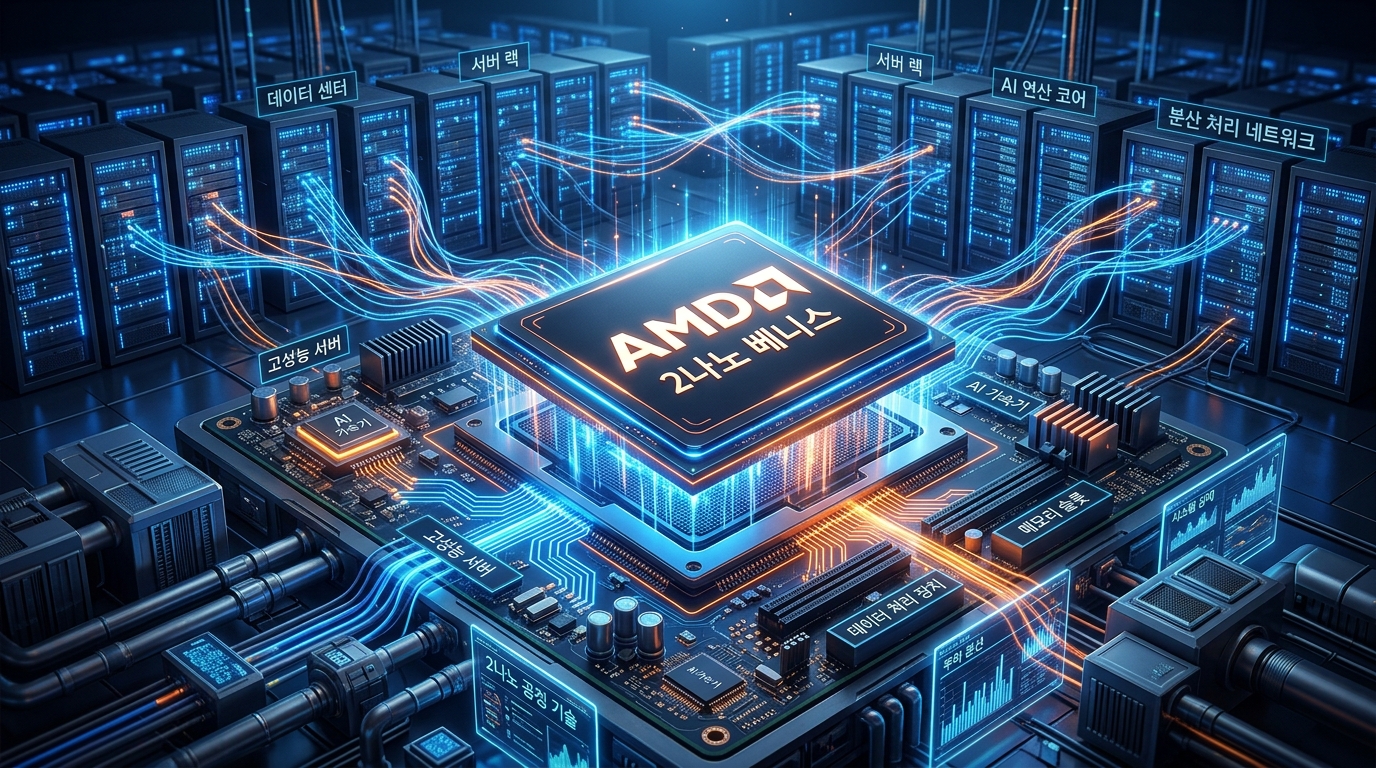
AMD, a strong challenger in the artificial intelligence (AI) semiconductor market, is continuously presenting new products and a robust demand roadmap to prove its market dominance ahead of its Q2 2026 earnings release on August 4.
[Image: /stdaily/uploads/202607/gen_6a654e62397236.28671870.png]
Key Takeaways
- **Likelihood of Meeting Q2 Earnings Guidance:** AMD provided Q2 2026 revenue guidance of $10.9 billion to $115.0 billion (midpoint of $11.2 billion, representing approximately 46% year-over-year growth), and market expectations have recently trended upward to around $11.31 billion.
- **Historic Achievement in Server CPU Market Share:** As of Q1 2026, AMD EPYC processors recorded a 46.2% share of global server CPU spending (revenue-based), marking an all-time high. This indicates that AMD is securing a solid advantage over Intel in terms of Average Selling Price (ASP).
- **Leap into an All-Round AI Platform Company:** At the recently held 'Advancing AI 2026' conference, the company unveiled the commercialization timeline for the Zen 6 EPYC 'Venice' processor utilizing TSMC's 2nm process, alongside delivery schedules of the rack-scale AI server 'Helios' to Big Tech companies. Analysts note that AMD has successfully transitioned from a mere chip supplier to an AI infrastructure platform company similar to Nvidia.
Current Status Overview
As of the closing bell on July 24, 2026, AMD's stock price stood at $521.95, down 3.29% from the previous day, showing some cooling-off momentum.
Nevertheless, the stock price has surged nearly 100% year-to-date, cementing its market capitalization at around $851.0 billion. The continuation of infrastructure investment by Big Tech companies is considered a key variable sustaining the stock price moving forward.
Particularly, during the 'Advancing AI 2026' event held on July 22–23, CEO Lisa Su revised the global server CPU Total Addressable Market (TAM) forecast for 2030 upward by over 80%, from the previous $120.0 billion to $220.0 billion. She also declared a mid-to-long-term guideline to capture more than half of this massive market.
This acceleration in market share is being driven by the expansion of 'Agentic AI' workloads—autonomous decision-making services. In Agentic AI systems, the proportion of high-performance CPUs responsible for computing control increases dramatically, narrowing the CPU-to-GPU pairing ratio from the traditional 1:8 down close to a 1:1 ratio.
Financial Analysis
AMD delivered a strong earnings surprise in Q1, with data center revenue jumping 57% year-over-year to surpass $5.8 billion.
For the upcoming Q2, the expansion of EPYC Turin's market share and the speed of overcoming bottlenecks in AI accelerator distribution will likely serve as key drivers of performance growth.
| Indicator | Q1 2026 (Actual) | Q2 2026 (Consensus Est.) | Estimated YoY Trend |
|---|---|---|---|
| **Total Revenue** | $10.3 billion | Approx. $11.31 billion | High growth expected at ~+46% YoY |
| **Non-GAAP EPS** | $1.37 | Approx. $1.61 | Profitability improvement driven by high-margin server sales |
| **Data Center Revenue** | $5.8 billion | Approx. $6.4B to $6.6B | Boosted by full-scale deliveries to hyperscalers |
| **Client & Gaming Revenue** | $3.64 billion | Concerns of temporary flat performance | Bound to gradual annual PC replacement cycles |
| **Embedded Revenue** | $873 million | Gradual bottoming out | Entering a quarterly stabilization phase |
|
[Image: /stdaily/uploads/202607/gen_6a654e6ad3c146.99934806.png]
Valuation
Currently, AMD's forward Price-to-Earnings (P/E) ratio stands at around 164x, receiving a premium valuation based on high growth expectations relative to competitors.
With market forecasts predicting annual revenue to exceed $107.0 billion by 2028, scenarios of rapid valuation compression are emerging as actual earnings materialize.
Looking at macroeconomic trends, domestic and global market climates are linked to the KOSPI at 6,690.62 points, KOSDAQ at 748.22 points, Nasdaq at 24,975.82 points, and the USD/KRW exchange rate at 1,463.10. High volatility in the US 10-year Treasury yield (US10Y) remains a variable that could trigger fluctuations in the discounted cash flow models of high-multiplier growth stocks like AMD.
According to Daily Stock's proprietary Fear & Greed Index, the current KOSPI Fear & Greed level is in "Extreme Fear" (12.9), testing downward support compared to Extreme Fear (11.6) a week ago, Neutral (41.7) a month ago, and Greed (64.2) three months ago.
Meanwhile, the Nasdaq Fear & Greed Index is also staying in the "Fear" (39.4) stage, indicating that valuation caution remains prevalent in the market compared to Fear (37.2) a week ago, Fear (26.5) a month ago, and Greed (75.3) three months ago. With the Dollar Index (DXY) and the Volatility Index (VIX) showing signs of rising, checking support levels for the Philadelphia Semiconductor Index (SOX) is crucial.
Analyst and Institutional Commentary
Major global investment banks maintain a continuously positive outlook on AMD. Wedbush raised its target price for AMD from $450 to $600, citing supply chain reinforcements unveiled at 'Advancing AI 2026'.
Bank of America (BoA) analyst Vivek Arya placed emphasis on AMD's scalability, noting its transition from fragmented chip-level competition to becoming a "comprehensive AI systems company" bundling EPYC CPUs and accelerators.
Baird aggressively raised its long-term target price to $1,250, pointing out that the AI hardware market size itself is expanding exponentially beyond previous estimates.
Particularly, Microsoft Azure's official announcement of dedicated virtual machines powered by the 2nm-based Zen 6 Venice chip is interpreted as a significant milestone certifying technological stability.
Risk Factors
- **Verification Cycle of AI Infrastructure Profitability:** If actual AI business returns (FCF) underperform compared to Big Tech's massive capital expenditure (CapEx), there is a risk of a correction in overall chip demand.
- **Advanced 2nm Yield and Supply Limits:** Close cooperation with TSMC, which holds a foundry monopoly, is essential. Guidance could be delayed if there are bottlenecks in acquiring High Bandwidth Memory (HBM) or if new 2nm yields fall short of expectations.
- **Uncertainty over Interest Rate Trends:** If expectations of macroeconomic monetary policy normalization continue to be pushed back or inflation indicators come in higher than expected, it could trigger profit-taking in high-multiplier semiconductor growth sectors.
Investment Perspective Summary
AMD's greatest strength lies in its role as an alternative to Nvidia's dominant AI GPUs, while effectively capturing market share from its server CPU rival, Intel.
Having established a premium position accounting for nearly half (46.2%) of global server CPU spending, the scenario of stronger system-centric design revenue remains highly probable if generative Agentic AI demand accelerates.
However, macroeconomic supply-demand instability and the Nasdaq Fear & Greed Index remaining in "Fear" suggest that volatility management should precede aggressive buying. It seems advantageous to monitor the virtuous cycle of data center revenue growth and margin expansion in the upcoming Q2 earnings report on August 4 before widening exposure.
Investor Q&A Checklist
Q1. How does the newly announced next-generation server CPU 'Venice' differ from its predecessor?
A1. Venice is a Zen 6-based CPU manufactured using TSMC's industry-leading 2nm process, delivering up to a 1.7x increase in computing efficiency compared to the previous-generation EPYC ecosystem.
Q2. What is the specific mechanism by which the AI trend increases server CPU demand?
A2. As Agentic AI with autonomous execution capabilities becomes more complex, bottlenecks occur in the CPUs responsible for central control calculations. This dramatically expands the CPU-to-accelerator pairing ratio up to a 1:1 level.
Q3. What numbers should investors focus on in AMD's Q2 earnings release?
A3. Whether total quarterly revenue beats the market consensus of $11.31 billion, and whether quarterly data center revenue—the backbone of the overall earnings structure—continues stable, step-by-step growth.
Q4. What is AMD's unique advantage in server CPUs compared to Intel?
A4. While Intel still leads in terms of volume (54.9%), AMD leverages high cost-efficiency and TCO (Total Cost of Ownership) savings to command high average selling prices (ASP), capturing a highly efficient 46.2% of total spending.
Q5. What is the commercialization timeline for the rack-scale AI server platform 'Helios'?
A5. Deployment in Microsoft Azure data centers has been officially confirmed, and the sequential delivery of initial volume is scheduled to begin in the second half of this year (H2).