Hello. This is Daily Stock, delivering sharp analyses of South Korean capital markets and global macroeconomic trends.
Key Summary
- **Capturing the Historic $100 Billion Monthly Export Peak**: In June 2026, South Korea's exports surged 70.9% year-on-year to reach $102.25 billion, surpassing the monthly $100 billion milestone for the first time in history.
- **AI Semiconductor Concentration and Explosive Trade Surplus**: With semiconductor exports topping $40 billion monthly and the preliminary trade balance for July 1–20 recording a surplus of $12.22 billion, the cumulative annual surplus is nearing $149.91 billion.
- **Extreme Decoupling of Earnings and Market Supply/Demand**: Despite the unprecedented export boom, the KOSPI index closed at just 6,690.62 as of July 25, 2026, with the KOSPI Fear & Greed Index lingering in the 'Extreme Fear (12.9)' territory.
[Image: /stdaily/uploads/202607/gen_6a645f373ae373.42477004.png]
Current Situation Summary
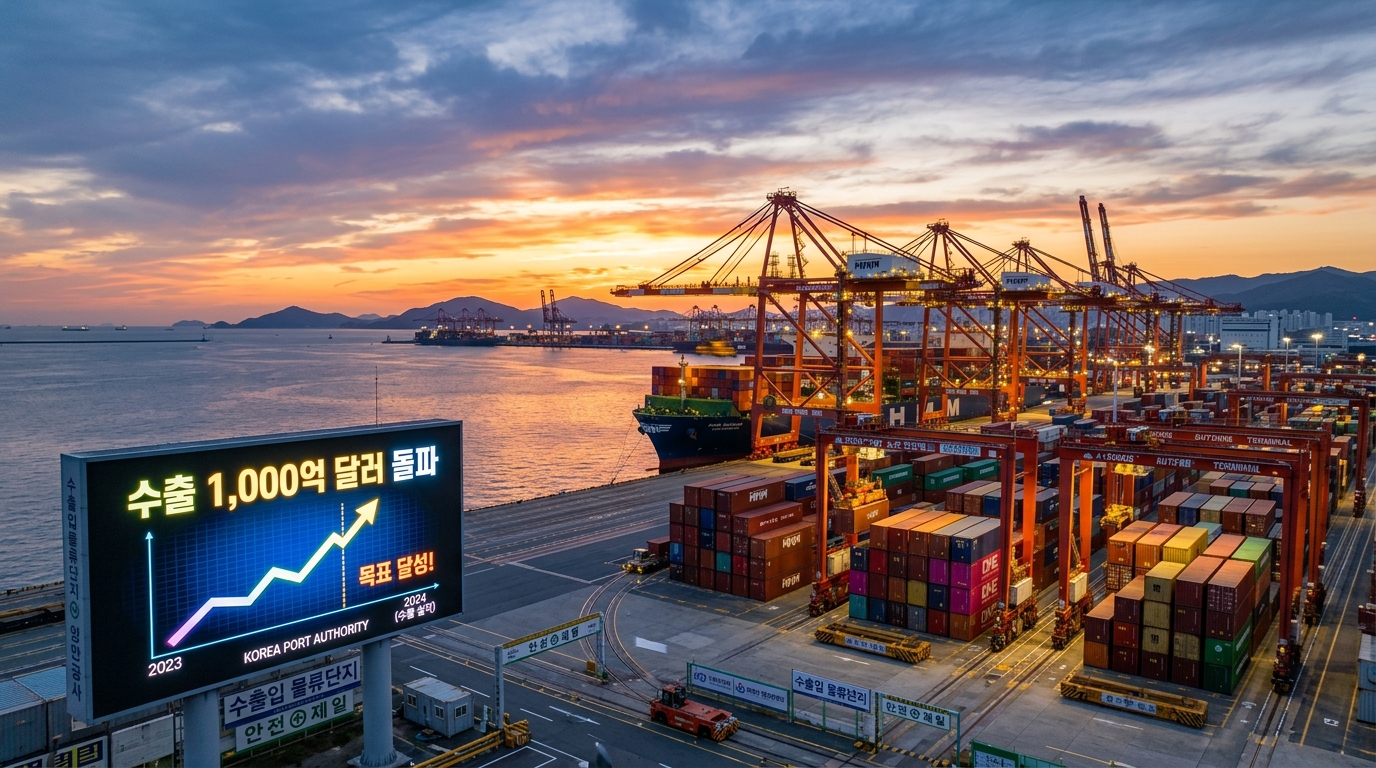
South Korea's exports have achieved a monumental milestone, demonstrating unrivaled prominence on the global stage.
According to the Ministry of Trade, Industry and Energy and the Korea Customs Service, exports in June jumped 70.9% year-on-year to record $102.25 billion.
With this achievement, South Korea has become the fourth country in the world—following Germany, China, and the United States—to surpass $100 billion in monthly exports.
At the same time, the June trade balance recorded a surplus of $36.15 billion, crossing the $30 billion threshold for the first time in history.
This robust momentum has continued unabated into July.
Preliminary exports for July 1–20 reached $54.93 billion, up 52.3% year-on-year, once again breaking the record for the highest performance in July history.
However, in stark contrast to the dazzling run of physical indicators, sentiment in the domestic stock market remains deeply frozen.
As of today's close (2026-07-25), the KOSPI index stands at 6,690.62 points.
According to Daily Stock's proprietary Fear & Greed Index, KOSPI sentiment reflects 'Extreme Fear (12.9)', underscoring deep-seated concerns in the market.
Although this is a marginal rise from the 'Extreme Fear (11.6)' level recorded a week ago, the market remains stuck in an extreme state of psychological contraction.
Financial Analysis
Driven by the tailwinds of the semiconductor supercycle, the country's 'national balance sheet'—the trade account—is seeing maximized cash flows.
In particular, the cumulative trade surplus from January to July 20, 2026, reached an astounding $149.91 billion.
This is an overwhelming figure, more than five times the cumulative surplus of $27.87 billion recorded during the same period last year.
The primary driver of this explosive surplus is undeniably the semiconductor (memory) sector, fueled by the massive expansion of AI infrastructure.
| Classification | June 2026 Performance | July 1–20, 2026 Preliminary | 2026 Cumulative (Jan 1 – Jul 20) |
|---|---|---|---|
| **Export Volume** | $102.25 billion (+70.9%) | $54.93 billion (+52.3%) | $551.28 billion (+48.7%) |
| **Import Volume** | $66.10 billion (+30.1%) | $42.71 billion (+20.0%) | $401.37 billion (+17.1%) |
| **Trade Balance** | $36.15 billion surplus | $12.22 billion surplus | $149.91 billion surplus |
During the first 20 days of July, semiconductor exports surged by 180.6% year-on-year to record $22.11 billion.
Semiconductors accounted for a massive 40.3% of total exports, highlighting an intensifying concentration of risk on a single sector.
[Image: /stdaily/uploads/202607/gen_6a645f42925732.76075158.png]
Valuation
The current earnings growth centered on South Korea's large-cap exporters has significantly boosted the fundamental strength of the KOSPI.
However, market valuations remain heavily discounted and have failed to fully reflect this earnings improvement.
This is primarily due to the outflow pressure of foreign capital, as the USD/KRW exchange rate remains elevated at 1,463.10 won.
While a high exchange rate acts as a tailwind for exporting companies by boosting won-denominated earnings, it is a double-edged sword for the broader stock market due to concerns over foreign exchange losses.
Price-to-earnings (P/E) ratios for large-cap KOSPI 200 companies remain near historical lows compared to major global indices.
The fact that the KOSPI index remains anchored at 6,690.62, even amid upward revisions of semiconductor-driven earnings forecasts, is interpreted as the impact of 'peak-out' concerns.
Expert & Institutional Analysis
Investment banks (IBs) and domestic financial institutions note that the economic strength demonstrated by the current trade indicators is not a 'short-term bubble.'
This is because rising fixed prices for memory semiconductors (strong prices for DDR5 16Gb and NAND 128Gb) are driving substantial margin expansions.
Experts project that AI data center investments by global Big Tech companies will remain robust through at least the first half of next year.
Under this scenario, domestic manufacturers possessing High Bandwidth Memory (HBM) and high-performance SSD technologies are highly positioned to be the primary beneficiaries.
While some institutions caution against the slowdown in passenger car exports (-10.6%), they evaluate that the growth in ships (+70.8%) and computer peripherals (+231.9%) is supporting portfolio diversification.
Ultimately, the key variable will be the return of foreign capital accompanied by the stabilization of the exchange rate.
[Image: /stdaily/uploads/202607/gen_6a645f4d0e5365.59703313.png]
Risk Factors
Behind the spectacular performance of the export front lines lie several heavy risks.
First is the vulnerability of an export structure excessively concentrated on semiconductors (40.3%).
If global IT demand experiences even a minor slowdown in the future, there is a risk that the overall trade balance could slide rapidly.
Second is the burden of energy import costs, such as oil and gas, which continue to hover at high levels.
As of mid-July, energy imports (crude oil, gas, coal) rose 27.4% year-on-year, adding to South Korea's cost burden.
Lastly, escalating US-China tensions and moves toward stronger tariff barriers present permanent uncertainties for South Korea, an open trading nation.
Investment Perspective Summary
The divergence between miraculous export performance and a market sentiment of 'Extreme Fear (12.9)' presents both confusion and opportunity for investors.
As long as the fundamental trend of the indicators remains intact, the valuation attractiveness of large-cap stocks is highly likely to strengthen progressively.
However, a phased buying approach is recommended until the macroeconomic environment (the USD/KRW rate at 1,463.10 won and global stock market volatility) stabilizes completely.
This is a time that requires the patience to calmly wait for the gears of the physical economy and stock market liquidity to realign.
Investor Checklist Q&A
Q1. Where does South Korea rank globally in breaking the $100 billion monthly export milestone?
A1. South Korea is the fourth nation in the world to surpass $100 billion in monthly exports, following Germany, China, and the United States.
Q2. Is the trade surplus streak continuing into July?
A2. Yes, the trade surplus for July 1–20 stood at $12.22 billion, pushing the cumulative annual surplus near $149.91 billion.
Q3. Which key sectors and products have driven the recent export boom?
A3. The primary drivers are semiconductors (+180.6% as of mid-July), fueled by the explosion in AI chip demand, and computer peripherals (including SSDs, +231.9%), driven by expanding Big Tech investments.
Q4. Why is the KOSPI index underperforming despite outstanding export results?
A4. The USD/KRW exchange rate remaining elevated in the 1,463 won range is hindering the inflow of foreign capital, while global tightening policies and economic growth worries continue to suppress market sentiment.
Q5. What are the main risk factors for exports and the trade balance in the second half?
A5. Major risks include the excessive concentration of exports on semiconductors and the rising burden of energy import costs (+27.4% as of mid-July) due to fluctuations in global crude oil and natural gas prices.