Hello. This is Daily Stock, bringing you the latest flows from the Korean financial market.
[Image: /stdaily/uploads/202607/gen_6a630dfaa8d665.61235869.png]
Summary
The USD/KRW exchange rate is hovering above the 1,460 won level, cementing a new normal of a high exchange rate.
Although the worst of the surge has eased slightly due to the government's request for foreign currency exchange and the strategic FX hedging activated by the National Pension Service, market wariness remains high.
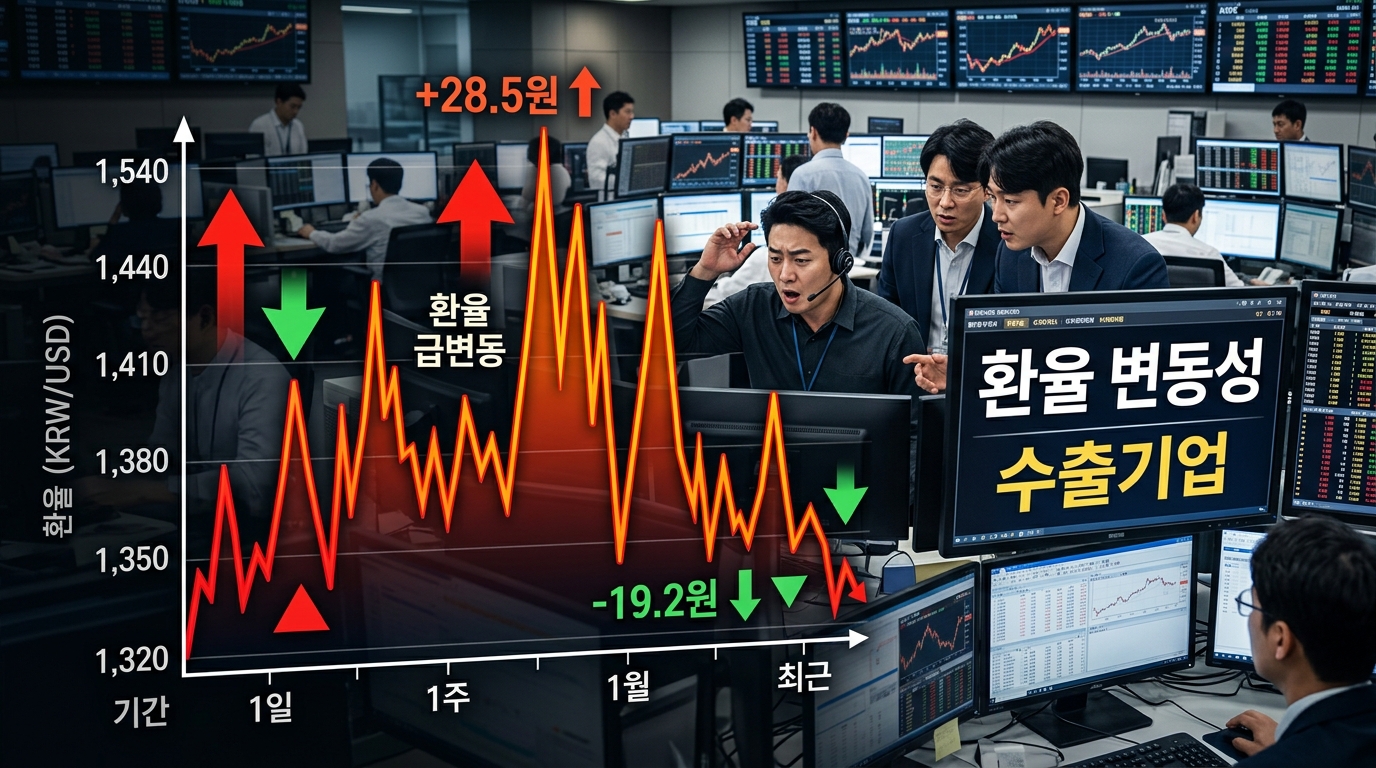
In the past, a high exchange rate was considered positive for exporters' earnings. However, the profit-and-loss calculation has recently grown complex due to a surge in raw material import costs and the boomerang effect of FX hedging trigger contracts.
In particular, for export companies, FX derivative losses triggered at around the 1,500 won level are emerging as a key variable for financial health.
Current Status
As of the market close on July 24, 2026, the USD/KRW exchange rate stood at 1,466.80 won, maintaining its long-term high exchange rate trend.
On the same day, the KOSPI index closed at 6,690.62 points, while the KOSDAQ index closed at 748.22 points.
Unlike the numerical trends of the major indices, internal investment sentiment in the Korean market is extremely contracted.
According to Daily Stock's own Fear and Greed Index, the KOSPI is currently indicating a level of Extreme Fear (12.8).
This shows that market sentiment is severely frozen, following the Extreme Fear (12.2) level seen a week ago. This is a sharp cooldown compared to the Neutral (53.8) level one month ago and the Greed (63.9) level three months ago.
Amid ongoing global macroeconomic uncertainties, the Nasdaq Fear and Greed Index also remains at the Fear (39.7) level.
Although the US market has eased slightly compared to Fear (37.2) one week ago and Fear (26.5) one month ago, extreme caution still dominates compared to the Greed (75.3) level seen three months ago.
[Image: /stdaily/uploads/202607/gen_6a630e063ff789.33653499.png]
Financial Analysis
As the high exchange rate environment persists, the financial statements of domestic export companies are showing a dual trend.
On the surface, there is an illusionary effect of increased dollar sales converted into won, but the actual improvement in operating profit margins is showing limitations.
This is because the import prices of basic raw materials and semi-finished products have risen simultaneously due to global supply chain restructurings.
In particular, FX trigger contracts signed by some companies with financial institutions have led to locked-in losses instead of FX gains as exchange rates exceeded the pre-set ranges.
| Industry | Key Export Structure & Raw Material Import Share | Impact Analysis at 1,460 Won Level | Responses & Risk Factors |
|---|---|---|---|
| **Semiconductors / IT** | Maximized finished goods exports, moderate raw material imports | Short-term operating margin rises due to expanded USD sales | Concerns over slowing global set demand & potential FX hedge trigger losses |
| **Automotive / Parts** | Increased parts imports & local production, direct exports of finished goods | High earnings expected due to increased USD-converted sales from won weakness | Concerns that rising import prices of high-cost parts will offset profit gains |
| **Shipbuilding / Machinery** | High ratio of USD collections, high import dependence on steel plates, etc. | Stable profits pursued through early activation of forward exchange contracts | Long-term high exchange rates will worsen raw material import burdens & stall margins |
| **Refining / Chemical** | Entire crude oil quantity imported, refined products exported | Massive surge in raw material acquisition and fuel costs due to weaker KRW | Concerns over deteriorating profitability as cost burdens outweigh margin improvements |
Valuation
Valuation assessments at the current KOSPI 6,690.62 level must account for won value distortions caused by FX fluctuations.
For pure large exporters, the increase in the value of USD-denominated assets can act as a factor lowering the book-value Price-to-Earnings Ratio (PER).
However, industries with a large share of domestic sales or high import material sourcing costs are experiencing risks of spiking debt ratios and falling asset values.
According to an analysis by the Korea International Trade Association, the long-term proportion of exporters whose operating profit margins improve when the exchange rate rises shrinks drastically to 19.9% when production cost increases are reflected.
Therefore, the current high exchange rate phase is a time to re-evaluate valuations based on individual companies' actual cash flows and margin defense capabilities, rather than simple book values.
It is pointed out that profit growth relying solely on exchange rate effects without real growth in export volumes may lack sustainability.
Expert & Institutional Analysis
Foreign exchange and financial investment experts assess that the possibility of this high exchange rate situation escalating into a rapid systemic collapse similar to past financial crises is limited.
However, they analyze that frictional costs due to supply-demand imbalances are continuously occurring as the range above 1,450 won persists for a long period.
In particular, the National Pension Service (NPS)'s strategic FX hedging trigger level (around 1,450 won) and the intensity of foreign exchange authorities' interventions have served as key support lines defending the upper limit of the exchange rate.
Experts warn that while large corporations are absorbing the shock through their own FX hedging methods, small and medium-sized enterprises (SMEs) may suffer larger losses as they cannot immediately pass on rising processing costs to supply prices.
Regulatory authorities, including the Financial Supervisory Service, are also focusing on blocking risks by monitoring outstanding commitments in import-export derivative contracts and foreign exchange liquidity. The fact that the government continues to implement supply-demand stabilization measures, such as encouraging the conversion of export proceeds, is also a variable in easing volatility.
[Image: /stdaily/uploads/202607/gen_6a630e115a9033.96652368.png]
Risk Factors
The biggest risk is the scenario of further increases in key energy and raw material prices, such as crude oil, due to prolonged geopolitical tensions.
If high exchange rates and high oil prices hit simultaneously, the margin spreads across the domestic manufacturing industry could be rapidly damaged.
Secondly, there are risks of changes in contract terms and liquidation of derivative products entered into for FX hedging purposes.
Valuation losses arising from exceeding the established trigger exchange rates run the risk of being largely reflected as non-operating expenses at the time of quarterly earnings announcements.
Lastly, concerns over foreign investor capital outflows persist.
If worries over further depreciation of the won grow, foreign investors may engage in massive selling in the KOSPI market to avoid FX losses, which could trigger a supply-demand imbalance in the index.
Investment Perspective
Overall, investing in export stocks at the current USD/KRW exchange rate level of 1,466.80 won requires a meticulous approach to identify the margin defense capabilities of each industry and company.
A simple approach of betting solely on FX gains from a rising exchange rate could backfire due to unexpected derivative losses and skyrocketing import costs.
An alternative strategy could be to focus on high-value-added export companies that have stable FX hedging structures, low dependence on imported raw materials, and global market dominance with pricing power.
As the KOSPI is facing an atmosphere of Extreme Fear (12.8), a cautious installment-buying approach seems advisable until macroeconomic FX volatility enters a stabilization phase.
Investor Checkpoint Q&A
Q1. Is a rising exchange rate unconditionally positive for exporters' stock prices and earnings?
A1. Unlike in the past, dependence on imported raw materials has risen, increasing cost burdens, and losses can occur due to derivative trigger contracts, so it is difficult to view it as an unconditional positive.
Q2. How is this high exchange rate phase different from the crises in 1997 or 2008?
A2. Unlike back then, South Korea's foreign exchange reserves and fundamental strength have improved, meaning this is a phase driven by macro volatility rather than a systemic default crisis.
Q3. What is an 'FX hedging trigger contract' and why is it a threat to companies?
A3. It is a contract structure where companies exchange currency favorably when the rate is below a certain level, but are forced to sell dollars at a highly unfavorable rate far below the market price once it exceeds a designated range. This causes massive valuation losses when the exchange rate spikes.
Q4. What is the impact of the National Pension Service's strategic FX hedging on the FX market?
A4. By implementing FX hedging on foreign assets, the NPS can supply a large volume of forward exchange sales, which plays a buffering role in easing the dollar shortage and curbing rapid exchange rate spikes.
Q5. What is the most important indicator for investors to monitor in a high exchange rate environment?
A5. Along with the proportion of imported raw materials and trends in operating profit margins of individual companies, investors must check the intervention stance of foreign exchange authorities and the implementation of supply-demand stabilization policies.