Hello, this is Daily Stock.
Summary
[Image: /stdaily/uploads/202607/gen_6a5c1443bebbe9.13670832.png]
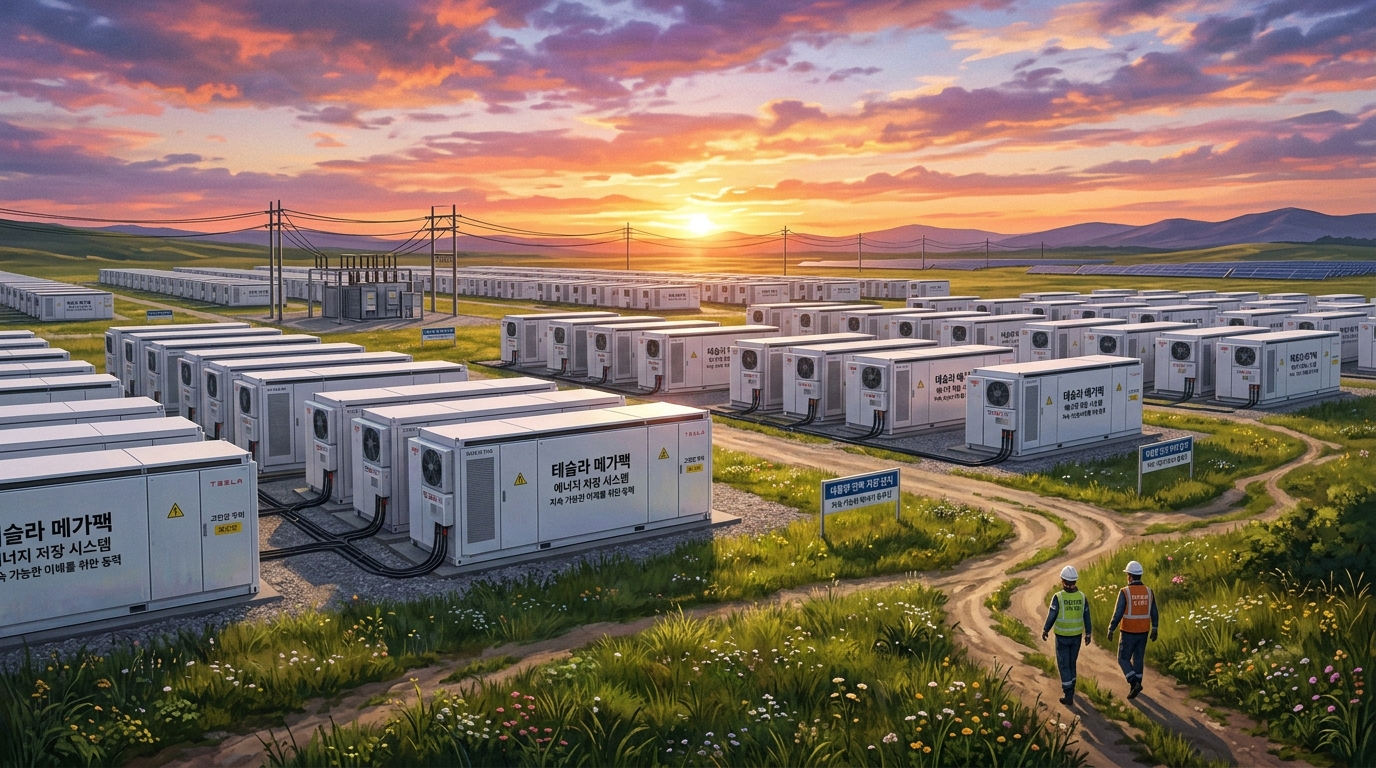
In the second quarter of 2026, Tesla demonstrated strong growth momentum by recording 13.5 GWh of energy storage system (ESS) deployments, representing the second-highest quarterly figure in its history.
At a time when growth in the existing automotive business is undergoing adjustments, the growth of the energy sector, which is leading margin defense, is raising market expectations.
In particular, analysis suggests that the rising utilization rates of Megafactories in California and Shanghai, China, are acting as a key driver for improving the company's profit structure.
Current Status Summary
Tesla's Q2 deployment of 13.5 GWh is a record level, representing approximately 53% growth compared to the previous quarter (8.8 GWh) and an approximate 40% increase year-over-year.
This achievement is driven by global utility companies significantly increasing the adoption of Megapack, Tesla's large-scale energy storage solution, to stabilize electrical grids.
In particular, as demand for stable power supply surges due to the expansion of Artificial Intelligence (AI) data centers, strong demand for Battery Energy Storage System (BESS) products is being sustained.
With the Nasdaq Index standing at 25,520.24 as of July 19, 2026, navigating macro uncertainties, Tesla's portfolio diversification is receiving positive evaluations.
According to Daily Stock's proprietary Fear & Greed Index, the Nasdaq market is currently in the "Fear" (37.1) stage, highlighting the need for validation of actual fundamentals.
In the domestic stock market, the KOSPI index is at 6,820.60, and the KOSDAQ index is at 791.84, with the KOSPI Fear & Greed Index indicating an "Extreme Fear" (12.4) territory.
Financial Analysis
Tesla's energy generation and storage revenue reached $12.7 billion for the full year of 2025, establishing itself as a core segment representing approximately 13% of total company revenue.
Ahead of the upcoming Q2 2026 financial earnings release on July 22, 2026, the market consensus estimate for Tesla's average energy sector revenue stands at approximately $3.773 billion.
[Image: /stdaily/uploads/202607/gen_6a5c144be82ff1.47754751.png]
The table below shows the performance trends of Tesla's major business segments, alongside market consensus estimates for Q2 2026 and the full year of 2026.
| Category | Full Year 2025 | Q1 2026 | Q2 2026 Consensus (Average) | Full Year 2026 Consensus (Average) |
|---|---|---|---|---|
| **Energy Deployments (GWh)** | 46.7 GWh | 8.8 GWh | 13.5 GWh (Actual) | - |
| **Energy Revenue ($100M)** | 127.0 | 24.08 | 37.73 | 155.33 |
| **Automotive Revenue ($100M)** | - | - | 200.48 | 742.95 |
| **Total Revenue ($100M)** | - | 223.90 | 275.84 | 1,052.21 |
| **GAAP Gross Margin (%)** | - | - | 19.5% | 19.7% |
These figures indicate that the energy sector is transforming into a substantial cash cow that buffers the slowdown in the automotive business.
In particular, Wall Street has set the total company gross margin consensus for this second quarter at 19.5%, and analysts are closely analyzing the margin contribution from the energy division.
Valuation
Tesla's historical valuation has not been limited to its value as an electric vehicle manufacturer, but has complexly reflected software and robotics multiples.
On top of this, the growth of the energy ESS segment is functioning as a fundamental strength supporting the short-term downside of Nasdaq growth stocks, which are sensitive to fluctuations in macro indicators such as the US 10-year Treasury yield.
With the Megafactory in Lathrop, California, and the newly operational Megafactory in Shanghai, China, each securing a design capacity of 40 GWh annually, the scale effect is expected to accelerate.
If reductions in manufacturing unit costs through mass production are realized, a valuation rerating as a high-margin business in the future appears likely.
Investors are increasingly focusing on scenarios for improving the company's total operating margin brought about by the growth in energy deployments, rather than just vehicle delivery volumes.
Analyst & Institutional Insights
Many Wall Street investment firms interpret that global demand for Megapack and Powerwall remains in a sustained expansion phase.
Institutional analysts, including Morgan Stanley, have evaluated the long-term value of Megapack, coupled with the power infrastructure replacement cycle, as a hidden driver raising share value.
The platform business connecting individual homeowners into Virtual Power Plant (VPP) networks is also cited as Tesla's unique competitive advantage.
On the other hand, some analyses suggest that securing continuous cost competitiveness must come first to prepare for potential market entry by competitors and weakening pricing power.
Different profit scenarios depending on changes in global green policies and regulatory environments, such as country-specific tariff regulations, are also factors that must be examined from multiple angles.
Risk Factors
First, negative volatility in profitability could arise from fluctuations in procurement costs for raw materials like lithium and key battery cells.
Second, intense low-cost bidding competition from strong China-based large-scale ESS designers and manufacturers, such as BYD and Sungrow, is a risk.
Finally, utility-scale projects, which form the core of the business, do not recognize revenue all at once upon contract signing but rather on a deferred basis according to long-term installation milestones, which can cause quarterly earnings volatility.
These factors imply that the growth of Tesla's energy division may not be smooth in the short term and could exhibit a step-like trajectory.
Investment Perspective Summary
[Image: /stdaily/uploads/202607/gen_6a5c145376cd56.17338432.png]
In conclusion, Tesla's energy business is facing an inflection point, moving beyond a simple auxiliary business to reshape the company's long-term growth profile.
There is a high likelihood that the 13.5 GWh deployment achieved in the second quarter will sequentially translate into improved quarterly revenue and margins moving forward.
Therefore, rather than focusing on concerns over short-term automotive revenue slowdowns, it seems valid to track the expansion of hardware infrastructure led by Megafactories from a long-term perspective.
Investor Checkpoint Q&A
- **Q1. What is the significance of Tesla's energy deployment performance in Q2 2026?**
- By recording 13.5 GWh, which surged 53% compared to the previous quarter, it demonstrates that utility-centered Megapack demand is nearing record highs.
- **Q2. How is the mass production system of the Megafactories structured?**
- The Lathrop plant in California, USA, and the Shanghai plant in China each have a production capacity of 40 GWh annually, establishing a steep global manufacturing capability of 80 GWh in total.
- **Q3. What is the scale of the energy storage business's contribution to earnings?**
- It reached approximately 13% of total revenue as of 2025 and is emerging as a major business, with an average revenue consensus of approximately $3.773 billion for Q2 2026.
- **Q4. What are the main competitive threats in the global battery energy storage system (BESS) market?**
- Global price competition from vertically integrated battery value chain companies in China, such as Sungrow and BYD, is highlighted.
- **Q5. Why does the profit recognition of the energy business appear unstable on a quarterly basis?**
- Because large-scale utility contracts are not recognized as revenue all at once, but are instead recognized as deferred revenue based on the completion of specific installation milestones.