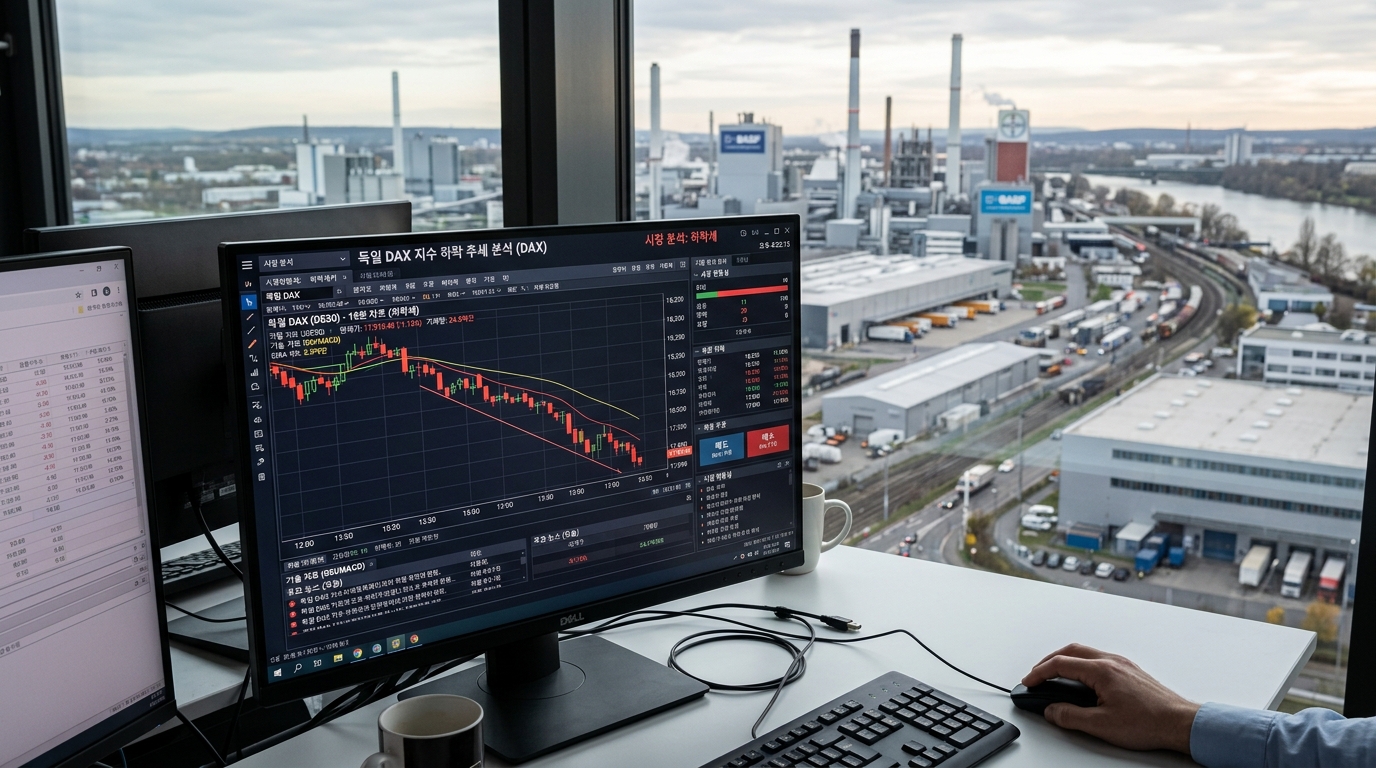
As fundamental decoupling in global financial markets accelerates, the Frankfurt stock market faces high uncertainty, with both the recovery potential and structural limits of German manufacturing—the backbone of the European economy—coming into sharp focus.
[Image: /stdaily/uploads/202607/gen_6a5a7c27810ce0.91311017.png]
Summary of Key Points
Germany's Industrial Production index for May rose 0.9% month-on-month (MoM), driven by increased automotive production, significantly beating market expectations.
However, it remained flat (0.0%) year-on-year (YoY), and the structural decline in employment and contraction in the chemical sector remain severe.
The Frankfurt Stock Exchange's DAX index closed at 24,830.98 points, extending its losses for a second consecutive week.
As the three-pole decoupling among the US, European, and Asian markets deepens, high energy costs and geopolitical tensions originating from the Middle East continue to act as chronic downside pressures on German manufacturing.
Market Overview
According to the Federal Statistical Office of Germany, industrial production in May 2026 increased by 0.9% MoM, expanding from the 0.2% growth recorded in April.
The primary drivers were the automotive industry, which surged 3.6% MoM, and the construction sector, which rose 0.9%.
However, the S&P Global Germany Manufacturing PMI for June only rebounded slightly to 50.3, a five-month high, while new order momentum remained stagnant.
In particular, as of the close on July 17, 2026, the DAX index fell 84.51 points (0.34%) from the previous day to 24,830.98, recording a weekly decline of 0.94%.
This represents a 3.82% decline from its historic peak of 25,817.89 points recorded on July 6.
During the same period, the Nasdaq closed at 25,554.35 points, remaining in the neutral zone (Fear and Greed Index at 42.6), while the KOSPI stood at 6,820.60 points, indicating extreme fear (Fear and Greed Index at 12.4), highlighting the sharp divergence among global stock markets.
[Image: /stdaily/uploads/202607/gen_6a5a7c2fce3fe9.61288585.png]
Financial Analysis
First-half performance in Germany's core chemical and petrochemical industries remains in a slump.
According to a survey by the German Chemical Industry Association (VCI), chemical production in the first half of 2026 decreased by 3.0% YoY, while petrochemical production suffered a steep decline of 5.5%.
Notably, manufacturing job losses have increased visibly, creating a cycle of weakening domestic purchasing power.
The Federal Employment Agency reported that about 15,000 additional jobs are being lost each month in the manufacturing sector alone, with the rapid transition from internal combustion engines to electric vehicles accelerating this structural adjustment.
| Industry Classification | Recent Indicators & Trends | Key Characteristics |
|---|---|---|
| May Industrial Production (MoM) | +0.9% (Beat expectations) | Driven by Automotive (+3.6%) and Construction (+0.9%) |
| May Industrial Production (YoY) | 0.0% (Flat) | Stagnant amid Middle East tensions and high raw material costs |
| 1H Chemical Production | -3.0% YoY | Affected by soaring energy prices and fierce global competition |
| 1H Petrochemical Production | -5.5% YoY | Escalating cost pressures for parts and raw materials |
| Manufacturing Employment Change | -15,000/month average | Ongoing restructuring in machinery and automotive sectors |
Valuation
The recent correction in Germany's DAX index reflects mounting energy cost burdens and concerns over sluggish earnings at major blue-chip corporations.
The DAX has gained only about 1.39% year-to-date, presenting a sluggish performance in contrast to the tech-driven rally in the US.
Valuations of manufacturing multinationals are facing multiple pressures due to high capital input costs.
Indeed, as US-Iran tensions escalated in mid-July, international oil prices, including Brent crude, surged by about 11% in a week, bringing the margin erosion scenario for energy-dependent German industries closer to reality.
The government also cut its economic growth forecast from 1.3% to 0.5%, undermining the valuation appeal of large-cap stocks.
Consequently, cyclically sensitive technology stocks such as Siemens (-2.48%) and Infineon (-4.20%) plummeted recently, exacerbating the index's decline.
Analyst and Institutional Insights
The Federation of German Industries (BDI) warned that German manufacturing will likely remain stagnant in 2026 due to geopolitical uncertainties, soaring energy costs, and chronic structural weaknesses.
The BDI projected that if supply chain risks persist, the manufacturing sector will struggle to avoid a long-term contraction.
The president of the German Chemical Industry Association (VCI) also pointed out that the temporary rebound in indicators during the first half was merely proactive ordering for inventory accumulation amid Middle East conflicts, rather than a genuine economic turning point.
According to an analysis by the private research institute Prognos, the productivity loss caused by the heatwave that hit Europe in late June alone was estimated at a minimum of 6.3 billion euros.
[Image: /stdaily/uploads/202607/gen_6a5a7c379de481.23058811.png]
Risk Factors
The most immediate risk is volatility in international oil and natural gas prices driven by escalating geopolitical crises in the Middle East.
If energy costs fluctuate again, Germany’s high-cost structure will worsen, causing it to lose price competitiveness against global rivals such as China.
Second is the decline in domestic investment and the relocation of factories overseas.
According to the VCI survey, 40% of major German chemical and pharmaceutical companies plan to increase overseas capital expenditures, while only 19% plan to increase domestic investment, accelerating the hollowing out of the industrial structure.
Third is supply chain trade conflicts and worsening climate risks.
Strengthening protectionist barriers poses a direct threat, limiting potential revenue for major DAX companies that are heavily dependent on exports.
Investment Perspective
It is reasonable to view the May surprise in German manufacturing as a "conditional rebound" based on statistical base effects and short-term inventory restocking rather than a structural trend reversal.
Amid global three-pole decoupling, European equities face long-term structural overhaul challenges.
Within the DAX, a conservative approach is recommended for companies highly exposed to cyclically sensitive sectors like machinery or auto parts and materials.
On the other hand, relative outperformance scenarios could emerge for defensive or geopolitically favored sectors like defense (Rheinmetall), utilities (E.ON), and telecommunications (Deutsche Telekom).
For major South Korean exporters of automotive parts and intermediate goods, risk management is essential. They must diversify export destinations to cope with Germany's prolonged employment freeze and stagnant demand.
Investor Checklist Q&A
Q1: Can the rebound in Germany's May industrial production be interpreted as a signal of a full-scale manufacturing recovery?
* A1: It is unlikely. Although May production rose 0.9% MoM, it was flat (0.0%) YoY. This is highly likely a short-term phenomenon driven by temporary proactive ordering due to logistics concerns from the Middle East crisis and strong automotive production.
Q2: What was the primary cause of the recent correction in the German stock market (DAX)?
* A2: Selling pressure emerged mainly in tech and manufacturing large-cap stocks. This was triggered by rising international oil prices due to geopolitical tensions and doubts regarding the sustainability of global semiconductor and AI demand. Consequently, the DAX slid to the 24,830.98 range, down 3.82% from its record high in early July.
Q3: Will the job losses in German manufacturing impact Korean exporters?
* A3: Yes. With ongoing restructuring in Germany resulting in about 15,000 job losses per month in manufacturing, there is a clear risk of declining Korean exports of automotive and machinery parts to Germany.
Q4: Under the current global three-pole decoupling, how do the market atmospheres of Korea, the US, and Germany differ?
* A4: Korea's KOSPI remains in "extreme fear" with a Fear and Greed Index of 12.4, whereas the US Nasdaq stays "neutral" at 42.6. Germany's DAX, owing to its high export reliance, is experiencing its own unique momentum slowdown between the two.
Q5: What investment strategies should be considered when participating in the German stock market at this juncture?
* A5: It is advisable to avoid fine chemicals and traditional manufacturing sectors vulnerable to oil price spikes and value chain bottlenecks. Instead, portfolios focusing on domestic-oriented defensive stocks or sectors benefiting from deregulation—such as telecommunications, defense, and green utilities—look more viable.