Hello, this is Daily Stock, analyzing real-time issues and macro trends in the domestic large-cap market.
[Image: /stdaily/uploads/202607/gen_6a59dc190823f4.81728148.png]
Summary
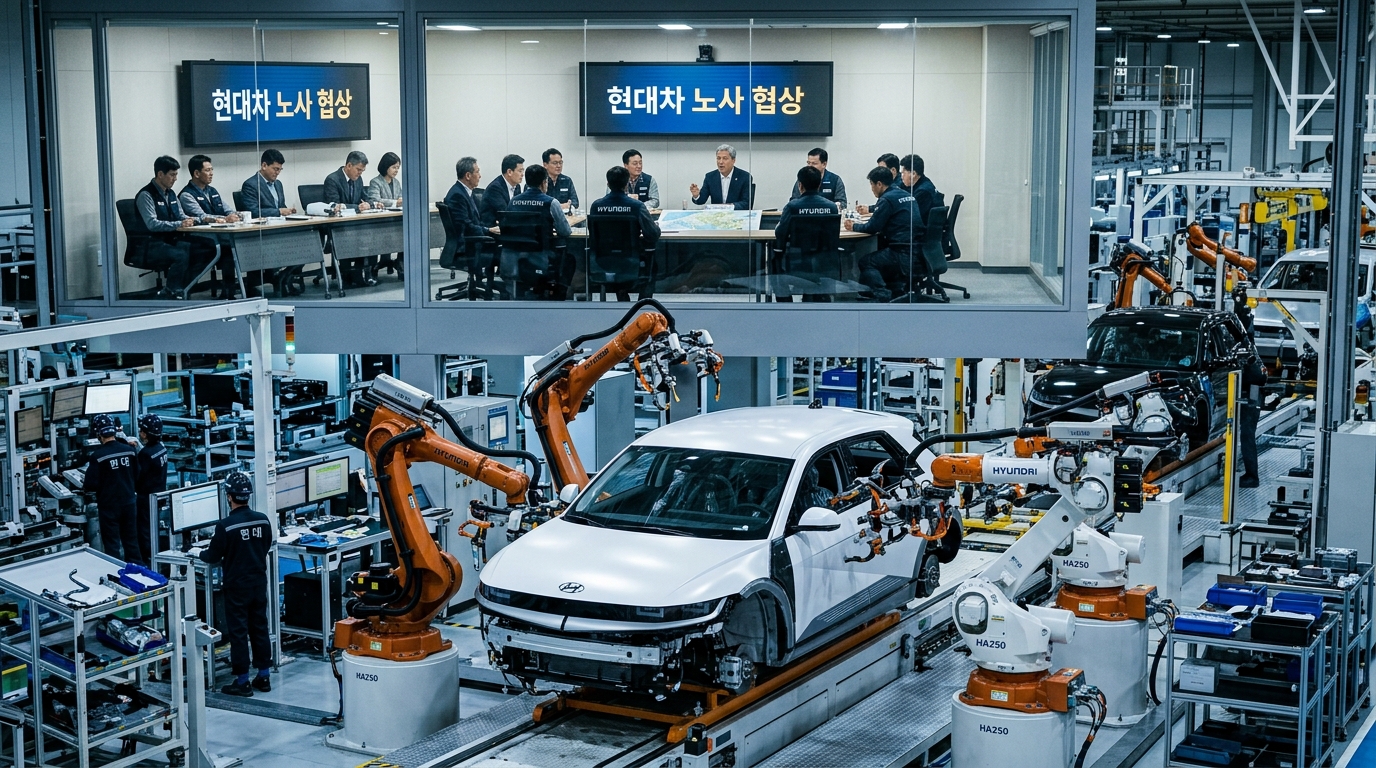
Tensions between labor and management have reached a peak as Hyundai Motor's labor union resolved to escalate the intensity of their strikes to four hours daily for three days starting on the 20th.
Second-quarter operating profit is projected to fall slightly short of market expectations, declining year-over-year due to a fire at a supplier and sluggish global sales.
However, the USD/KRW exchange rate reaching the 1,482.00 won level is fostering a favorable export environment, potentially acting as a buffer to prevent a sharp drop in performance.
Current Situation Overview
The Hyundai Motor branch of the Korean Metal Workers' Union officially announced that it will conduct partial strikes for four hours per shift daily for three days from the 20th to the 22nd.
This move, doubling the intensity from the previous two-hour partial strikes, appears intended to pressure management into offering a more favorable agreement.
During the 15th round of negotiations held on the 8th, management presented its third proposal, which included a basic salary increase of 89,000 won, performance-based bonuses of 350% + 10 million won, and 15 shares of treasury stock.
However, the union rejected this as falling short of members' expectations and continues a strong standoff, demanding an increase in bonuses (from 750% to 800%) and extending the retirement age to 65.
Notably, unlike past collective bargaining, securing job security against the reduction of assembly-line jobs due to the introduction of the AI humanoid robot 'Atlas' has emerged as a major point of contention.
Concerns in the industry are deepening that if a tentative agreement is not reached by the 24th, a resolution before the summer vacation will be impossible, dragging the strike into a prolonged dispute.
Financial Analysis
Securities firms project Hyundai Motor's Q2 2026 consolidated revenue to be around 48 trillion won, with operating profit estimated in the range of 3.0 trillion to 3.11 trillion won.
This is up to 5% below the previous market consensus of over 3.1 trillion won in operating profit.
The core reasons behind these weaker earnings forecasts are temporary production disruptions caused by a fire at a key supplier, Anjeon Industries, alongside sluggish wholesale sales in major regions, including the domestic market and Europe.
Analysts explain that a negative product mix effect and fixed cost burdens resulting from decreased global wholesale sales reduced profits compared to the same period last year.
| Classification | Revenue Forecast | Operating Profit Forecast | YoY Impacts & Key Characteristics |
|---|---|---|---|
| Shinyoung Securities Forecast | Approx. 48.00 trillion won | Approx. 3.00 trillion won | Expected to miss market consensus by about 5% |
| NH Investment & Securities Forecast | Approx. 48.1194 trillion won | Approx. 3.1179 trillion won | Operating profit expected to decrease 13.4% YoY |
| Eugene Investment & Securities Forecast | Approx. 48.80 trillion won | Approx. 3.10 trillion won | Expected to miss market expectations due to supplier fire effects, etc. |
Valuation
While the KOSPI index experiences volatility around the 6,820.60 level, market sentiment remains anchored in a state of "Extreme Fear (12.4)".
Due to domestic and international instability and a lack of liquidity, the valuation of KOSPI large-caps overall has fallen near historic lows.
[Image: /stdaily/uploads/202607/gen_6a59dc246751b0.57482243.png]
Some brokerage firms have slightly lowered their target price for Hyundai Motor to 900,000 won to reflect short-term earnings slowdowns.
However, this is viewed as a temporary setback driven by fixed costs and one-off supply chain factors rather than structural damage to long-term fundamentals.
Analyst and Institutional Insights
Institutional analysts diagnose that the decline in Q2 profitability is the result of temporary external and internal headwinds rather than a structural downturn.
Therefore, whether labor negotiations can be concluded in Q3 without major production halts will be the biggest turning point to confirm the company's ability to control fixed costs.
If the domestic plants normalize smoothly alongside the scheduled release of various new models like the Avante in the second half, the earnings rebound could accelerate.
Furthermore, mid-to-long term valuation re-rating momentum is expected from new business developments, including the consolidation of the Boston Dynamics production entity.
Risk Factors
The most concerning factor is the potential prolongation and escalation of the union's strikes.
If daily strike hours are raised to four hours per day and night shifts, production disruptions could exceed the 7,000 units and 300 billion won in revenue losses recorded during last year's partial strikes.
While the USD/KRW rate of 1,482.00 won benefits the export sector, cost burdens from rising imported raw material prices are also mounting.
Additionally, with the KOSPI Fear & Greed Index indicating "Extreme Fear (12.4)", stock prices may overreact even to minor negative news due to fragile market supply and demand.
Investment Perspective Summary
While Hyundai Motor maintains a robust, exchange-rate-friendly environment and global competitiveness in new models, the annual variable of labor-management conflict is clouding short-term visibility.
Rather than making hasty assumptions, investors should closely monitor the upcoming Q2 earnings announcement scheduled for July 23 and whether a tentative agreement can be reached before summer vacation.
A reasonable approach would be to design a gradual position-allocation strategy linked to the normalization schedule following a Q3 resolution and the trend of exchange rate fluctuations.
Investor Checklist Q&A
Q1. What makes this Hyundai Motor union strike unique compared to past ones?
A1. In addition to demands for basic salary and bonus increases, key issues include extending the retirement age to 65 and establishing job security measures for production workers in response to future mobility shifts and the introduction of the AI humanoid robot 'Atlas'.
Q2. What is the primary reason Q2 operating profit is expected to miss consensus?
A2. A fire at a key parts supplier, Anjeon Industries, caused bottlenecks in parts sourcing, and temporary sales declines in major global markets like domestic and European markets weakened the product mix.
Q3. How does the USD/KRW exchange rate of 1,482.00 won affect Hyundai Motor's earnings?
A3. A strong dollar acts as a buffer by maximizing KRW-converted revenues and profits for export-dependent Hyundai Motor, offsetting a portion of the short-term earnings decline risk.
Q4. When is the Q2 earnings release date, and what are the specific market profit estimates?
A4. The earnings announcement is scheduled for after the market close on July 23, 2026. The operating profit consensus is around 3.0 trillion to 3.11 trillion won, down approximately 10% to 13% year-over-year.
Q5. What is the most critical catalyst to drive a short-term stock price rebound?
A5. The key to short-term supply-demand improvement is whether labor and management can reach a dramatic tentative agreement by the 24th of this month, completely eliminating the risk of production shutdowns prior to summer vacation.