Hello, this is Daily Stock, delivering fast and accurate analysis of key global financial market trends.
Key Summary
* Short-Term Correction in the Nikkei 225: The Nikkei 225 index fell sharply by 1,915.97 points (2.79%) to close at 66,835.54 on the last trading day, July 16, under profit-taking pressure on global tech stocks, led by semiconductors.
* The Shadow of Unprecedented Yen Weakness: Amid a three-pole decoupling phase between the US, Europe, and Asia, the yen exchange rate has soared to the 162.4 JPY per dollar range. However, rising import costs are casting doubt on exporters' earnings resilience.
* Divergence Between Monetary Policy and Economic Fundamentals: Despite the Bank of Japan's (BOJ) interest rate hike (to 1.00%), the persistent US-Japan interest rate gap and a trade deficit (378.6 billion yen deficit in May) are entrenching the weak yen and increasing risk for marginal businesses.
Current Status Summary
[Image: /stdaily/uploads/202607/gen_6a592b0a106826.61931944.png]
The global financial market is clearly showing a "three-pole decoupling" trend, where the macroeconomic environments of the US, Europe, and Asia diverge.
While the US Nasdaq is undergoing corrections amid controversy over a tech peak, Asian stock markets are also experiencing large-scale capital outflows.
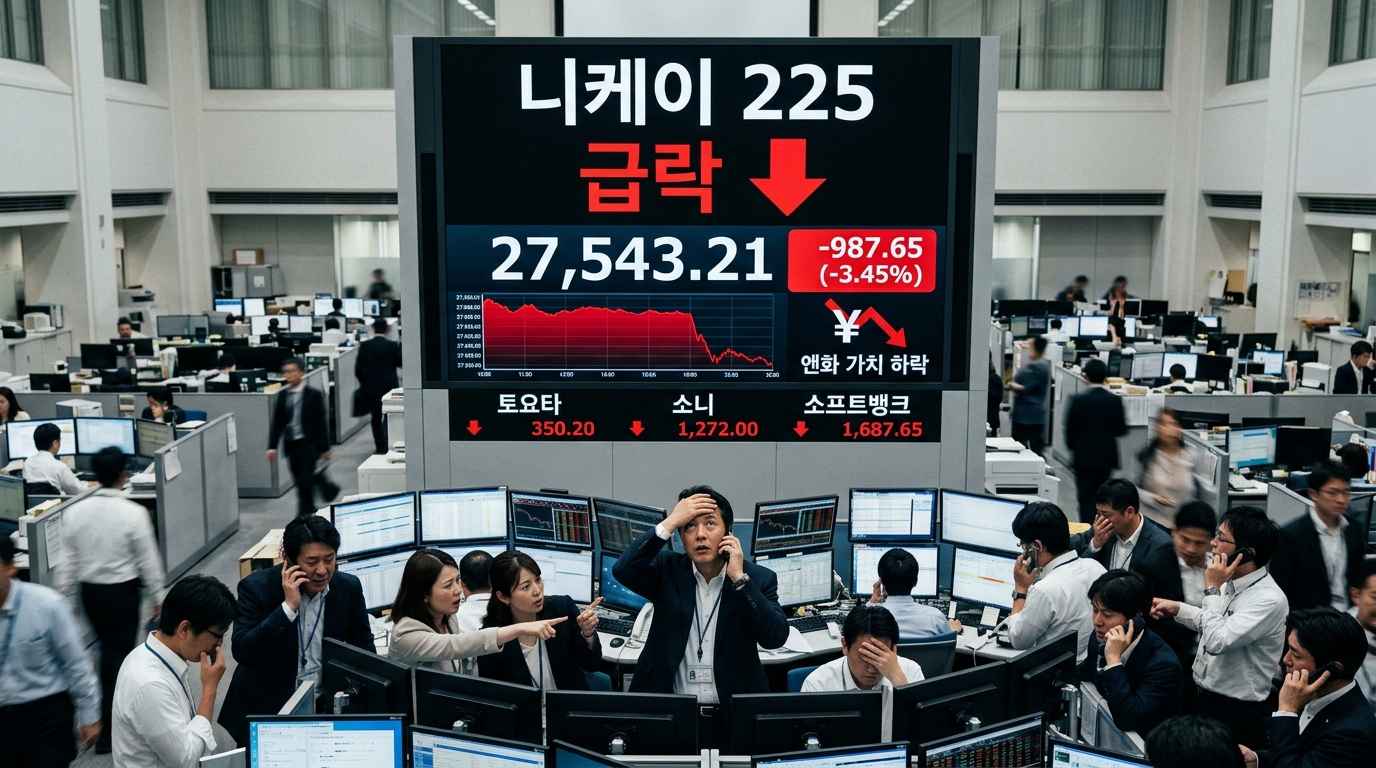
Particularly, the Nikkei 225 index, the benchmark for the Japanese stock market, plunged by over 1,800 points during intraday trading on July 16, retreating to the 66,835.54 level.
Leading semiconductor stocks such as Tokyo Electron, Advantest, and Kioxia led the decline as they faced broad selling pressure.
Regarding the intraday price, as of 04:01 KST on July 17, before the Asian market open, prices have not yet settled, but the flat trend in global overnight futures continues.
Additionally, the USD-JPY exchange rate is hovering at 162.48 yen, showing no signs of easing pressure on the weak yen.
Currently, the domestic stock market is also in a state of extreme fear.
According to the Daily Stock Fear & Greed Index, the KOSPI is currently in the "Extreme Fear" range (12.4), reflecting heavily subdued investor sentiment following last week's reading of 13.1.
Conversely, the US Nasdaq Fear & Greed Index is currently in "Neutral" (46.9).
This is similar to last week's level (46.1), presenting a sharp contrast to the extreme psychological contraction in Asian stock markets.
Financial Analysis
With the prolonged weakness of the yen, "lights and shadows" coexist in the financial performance of Japanese exporters.
While the automotive sector, including Toyota, benefited from foreign exchange gains, the IT and machinery sectors are seeing their profit margins squeezed by rising global commodity prices and surging import unit costs.
According to the Ministry of Finance, Japan's trade balance in May recorded a deficit of 378.6 billion yen.
Exports increased by 17% year-on-year to 9.5115 trillion yen, driven by robust demand for electrical machinery like semiconductors. However, total imports rose 12.5% to 9.8902 trillion yen due to a 31.5% jump in electricity and electrical machinery imports.
| Key Indicators (May-July 2026) | Value & Status | YoY Change | Special Notes |
|---|---|---|---|
| **Nikkei 225 Index (Close on 7/16)** | 66,835.54 pt | +65.77% | Short-term drop due to semiconductor correction |
| **USD-JPY Exchange Rate (Intraday on 7/16)** | 162.48 JPY | +9.46% (Yen depreciation) | Entrenched at a 40-year low |
| **Japan's May Export Volume** | 9.5115 trillion JPY | +17.0% | Steady demand for semiconductors and components |
| **Japan's May Import Volume** | 9.8902 trillion JPY | +12.5% | Rise in electrical machinery and import costs |
| **Trade Balance (Deficit)** | -378.6 billion JPY | Deficit continues | Shifted to deficit in 4 months |
| **Weak-Yen Bankrupt Marginal Businesses (1H)** | 45 companies | +32.3% | Increased bankruptcies centered on import-dependent SMEs |
[Image: /stdaily/uploads/202607/gen_6a592b148a8bf1.99645690.png]
Valuation
The Japanese stock market has retained valuation appeal compared to US and European markets.
The weak yen has boosted earnings per share (EPS), keeping the price-to-earnings (PER) ratio of the Nikkei index relatively low compared to other major global indices.
However, the Nikkei's recent retreat from the 72,000 level to the 66,000 range is less about valuation limits and more due to "fears of an earnings slowdown driven by high import prices."
Exporters' ability to withstand pressure through FX benefits will inevitably hit a wall if raw material and energy costs continue to rise.
In particular, divergence in the monetary policies of major Asian countries is also impacting valuations.
Although the BOJ raised its benchmark interest rate to 1.00% in June, the real interest rate gap remains wide compared to the US Federal Reserve's rate of 3.50% to 3.75%.
Consequently, investors are reacting more sensitively to the risk of yen carry trade unwinding due to the pace of monetary tightening rather than the relative undervaluation merits of Nikkei components. A more conservative valuation approach is required going forward.
Expert and Institutional Analysis
[Image: /stdaily/uploads/202607/gen_6a592b1de14bf6.49384792.png]
Major global investment banks (IBs) hold mixed outlooks regarding structural changes in the Japanese stock market.
Some experts positively evaluate the solid dominance of Japanese materials, components, and equipment companies in the global AI semiconductor supply chain.
However, warnings prevail that the prolonged yen weakness above the 162 yen mark may bring more harm than good to the Japanese economy.
Global credit rating agencies analyze that while the weak yen boosts nominal profits for large exporters, it shrinks Japan's domestic market and significantly reduces real purchasing power.
Furthermore, geopolitical instability in the Middle East has triggered fresh supply chain disruptions in the Strait of Hormuz, causing oil prices to spike. Given that Japanese companies import most of their energy, the combination of rising oil prices and a weak yen rapidly worsens manufacturing production costs.
Experts observe that the BOJ will have no choice but to raise interest rates further in the third quarter (forecasted at 1.25%) to defend the yen. If rate hikes materialize, the liquidity environment that has supported the stock market could change.
Risk Factors
The most pressing risk is the threat of sequential bankruptcies among small-and-medium enterprises (SMEs) and import-dependent marginal firms due to high-cost yen weakness.
In the first half of 2026 (Jan-Jun) alone, 45 companies went bankrupt due to the weakening currency, a 32.3% surge year-on-year, signaling that internal resilience is reaching its limits.
Second is the possibility of a rapid momentum slowdown (peak-out) in global semiconductor and AI demand.
The decline in the Philadelphia Semiconductor Index and the concurrent correction of Korean tech heavyweights are dealing a direct blow to Japan's core technology stocks, such as Tokyo Electron and Advantest.
Finally, geopolitical tensions and supply chain bottlenecks pose risks.
Prolonged conflict in the Middle East has pushed up ocean freight rates, directly eroding the logistics margins of Japanese exporters.
Investment Perspective
Currently, the Nikkei 225 index and the yen exchange rate stand at a structural crossroads marked by "high inflation and high cost burdens" rather than simple beneficiary logic.
Therefore, rather than unconditionally buying weak-yen beneficiaries, a conservative approach focusing selectively on monopolistic materials, components, and equipment companies with high pricing power over import costs seems appropriate.
Moreover, if the BOJ's additional tightening stance aligns with the US Fed's rate cuts, the yen could experience a sharp reversal (strengthening). Under this scenario, the FX gain momentum for export companies could quickly dissipate, making portfolio diversification strongly advised to prepare for exchange rate volatility.
Key Terms at a Glance
* Nikkei 225: Japan's benchmark stock index tracking 225 blue-chip stocks, currently aligning with global tech stock corrections.
* Paradox of the Weak Yen: A phenomenon where yen depreciation around the 162 JPY range raises raw material import costs and causes trade deficits rather than boosting exports.
* Three-Pole Decoupling: The phenomenon where global markets move independently in three regions: the US (tech correction), Europe (stagnated growth), and Asia (capital flight and currency instability).
* BOJ Monetary Policy: The Bank of Japan is considering further interest rate hikes to defend the yen and control inflation.
* Materials, Components, and Equipment Exporters: Japanese tech groups supplying essential components to the global AI and semiconductor value chain.