Hello, this is Daily Stock.
Highlights
- Apple's (AAPL) service revenue for FY26 Q2 reached $30.98 billion, setting a new record for any quarter.
- Backed by an active installed base of 2.5 billion devices, the share of service revenue has reached 27.9%, proving its transition into a high-margin software business.
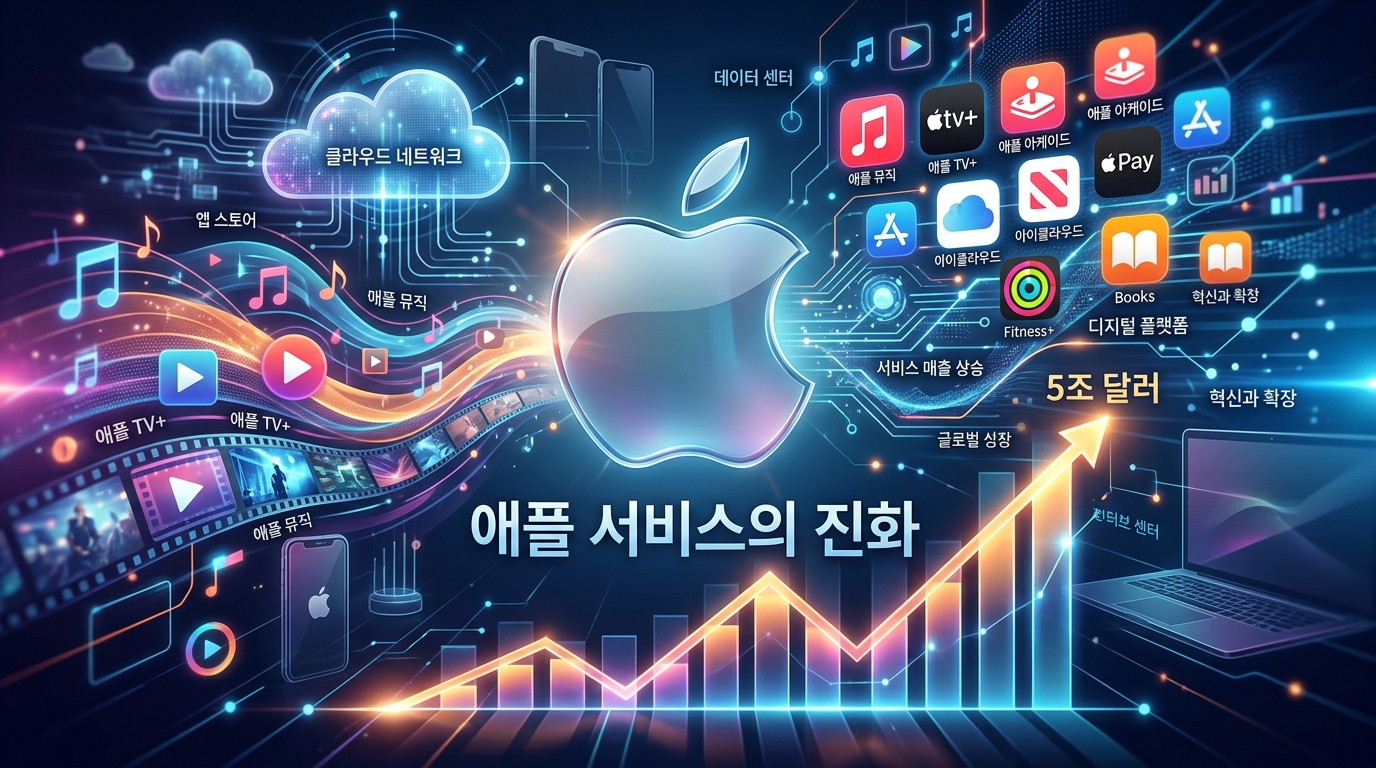
- With the service sector's high-profit margins, the market is pricing in a "SaaS (Software-as-a-Service)-style multiple" re-rating, solidifying the scenario of reaching a $5 trillion market capitalization.
[Image: /stdaily/uploads/202607/gen_6a5971179c1fc2.47006873.png]
Market Overview
While the US stock market is showing mixed reactions regarding the Federal Reserve's monetary policy direction and concerns over economic slowdown, it is once again focusing on the earnings stability of Big Tech companies.
As of midday on July 17, 2026, the Nasdaq index is hovering around 25,881.95, and the USD/KRW exchange rate remains somewhat elevated at 1,481.50 won.
Domestic markets are fluctuating during trading hours, with the KOSPI at 6,820.60 and the KOSDAQ at 791.84.
According to the Daily Stock proprietary Fear and Greed Index, the KOSPI Fear and Greed Index has entered the 'Extreme Fear' territory at 12.4, whereas the Nasdaq Fear and Greed Index is at a 'Neutral' level of 41.7, highlighting a distinct divergence in sentiment between the US and Korean stock markets.
In this macro environment, Apple's stock price maintains a robust trend, trading around the $333.13 mark during the session and attempting to break through the historic milestone of a $5 trillion market cap.
Financial Analysis
Apple's performance in the recent FY26 Q2 (quarter ending March 2026) was highlighted by harmonious growth across both hardware and services.
Total revenue came in at $111.2 billion, up 17% year-over-year, and earnings per share (EPS) was $2.01, beating market expectations.
The most notable segment was service revenue, which hit an all-time high of $30.98 billion, up 16.3% year-over-year.
| Segment | FY26 Q2 Results ($ Billion) | YoY Growth Rate |
|---|---|---|
| Total Revenue | 1,112 | +17% |
| iPhone Revenue | 570 | +22% |
| Service Revenue | 309.8 | +16.3% |
| Net Income | 296 | +19% |
| Gross Margin | 49.3% | +2.2%p |
Revenue growth in the services segment was the primary driver that pushed the overall gross margin up to 49.3%.
This is because the gross margin of the services segment is in the mid-to-high 70% range, which more than offsets the hardware segment's margin, which remains in the high 30% range.
[Image: /stdaily/uploads/202607/gen_6a5971204cb925.90931816.png]
Valuation
There are growing voices in the market that Apple, previously valued as a hardware manufacturer, should now be valued using a "SaaS-style recurring revenue" multiple.
Apple's service revenue accounts for 27.9% of the total, driven by its ecosystem of 2.5 billion active devices worldwide.
Subscription models (Apple Music, TV+, iCloud, etc.), App Store commission fees, and advertising form a recurring revenue stream that is resilient to economic fluctuations.
Even in a technology stock valuation environment sensitive to fluctuations in the 10-year US Treasury yield, Apple's robust cash-generating ability serves as a safe-haven asset.
In particular, the additional $100 billion share buyback program recently announced by the Board of Directors maximizes shareholder returns and serves as a strong factor supporting the valuation's floor.
Expert and Institutional Analysis
According to analysis by global investment bank Evercore ISI, the market is still undervaluing Apple's services segment.
Evercore ISI analyzed that "If Apple's services division is valued independently as a high-margin recurring revenue software business, it could add at least $13 in incremental value relative to the current stock price."
Some institutions present a scenario where Apple will comfortably achieve a $5 trillion market capitalization in the second half of 2026, driven by the steady growth of the services segment.
In addition, Tim Cook's transition to Chairman of the Board and the launch of the new CEO administration under John Ternus, scheduled for September 2026, are also attracting significant attention.
Experts assess that the generational shift in management could serve as a positive turning point for the execution of the Apple Intelligence roadmap and the diversification of service monetization.
Risk Factors
However, internal and external risks that could hinder the continuous growth of service revenue also persist.
The most critical risk factor is the US Department of Justice's antitrust lawsuit over the default search engine partnership deal with Google.
If the multibillion-dollar licensing revenue received from Google is suspended or reduced due to regulations, there is a possibility that the growth rate of service revenue could decelerate.
Furthermore, regulatory efforts worldwide, such as the European Union's (EU) Digital Markets Act (DMA), aimed at restructuring the App Store fee structure, are also cited as factors that could squeeze margins.
Lastly, if device replacement cycles lengthen or hardware penetration stagnates, the scalability of the "active installed device base," which serves as the foundation for service subscribers, may hit a wall.
[Image: /stdaily/uploads/202607/gen_6a59712845b566.03315901.png]
Investment Perspective Summary
Apple is proving its transition into a "Platform and SaaS company" beyond just an "iPhone maker."
The 27.9% share of service revenue and a gross margin exceeding 49% are effectively buffering the volatility of earnings that comes with hardware economic cycles.
Although legal and regulatory risks may increase potential volatility, the ecosystem of 2.5 billion active devices worldwide and high customer loyalty serve as Apple's unique, unparalleled economic moat.
Integrating AI services and executing monetized models under the new CEO John Ternus will be key milestones in determining whether Apple can expand its valuation beyond a $5 trillion market cap.
Investor Checklist Q&A
Q1. What specific items are included in Apple's service revenue?
A1. It includes App Store fees, subscription services such as Apple Music, Apple TV+, and iCloud, Apple Pay commission fees, search licensing revenues received from companies like Google, and AppleCare.
Q2. Why is the margin rate of the services segment significantly higher than that of hardware?
A2. Due to the nature of software and subscription businesses, there is virtually no pressure from physical manufacturing costs or raw material price increases, and fixed costs are highly optimized through the 2.5 billion global installed base.
Q3. Why is the antitrust lawsuit with Google a threat to Apple's service revenue?
A3. The amount Google pays Apple to be set as the default search engine on the iPhone is estimated to be tens of billions of dollars annually. Since this accounts for a significant portion of services revenue and profits, any regulatory action would deal a direct blow.
Q4. How will the CEO change scheduled for the second half of 2026 affect the stock price?
A4. Tim Cook will remain as Chairman of the Board to help stabilize governance. John Ternus, who will take office as the new CEO, has a hardware engineering background and will likely focus on a roadmap merging AI hardware and services to alleviate market concerns.
Q5. How should investors approach Apple's valuation when the Nasdaq Fear and Greed Index is 'Neutral'?
A5. As the Nasdaq investment sentiment remains at a neutral level (41.7), investors should prepare for volatility. However, Apple can be evaluated as a highly defensive alternative due to its strong shareholder return policy, represented by the $100 billion share buyback, and its solid recurring revenue mix.