Hello. This is Daily Stock, providing precise analysis on the global macroeconomy and the technology stock market.
Key Summary
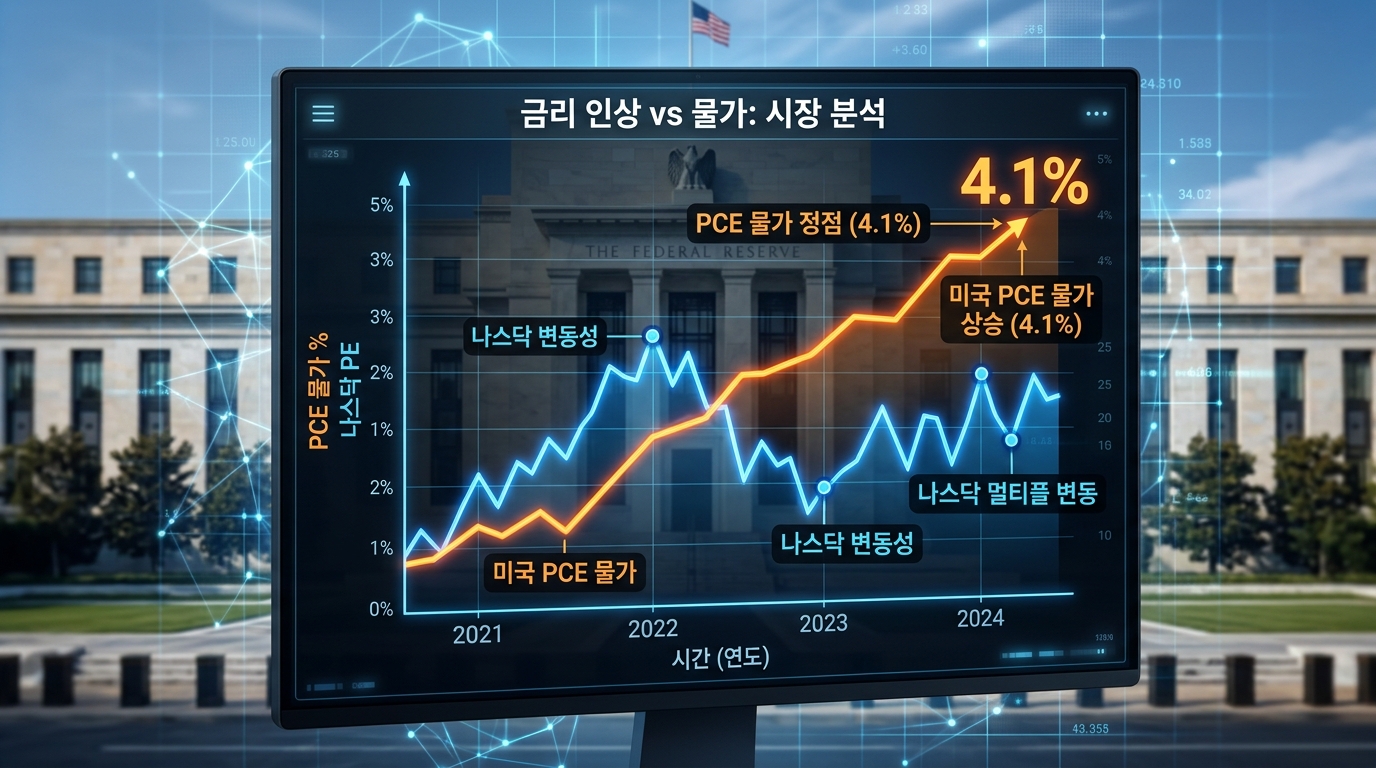
The recently announced US May Personal Consumption Expenditures (PCE) price index accelerated to 4.1% year-on-year, injecting tension into the market. With the Federal Reserve, newly led by Chairman Kevin Warsh, signaling both prolonged high interest rates and the possibility of additional rate hikes, the valuation multiples unique to technology stocks have entered a phase highly sensitive to macro variables. In this analysis, we examine how changes in the 10-year Treasury yield impact the Nasdaq index and major growth stock multiples under different high-level scenarios amid concerns over sticky inflation.
[Image: /stdaily/uploads/202607/gen_6a581ff3a7ec02.80787072.png]
Current Situation Summary
As of intraday on July 16, 2026 (tentative), the PCE, the US economy's most trusted inflation gauge, showed an upward trend month-on-month. The May headline PCE came in at 4.1%, and the core PCE recorded 3.4%, significantly exceeding the Fed's mid-to-long-term target of 2.0%. Although the June Consumer Price Index (CPI) and Producer Price Index (PPI) showed signs of slight moderation, providing brief breathing room, commodity risks such as rising oil prices persist, making it difficult to assume any easing of the Fed's tight stance.
In particular, newly appointed Fed Chair Kevin Warsh is taking a hawkish tone, prioritizing price stability. The market is keeping the scenario of a benchmark rate hike at the September FOMC meeting open, following a projected pause at the July FOMC meeting.
On this day, major domestic and international indicators showed mixed movements as follows:
| Indicator | Current Price (July 16, 2026 Intraday, Tentative) | Fear & Greed Index (Daily Stock Proprietary Formula) |
|---|---|---|
| **KOSPI** | 6,981.26 | 13.7 (Extreme Fear) |
| **KOSDAQ** | 818.57 | - |
| **NASDAQ** | 26,269.23 | 46.3 (Neutral) |
| **USD/KRW Exchange Rate** | 1,487.00 KRW | - |
The Nasdaq Fear & Greed Index currently stands at 46.3, indicating a "Neutral" stage, staying at a similar level to a week ago (44.1) and a month ago (41.6). On the other hand, the KOSPI is facing an "Extreme Fear" phase at 13.7, exposing greater vulnerability to US macro uncertainties.
Financial Analysis
To evaluate the correlation between current macro factors and Nasdaq multiples, we must analyze the trends of the US 10-year Treasury yield (US10Y) and the US Dollar Index (DXY). Currently, the US 10-year Treasury yield is hovering in the mid-to-high 4.5% range (approximately 4.57%), while the Dollar Index also remains above the 100-point mark, reflecting tightening vigilance.
This high-interest-rate environment increases the discount rate for the future cash flows of technology stocks, exerting downward pressure on multiples. Especially at a time when big tech companies are executing massive capital expenditures (CAPEX) to build out AI value chains, prolonged high interest rates directly translate to rising financing costs.
[Image: /stdaily/uploads/202607/gen_6a581ffe567a47.71029638.png]
Valuation
Currently, major growth stock multiples in the Nasdaq market are in a slightly overvalued territory compared to historical averages. In the current phase where PCE points to 4.1% and the hawkish Fed Chair raises the scenario of additional hikes, big tech earnings growth must significantly exceed market expectations for Nasdaq multiples to maintain their current levels.
If the June PCE release (scheduled for July 30) fails to control service-led price increases, Treasury yields could surge further, subjecting Nasdaq multiples to immediate downward pressure. Conversely, if the recently stabilized CPI/PPI trend filters into the PCE, it will justify current valuation multiples.
Expert & Institutional Analysis
Major Wall Street investment banks (IBs) assess that the Fed's stance has returned to a solid, price-stability-centric focus since Chairman Kevin Warsh took office. Analysts from major institutions, including Charles Schwab, warn: "While the recent CPI and PPI slowed slightly more than expected, easing immediate pressure for rate hikes, oil price volatility and the persistence of service inflation harbor risks of additional tightening in the autumn."
In addition, they advise that investors should concentrate their technology-focused portfolios on large-cap growth stocks. Growth stocks centered on mega-caps with strong balance sheets and overwhelming market share, rather than highly interest-rate-sensitive small-to-mid-cap tech stocks, could serve as viable alternatives in a volatile market.
Risk Factors
The biggest macroeconomic risk that investors should watch closely is a secondary spike in inflation. A rebound in oil prices driven by geopolitical crises in the Middle East is a potential factor that could trigger headline PCE again at any time.
Second is the concern over delayed monetization in the AI sector. If massive capital expenditures (CAPEX) are not timely converted into actual revenue and net income growth, a "de-rating" of big tech multiples could proceed rapidly alongside high-rate pressures.
Lastly, there is the potential for a sharp rebound in the Volatility Index (VIX). Although the VIX is currently hovering around the 16 level, an unexpected macro shock could trigger rapid capital outflows from the Nasdaq index.
Investment Perspective Summary
The combination of accelerating inflation and a hawkish Fed is one of the most unfavorable scenarios for tech stock valuations. However, if big tech companies prove differentiated earnings growth beyond simple expectations, a moderate adjustment in multiples could provide long-term investors with solid entry opportunities.
In the short term, the direction of tech stocks is expected to be determined by the June PCE data scheduled for release on July 30 and the results of the FOMC meeting in late July. A defensive and diversified asset allocation approach preparing for minor cracks in macro indicators seems valid.
[Image: /stdaily/uploads/202607/gen_6a5820083d10f3.91916642.png]
Investment Checklist
Q1. What is the key driver behind the US May headline PCE inflation surging to 4.1% year-on-year?
Along with volatile energy prices, sticky service prices (core inflation) such as housing and insurance premiums are cited as the primary culprits.
Q2. What is the disposition of the new Fed Chair Kevin Warsh, and what is the future rate outlook?
Chairman Kevin Warsh is evaluated as a typical hawk who places greater weight on "price stability" over employment, and the market is leaving the door open for additional rate hikes in the autumn.
Q3. How does the 10-year Treasury yield adversely affect technology stock multiples?
Rising interest rates increase the discount rate, lowering the value of technology stocks that rely on future growth, while also compounding financing costs for companies engaged in massive capital expenditure (CAPEX).
Q4. What is the current level of the proprietary Fear & Greed Index showing Nasdaq market sentiment?
As of intraday on July 16, 2026, the Nasdaq Fear & Greed Index stands at 46.3, indicating a "Neutral" stage, suggesting that the market is in a wait-and-see mode.
Q5. What are the most important macro schedules for market response in late July and early August?
The FOMC meeting results scheduled for July 28-29 (local time) and the June PCE price index scheduled for release on July 30 will serve as key bellwethers for the market's future direction.