Hello, Daily Stock readers.
Executive Summary
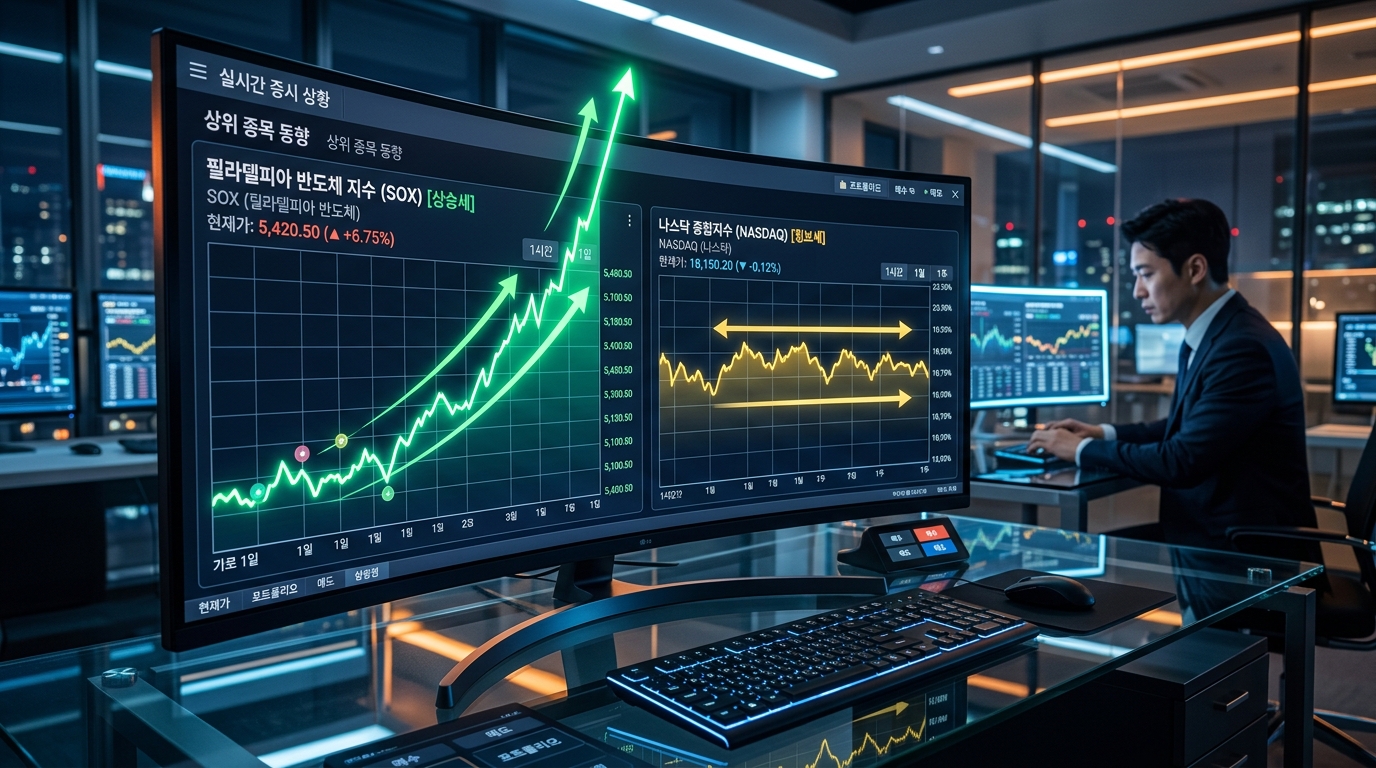
The defining characteristic of the US stock market in the first half of 2026 is the sharp decoupling between the Philadelphia Semiconductor Index (SOX) and the NASDAQ index.
While the massive capital expenditures (CAPEX) of AI hyperscalers weighed heavily on the stock prices of the tech giants spending the money, capital became excessively concentrated in the semiconductor equipment and design firms reaping the benefits.
As the semiconductor index entered a short-term correction phase in July due to high valuation pressures and elevated interest rate headwinds (with the US 10-year Treasury yield hovering around 4.56%), attention is shifting to a potential tug-of-war and capital rotation between the big tech and semiconductor sectors.
Current Market Summary
During the first half of 2026 (H1), the Philadelphia Semiconductor Index (SOX) surged by approximately 101%, posting the most dominant return among major global assets.
In contrast, the NASDAQ 100 Index rose by only about 18% over the same period, while the "Magnificent 7 (Mag 7)" index squeaked out a mere 1.1% gain. This stark decoupling led to the latter being dubbed the "Lag 7 (Lagging 7)."
However, the market mood as of mid-July (preliminary) is undergoing subtle shifts.
After hitting a historic peak (surpassing the 10,000 level) in late June, the SOX index underwent a roughly 12% correction in early July, slipping below its 50-day moving average. As of intraday July 13, 2026, while the NASDAQ index trades at 26,281.61 points, volatility within the semiconductor sector is expanding.
Compounding this, on July 10, SK hynix ADR's NASDAQ debut—recorded as the largest foreign IPO in history at approximately $29 billion—has accelerated a massive shift of capital across the global memory and semiconductor value chain.
[Image: /stdaily/uploads/202607/gen_6a542b428a72f8.02109652.png]
Financial Analysis
Capital expenditure (CAPEX) plans for big tech hyperscalers (Microsoft, Google, Meta, Amazon, etc.) are breaking historical records, directly translating into explosive earnings growth for SOX index components like NVIDIA, Micron, and Broadcom.
Memory market leaders such as Micron and Samsung Electronics have continuously announced record quarterly operating results. However, because market expectations had risen to extreme heights, these earnings releases triggered large-scale profit-taking, manifesting as a "sell the news" pattern.
The table below summarizes the recent trends and volatility of major semiconductor indices and key macroeconomic indicators.
| Classification | H1 2026 Return | July Correction (From Peak) | Characteristics & Current Status |
|---|---|---|---|
| Philadelphia Semiconductor Index (SOX) | ~101.14% | ~-12% | Volatility as it fell below the 50-day MA after breaching the 10,000 mark for the first time. |
| NASDAQ 100 Index | ~18% | Relatively resilient | Confronting ROI skepticism regarding massive hyperscaler investments. |
| Magnificent 7 (MAGS) | ~1.1% | Flat / Slight drop | Cost burdens intensify as the primary spenders of CAPEX. |
| US 10-Year Treasury Yield (US10Y) | - | ~4.56% range | Valuation discount pressure on growth stocks due to a "higher for longer" interest rate environment. |
Meanwhile, according to our proprietary investment sentiment tracker, the NASDAQ Fear and Greed Index stood at 49.5 (Neutral) as of July 13, reflecting a gradual recovery in sentiment compared to 32.4 (Fear) a week ago and 26.9 (Fear) a month ago.
In contrast, the KOSPI Fear and Greed Index remains near its bottom at 16.2 (Extreme Fear).
Valuations
The powerful surge of the semiconductor index (SOX) has been accompanied by extreme valuation expansion.
The 12-month forward price-to-earnings (Forward P/E) ratio of the US semiconductor sector skyrocketed to approximately 74.3x, more than double the average of the NASDAQ 100.
This is reminiscent of the overshooting period during the dot-com bubble of 2000. With the risk-free rate (US 10-year Treasury yield) sitting at 4.56%, such high multiples are highly vulnerable to interest rate volatility.
Should expectations of interest rate cuts fade or borrowing costs remain elevated over the long term, we cannot rule out a scenario where multiple contraction pressures mount, potentially denting the earnings visibility of semiconductor equipment manufacturers (AMAT, LRCX, KLAC) and memory chipmakers.
Analyst & Institutional Perspectives
Wall Street institutions diagnose the current decoupling as a gap between "the Spenders and the Earners."
While big tech players like Microsoft and Meta are spending astronomical sums and being pressured by shareholders to prove short-term profitability, the semiconductor hardware companies receiving that capital have successfully demonstrated immediate profit growth.
However, Mike Wilson, chief equity strategist at Morgan Stanley, noted that "a correction phase has begun after the excessive overshooting of semiconductor stocks," presenting a scenario where capital rotates back into hyperscalers (Big Tech).
Furthermore, market caution has intensified following news that hedge funds, including Michael Burry's, have recently made large short bets targeting valuation anomalies in AI chip sectors like NVIDIA, AMD, and Micron, logging four consecutive weeks of net sales of tech stocks.
[Image: /stdaily/uploads/202607/gen_6a542db2ac12.67015823.png]
Risk Factors
Delayed AI Monetization and CAPEX Cutback Concerns
If investment capital spent by hyperscalers does not translate smoothly into service revenues, big tech firms may scale back or defer future CAPEX. This would deal a severe blow to the semiconductor industry cycle.
Higher for Longer Rates and Macro Pressure
With the US 10-year yield anchored in the mid-4.5% range, discount rates for high-multiple growth stocks remain high, acting as a trigger for semiconductor valuation adjustments.
Dilution of Monopolistic Power through In-house Chip Development
Companies like OpenAI, Meta, and Google are rushing to design their own custom application-specific integrated circuits (ASICs) and internalize supply chains, which could threaten the long-term profit margins of current GPU and high-performance memory monopolists.
Investment Outlook Summary
The decoupling of the SOX index and the NASDAQ was an inevitable outcome driven by the peerless earnings growth of the AI hardware value chain.
However, the short-term correction seen in the semiconductor index in July should be interpreted as a healthy process of re-evaluating fundamentals, as overheated multiples face macroeconomic interest rate pressures.
Rather than blindly expecting the rally to continue, investors should monitor the quarterly guidance of hyperscalers alongside interest rate trends, maintaining a balanced, scenario-based approach that flexibly adjusts the weight of semiconductors versus software and big tech in portfolios.
Investor Checklist Q&A
Q1. What is the fundamental reason behind the recent decoupling of the SOX index and the NASDAQ?
A1. As big tech hyperscalers deployed massive capital expenditures (CAPEX) into AI infrastructure, those expenditures fed directly into explosive earnings growth for chipmakers and equipment firms. The market reacted conservatively to the "spending firms" (Big Tech) while concentrating capital into the "earning firms" (Semiconductors).
Q2. Why did the semiconductor index (SOX) pull back in July?
A2. Valuation pressures reached an extreme, with the sector's 12-month forward P/E soaring to 74.3x. Additionally, as the US 10-year Treasury yield hovered around 4.56%, investors who found it difficult to justify such high multiples engaged in active profit-taking.
Q3. Why are the Magnificent 7 (Mag 7) being called the "Lag 7"?
A3. Despite committing astronomical sums to AI-related CAPEX, the big tech companies leading these investments have yet to present clear, near-term AI monetization roadmaps. Consequently, their valuation multiples stagnated instead of being re-rated upward.
Q4. What impact does SK hynix's NASDAQ ADR listing have on the market?
A4. The listing of SK hynix ADRs, valued at approximately $29 billion, represents the arrival of a massive player dominating the global AI memory (HBM) space. This introduces a new benchmark for peer valuations (e.g., against US-listed Micron) and prompts global institutions to reallocate capital, sparking broader volatility.
Q5. What are the projected scenarios for semiconductor and big tech stocks moving forward?
A5. Due to short-term peak fatigue in the semiconductor index, a "rotation" scenario is gaining traction, where institutions scale back chip exposure and move funds into relatively undervalued hyperscalers or broader index products. However, this rotation can only be sustained if big tech proves its ability to monetize these heavy investments.