Hello. This is Daily Stock. Samyang Foods (003230), which is rewriting K-food history in the global market with its Buldak brand, has unveiled a new weapon targeted directly at the domestic market.
[Image: /stdaily/uploads/202607/gen_6a51ea5b145980.74159349.png]
Key Summary
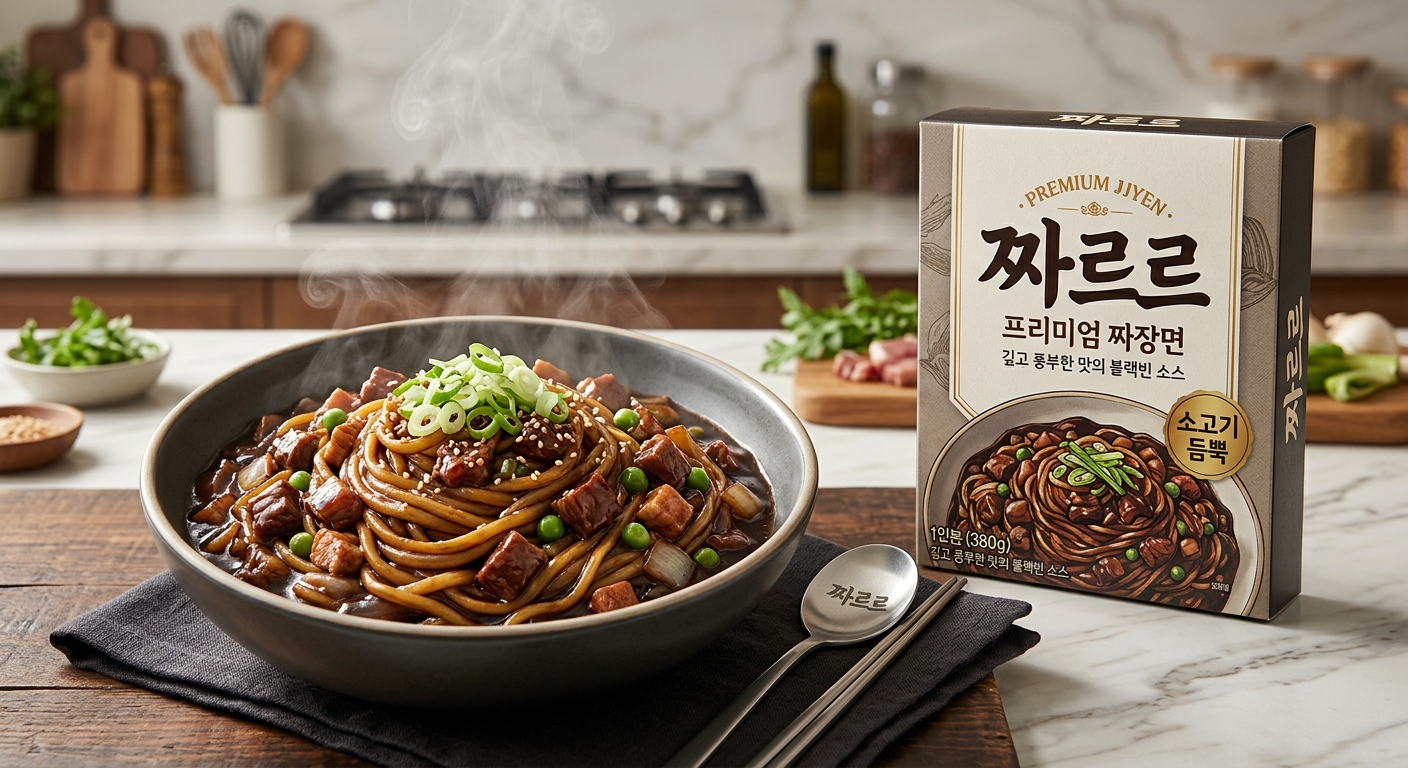
- **Launch of New Product 'Jjareureu'**: Samyang Foods has introduced 'Jjareureu', a premium Jajang ramen fried in beef tallow (beef fat), to diversify its domestic portfolio.
- **Record-Breaking Earnings Trend**: The company achieved its highest-ever quarterly performance in Q1 2026, recording consolidated revenue of KRW 714.4 billion and an operating profit of KRW 177.1 billion.
- **Impact of Miryang Plant 2 Expansion**: A scenario is emerging in which global shortages in regions like the Americas and Europe will gradually ease in the second half of the year as the utilization rate of Miryang Plant 2 rises.
- **Macroeconomic and Supply-Demand Variables**: While Samyang is a representative export-driven stock benefiting from the ultra-high exchange rate of over KRW 1,500, managing stock price volatility has become a key challenge amid the recent "extreme fear" (16.2) phase in the KOSPI market.
Current Status Summary
On July 8, 2026, Samyang Foods officially launched its new premium Jajang ramen, 'Jjareureu', through major retail channels, including national hypermarkets and convenience stores.
This new product modernizes and inherits Samyang Foods' unique "beef tallow heritage" technology of frying noodles in beef tallow (refined beef fat).
By incorporating a manufacturing method that laid the foundation for Korean ramen in the 1960s, it harmonizes a savory, rich beef flavor with a high-temperature roasted Jajang sauce.
The launch aims to challenge the dominance of Nongshim's Chapagetti—the absolute leader in the existing Jajang ramen market—and diversify its domestic product portfolio, which is heavily reliant on the 'Buldak' brand.
As of July 10, 2026, Samyang Foods closed at KRW 1,139,000, up 3.26% from the previous day, bringing its market capitalization to KRW 8.5801 trillion.
With the USD/KRW exchange rate remaining elevated around KRW 1,503.40, expectations for foreign exchange gains remain solid for Samyang Foods, which generates over 80% of its total revenue overseas.
However, because the KOSPI market's Fear and Greed Index stands at 16.2, indicating an "extreme fear" stage, supply and demand volatility across large-cap stocks has surged.
The company faces a complex macroeconomic environment where stock price corrections remain possible depending on whether foreign and institutional investors decide to lock in profits.
[Image: /stdaily/uploads/202607/gen_6a51ea6529bb62.51480959.png]
Financial Analysis
Samyang Foods' consolidated revenue for Q1 2026 rose 35% year-on-year to KRW 714.4 billion, and its operating profit increased 32% to KRW 177.1 billion.
This marks a record quarterly performance, beating market consensus by approximately 8%.
Notably, the quarterly operating margin reached 24.8%, successfully maintaining a highly profitable structure in the 20% range for five consecutive quarters.
With the share of overseas sales expanding to 82% (KRW 585 billion), strong growth in high-margin US (KRW 185 billion) and European (KRW 77 billion) subsidiaries drove overall profitability.
| Classification | Q1 2026 Performance | Year-on-Year (YoY) | Q2 2026 Forecast (Consensus) |
|---|---|---|---|
| **Revenue** | KRW 714.4 billion | +35% | KRW 762.3 billion |
| **Operating Profit** | KRW 177.1 billion | +32% | KRW 180.9 billion |
| **Operating Margin** | 24.8% | +0.9%p | Approx. 23.7% |
| **Overseas Revenue** | KRW 585.0 billion | +38% | - |
(Source: Samyang Foods public disclosure and Kiwoom Securities Research Center forecasts)
For the upcoming Q2 2026, consolidated revenue is estimated at KRW 762.3 billion and operating profit at KRW 180.9 billion, bolstering the growth acceleration scenario.
This is a result of effectively securing export prices amid high exchange rates, combined with a downward stabilization trend in raw material prices such as wheat and palm oil.
Valuation
Driven by years of explosive profit growth, Samyang Foods has transitioned from a traditional domestic food stock (typically valued at a PER of around 10x) to a re-rated global consumer growth stock.
Based on its current price of KRW 1,139,000, its Price-to-Earnings Ratio (PER) stands at approximately 22x.
Considering that Japanese global competitors like Nissin Foods and Toyo Suisan trade at PERs of 20x to 25x, this is interpreted as a reasonable valuation range.
However, with the stock price soaring well past KRW 1 million (joining the ranks of high-priced "emperor stocks"), it also carries structural weaknesses, such as limited accessibility for individual investors and vulnerability to price volatility.
Some market participants continue to demand shareholder return policies, such as stock splits (to boost trading activity and broaden the investor base) and aggressive dividend payout ratio increases (currently under 10%).
Should shareholder-friendly policy changes materialize, a conditional scenario for further multiple expansion could unfold.
Expert & Institutional Analysis
Securities analysts interpret the release of the premium product 'Jjareureu' as a signal for domestic market defense and brand diversification, rather than a simple lineup expansion.
While the explosive popularity of Buldak Bokkeum Myeon has persisted, analysts believe Samyang is officially entering the Jajang category using its unique "beef tallow" selling point to address criticisms regarding its high dependence on a single category.
Institutional investors are focusing heavily on second-half scenarios where supply capacity will expand significantly.
Since the first half of this year, the introduction of a flexible production system has boosted the Miryang plant's production capacity by about 10%. Once Miryang Plant 2, which is currently undergoing expansion, enters full-scale operation in the second half, the cumulative supply shortage in the US and Europe is expected to ease substantially.
Furthermore, the new factory being built in Jiaxing, China, targeted for completion in 2027 (with an investment of approximately KRW 207.2 billion), is another core factor supporting long-term growth.
Major brokerages, including Kiwoom Securities, view Samyang Foods' global scalability positively, maintaining a 'BUY' rating and a target price of around KRW 1.85 million.
[Image: /stdaily/uploads/202607/gen_6a51ea6d80b850.71407275.png]
Risk Factors
- **Overseas Regulations and Non-Tariff Barriers**: As seen in cases where some foreign countries initiated temporary recalls of certain ramen products due to specific ingredients, tightening export regulations and food safety standards across countries remain constant threat factors.
- **Potential Easing of Ultra-High Exchange Rates**: Although the company currently enjoys record-high foreign exchange gains with the USD/KRW rate above 1,500, a rapid drop in the exchange rate due to future macroeconomic stabilization could shrink operating profit margins.
- **Liquidity Restrictions**: Because the unit price per share exceeds KRW 1.1 million, daily trading volume is restricted. Under the current KOSPI environment of "extreme fear" (16.2), any concentrated supply-demand shifts or sudden sell-offs could spark elevated volatility.
Investment Outlook Summary
With the launch of 'Jjareureu', Samyang Foods has initiated a scenario to secure a premium foothold in the domestic market and reduce its single-product reliance on Buldak.
Furthermore, maximizing the utilization rate of Miryang Plant 2 and resolving the global supply shortage in the second half of the year are key catalysts for top-line growth.
However, investors should bear in mind that the current ultra-high exchange rate environment around KRW 1,500 may act as a macroeconomic illusion that slightly inflates earnings.
Given that the KOSPI is in a state of extreme fear (16.2), a cautious approach involving split purchases is advised, taking into account the supply-demand instability surrounding large-cap stocks.
Frequently Asked Questions
Q1. How do the taste and characteristics of the new 'Jjareureu' differ from existing Jajang ramen?
A1. Jjareureu utilizes the traditional manufacturing method of frying noodles in 'beef tallow' (beef fat) to deliver a uniquely savory aroma and chewy texture. It also features a unique recipe where you stir-fry the noodles without draining the cooking water, complemented by large diced beef flakes.
Q2. Is Samyang Foods' current valuation level overvalued?
A2. As of July 2026, the PER is around 22x. While this is higher than when the company was valued as a domestic-oriented food stock, it is in line with the multiples of global ramen peers, meaning it is not excessively overvalued relative to its growth sustainability.
Q3. When will the effects of the Miryang Plant 2 expansion begin to reflect in earnest?
A3. Miryang Plant 2 is gradually ramping up production. As the production line's utilization rate is maximized in the second half of 2026, the export supply shortage in the US and European markets is expected to quickly alleviate.
Q4. Why is a stock split being mentioned?
A4. Since the share price exceeds KRW 1.1 million, it is less accessible to general investors and trading volume is constrained. To enhance corporate value and provide liquidity, demands for a stock split have been continuously raised in the market.
Q5. How does a decline in the exchange rate affect earnings?
A5. Since more than 80% of sales are settled in foreign currencies overseas, a decline in the exchange rate (strengthening of the Korean Won) is a direct risk factor that can reduce converted Won-denominated revenues and operating margins.