Hello, this is Daily Stock.
[Image: /stdaily/uploads/202607/gen_6a4ee4cda0aa48.76851443.png]
Summary
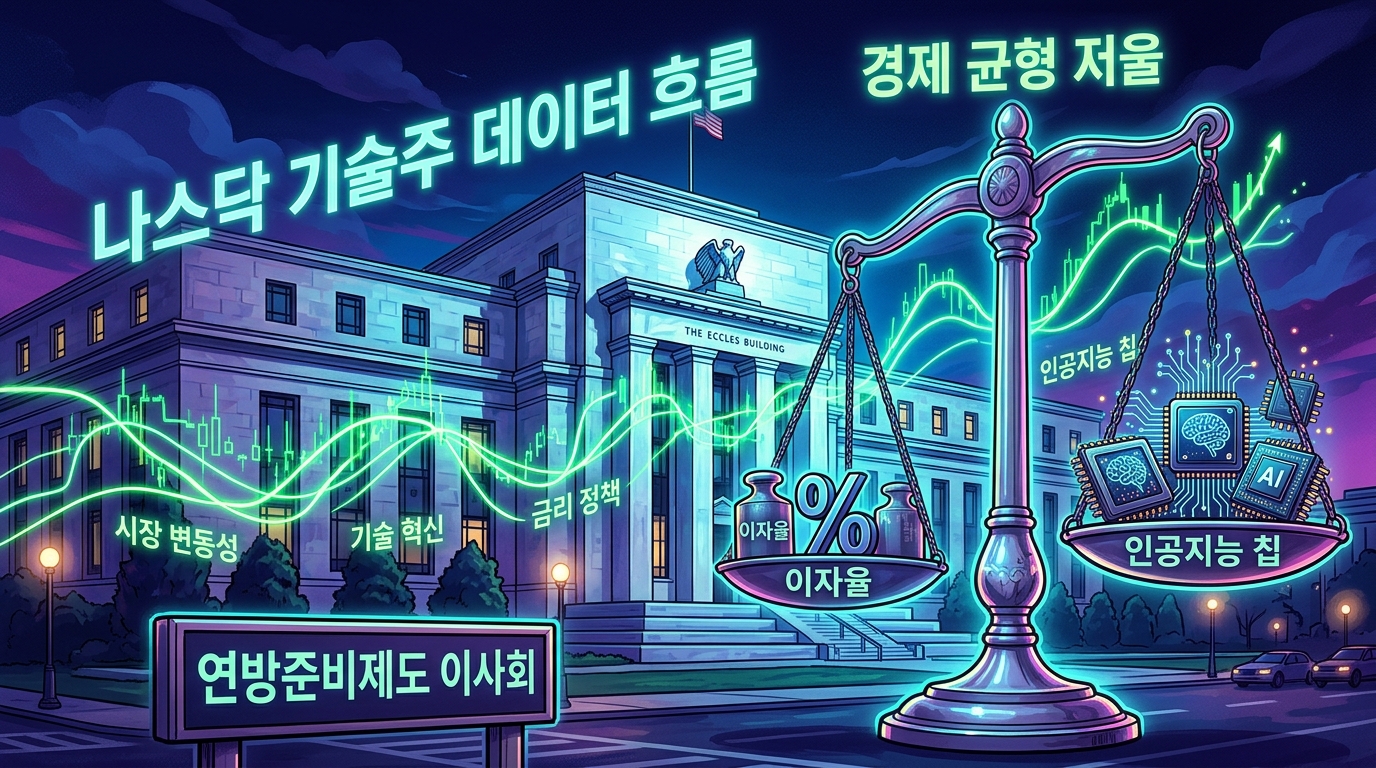
Recently, the U.S. Federal Reserve's policy stance has leaned much more hawkish than market expectations, pushing the tech-heavy Nasdaq market into a new phase.
In particular, following the release of the minutes from the first FOMC meeting chaired by the new Fed Chairman Kevin Warsh, the possibility of an interest rate hike in the second half of 2026 has surfaced.
Adding to this are new variables driving up inflation, such as oil price instability caused by geopolitical tensions between the U.S. and Iran, and the corporate boom in AI infrastructure investment.
In this article, we analyze the upcoming July FOMC interest rate decision outlook and how the trajectory of the U.S. 10-year Treasury yield (US10Y) will impact Nasdaq valuation multiples from various angles.
---
Market Overview
As of intraday trading on July 9, 2026 (provisional), the Nasdaq Composite Index stood at 25,870.65, continuing a tense wait-and-see stance.
At the same time, the domestic markets saw the KOSPI at 7,488.89, the KOSDAQ at 785.25, and the USD/KRW exchange rate trading around 1,503.50 won.
According to Daily Stock's proprietary Fear & Greed Index, the KOSPI is currently in the "Extreme Fear (12.5)" stage.
On the other hand, the Nasdaq Fear & Greed Index is currently at a "Neutral (42.2)" level, recovering slightly from the "Fear (30.5)" stage a week ago, but caution remains high.
The primary driver behind this subdued investment sentiment is the hawkish shock from the June FOMC minutes released on July 8 (local time).
With as many as 9 out of 18 Fed officials forecasting at least one rate hike by the end of 2026, the rate-cut path that the market had anticipated has been pushed back entirely.
[Image: /stdaily/uploads/202607/gen_6a4ee4d644c151.66909709.png]
---
Financial Analysis
The U.S. benchmark interest rate currently stands at 3.50% to 3.75%, remaining frozen for the fourth consecutive time.
However, projections for Personal Consumption Expenditures (PCE) inflation, the Fed's preferred inflation gauge, have been revised upward significantly.
| Category | March 2026 Projection | June 2026 Projection |
|---|---|---|
| **PCE Inflation Forecast** | 2.7% | 3.6% |
| **Year-end Policy Rate Forecast (Median)** | 3.4% | 3.8% |
| **Actual Policy Rate (Current)** | - | 3.50% ~ 3.75% |
| **U.S. 10-Year Treasury Yield (US10Y)** | - | 4.58% (As of July 8) |
Source: June 2026 FOMC Summary of Economic Projections (SEP) & Compiled Market Data
The U.S. 10-year Treasury yield (US10Y) was unconfirmed for the current day's intraday trading, but stood at 4.58% as of July 8 (the latest confirmed value), surging to its highest level since May due to rising energy prices and a hawkish Fed.
Fed officials particularly pointed out that the massive capital expenditures (CAPEX) on data centers and AI computing power led by Big Tech companies are exceeding market supply capacities, further fueling inflation.
---
Valuation
With the U.S. 10-year Treasury yield climbing above 4.5% and maintaining its upward march, the valuation multiples of Nasdaq's high-growth tech stocks are under heavy pressure.
An increase in treasury yields, representing the risk-free rate, raises the discount rate used to value the future cash flows of tech companies.
Currently, the Forward P/E ratio of the Nasdaq 100 Index is trading above its 5-year historical average, a structure that makes it highly sensitive to interest rate volatility.
Furthermore, as the Dollar Index (DXY) remains strong due to geopolitical risks in the Middle East and concerns over prolonged high interest rates in the U.S., it could negatively impact the translated overseas revenues of multinational Big Tech companies.
Nonetheless, the robust cash-generation capabilities of Big Tech firms and their achievements in infrastructure optimization serve as the sole line of defense enduring this high-interest-rate environment.
---
Expert & Institutional Analysis
Ed Yardeni, a veteran Wall Street strategist and president of Yardeni Research, presented a bold outlook suggesting that the Fed could hike interest rates by 25 basis points as early as the July 29 meeting.
Although the probability of a pause in July according to the CME FedWatch Tool remains dominant, the possibility of additional hikes in the second half of the year has gradually begun to be priced into the market.
New Fed Chairman Kevin Warsh took the unprecedented step of completely removing "forward guidance" from the policy statement since taking office.
Experts interpret this as an expression of the Fed's intent to no longer seek "compromise" or offer verbal interventions to the market, but rather to move immediately and purely based on incoming hard data.
Consequently, the consensus is that Nasdaq volatility on days of monthly employment report and Consumer Price Index (CPI) releases could be amplified much more than before.
[Image: /stdaily/uploads/202607/gen_6a4ee4dee929d8.99642229.png]
---
Risk Factors
The most immediate threat is the potential for a secondary spike in energy prices stemming from geopolitical conflicts in the Middle East, such as around the Strait of Hormuz.
Should rising oil prices translate into higher manufacturing and logistics costs, it risks further fueling the Fed's PCE projection, which has already jumped to 3.6%.
Secondly, there are doubts over "AI investment efficiency" and infrastructure bottlenecks.
If the pace at which massive capital expenditures translate into actual revenue and profit is delayed while only stimulating inflation, a contraction in Nasdaq market multiples will be difficult to avoid.
Lastly, there is a risk of liquidity contraction in emerging markets, including South Korea.
With the USD/KRW exchange rate breaking above 1,500 won and the Bank of Korea contemplating additional rate hikes within the year to stabilize prices, global capital's preference for safe-haven assets could intensify further.
---
Investment Perspective Summary
For the July FOMC, the focus should be on the message delivered by Chairman Kevin Warsh and the degree of his data-dependent stance, rather than the simple decision of whether to freeze rates.
In the absence of macro tailwinds like rate cuts, stellar earnings growth from Big Tech companies is essential for the Nasdaq to maintain an upward trajectory.
Investors need to monitor in real-time whether the U.S. 10-year Treasury yield breaks above the 4.6% level, which would trigger further multiple compression.
Until geopolitical risks ease and oil prices stabilize, a conservative strategy maintaining a split-buy (dollar-cost averaging) approach appears valid.
---
Investor Checklist Q&A
Q1. Is there a realistic chance of a rate hike at the July FOMC?
While the probability of a freeze at the July meeting is overwhelmingly high according to the CME FedWatch, a hawkish pause scenario is highly likely as some officials have raised the need for hikes.
Q2. How does Chairman Kevin Warsh's removal of 'forward guidance' affect the market?
Because the Fed will not signal its future monetary policy path in advance, market volatility could expand significantly depending on each inflation and employment data release.
Q3. Why is AI infrastructure investment being singled out as an inflation-stimulating factor?
As countless tech companies spend astronomical sums on building data centers and securing power grids, demand for raw materials and components has surged, driving up overall producer prices.
Q4. Why do tech stocks fall when the U.S. 10-year Treasury yield (US10Y) rises?
High-growth companies have a large share of expected future profits. When interest rates rise, the discount rate applied to convert future value into present value increases, lowering their current valuation.
Q5. How should domestic investors respond with the USD/KRW exchange rate exceeding 1,500 won?
A high exchange rate stimulates import prices, making it difficult for the Bank of Korea to cut rates. Considering exchange loss risks, investors should carefully diversify their portfolio allocations between dollar-denominated and won-denominated assets.
---