[Image: /stdaily/uploads/202607/gen_6a4d9358269174.63314269.png]
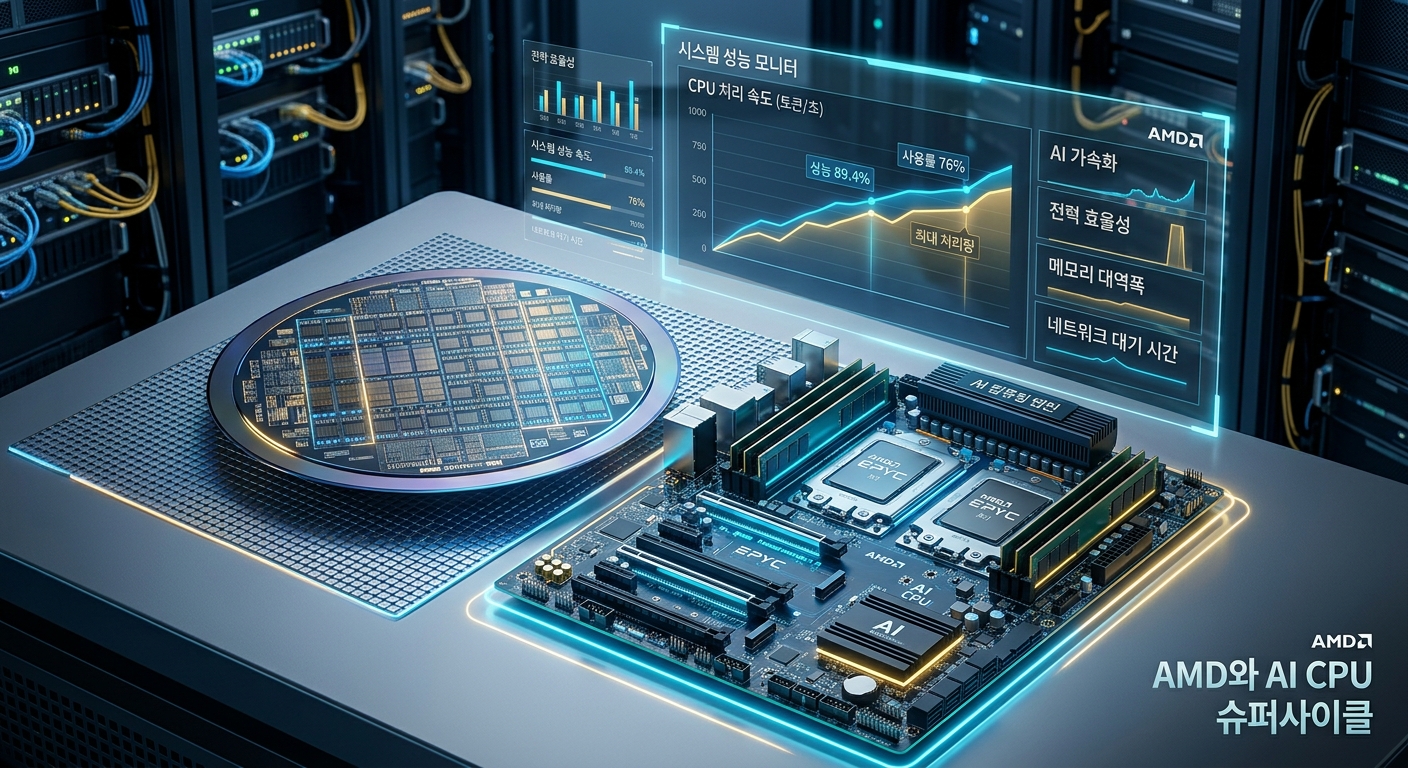
Recently, in global capital markets and Nasdaq, investment in artificial intelligence (AI) infrastructure has been rapidly expanding from a GPU-centric focus to the CPU domain, which coordinates overall data transmission and computation.
In this process, the value of AMD, which possesses unique CPU architecture competitiveness, is once again receiving intensive re-evaluation on Wall Street.
Core Summary
- **Earnings Beat Consensus**: AMD recorded Q1 2026 revenue of $10.3 billion, significantly exceeding market expectations.
- **Strengthened Server CPU Dominance**: Its x86 server shipment share settled at 33.2%, and its revenue-based share reached an all-time high of 46.2%.
- **Agentic AI Beneficiary**: Demand for EPYC processors, which handle complex AI agent implementation and multi-threading coordination, is surging, leading to a supply shortage.
Current Situation Summary
As of during the trading day on July 8, 2026, AMD's stock price is experiencing an intense tug-of-war between profit-taking and bargain-hunting based on the previous trading day's close of $521.81 (real-time price on the day unconfirmed; reflecting the latest confirmed value of $521.81).
Amid a general breathing spell for the Semiconductor Index (SOX), AMD is solidifying its position as a partner responsible for overall data center computation beyond being a simple graphics processing unit (GPU) manufacturer.
In the domestic market, the KOSPI index is recording 7,431.76, the KOSDAQ index is at 813.50, and the USD/KRW exchange rate has reached 1,520.00 won.
While global macro indicator volatility continues, according to this blog's proprietary 'Fear and Greed Index', the KOSPI Fear and Greed Index is currently bottoming out at the 'Extreme Fear (13.6)' level.
On the other hand, the Nasdaq Fear and Greed Index points to the 'Neutral (43)' stage, agilely reflecting changes in US Big Tech earnings and guidance.
In particular, the 'Advancing AI' event scheduled for July 22 and 23 is expected to be a major turning point.
At this event, next-generation AI infrastructure platforms and roadmaps are projected to be unveiled on a large scale, aligning the focus of global investors.
[Image: /stdaily/uploads/202607/gen_6a4d93605ed670.05630376.png]
Financial Analysis
AMD's Q1 2026 performance was primarily driven by the dramatic leap in its Data Center Segment.
Non-GAAP earnings per share (EPS) reached $1.37, pleasantly surpassing the Wall Street estimate of $1.27.
| Evaluation Metric (Non-GAAP) | Q1 2026 Performance | Market Forecast (Consensus) | Year-on-Year (YoY) |
|---|---|---|---|
| **Quarterly Revenue** | $10.3 billion | $9.85 billion | +38% |
| **Non-GAAP EPS** | $1.37 | $1.27 | +45% (Est.) |
| **Data Center Revenue** | $5.8 billion | $5.4 billion | +57% |
| **Non-GAAP Gross Margin** | 55% | 54.5% | +2.0%p (Est.) |
| **Q2 Revenue Guidance** | ~$11.2 billion | $10.8 billion | +46% (Guidance Midpoint) |
Data center segment revenue grew explosively by 57% year-on-year to reach $5.8 billion.
It is observed that the hybrid demand for next-generation EPYC Turin CPUs and Instinct AI accelerators successfully drove the top-line expansion of the overall performance.
The Q2 revenue guidance announced by the company stood at approximately $11.2 billion, demonstrating strong aggressiveness by forecasting a growth of about 46% year-on-year.
Valuation
Currently, AMD's Forward Price-to-Earnings (P/E) ratio is fluctuating around 54x.
This is a somewhat demanding range compared to the days when it was classified as a simple CPU company, but the quality of revenue growth and operating leverage demonstrate a clear fundamental improvement.
From a macro perspective, as the US 10-year Treasury yield (US10Y) hovers around 4% per annum, valuation multiple pressure on high-growth tech stocks persists.
Nevertheless, thanks to the improvement in the high-unit-price product mix sweeping both the AI accelerator and data center CPU markets, the value per share is structured to receive stronger upward pressure.
The mild volatility of the US Dollar Index (DXY) could be a minor variable for the translated revenue of AMD, a multinational technology company.
However, as long as capital expenditures (CAPEX) of major local cloud service providers (CSPs) do not decline, these foreign exchange factors are expected to remain marginal.
Expert & Institutional Analysis
Global market research firm Gartner recently assessed in a special report that "AMD is currently the most dominant front-runner (The Company to Beat) in the enterprise AI server CPU space."
This is because serial processing computing power has become absolutely crucial as AI models transition from pure pattern learning to the era of 'Agentic AI,' where they think and act on their own.
[Image: /stdaily/uploads/202607/gen_6a4d9368f21035.50671108.png]
The latest data from Mercury Research proves that AMD reached a 32.6% share of the overall x86 architecture market, breaking its historic high.
In particular, with the server segment's revenue share nearing 46.2%, Wall Street is pouring out praise that the company is completely changing generations from its long-held image of a perpetual runner-up lagging behind its competitor.
Major US investment banking (IB) groups, including Wells Fargo, are also raising their target prices, highly evaluating this rapid advance in data center CPU market share and the potential of the next-generation 'MI350' series lineup.
Risk Factors
The most critical practical risk is securing TSMC's 3nm advanced process capacity and the limited supply-demand situation of advanced packaging lines.
Indeed, the waiting delivery time (lead time) for high-performance EPYC Turin processors has recently extended significantly to 8–10 weeks in major retail channels in North America and Asia.
If the supply shortage is prolonged, there is always an co-existing risk that big tech clients' schedules for building next-generation systems will be deferred or that they will revert to competing models.
In addition, if the Volatility Index (VIX), which reflects fear sentiment on Nasdaq, surges or if big tech's infrastructure CAPEX is limited due to deteriorating global economic indicators, there is room for the growth premium (multiple) to shrink.
As Nvidia is expected to defend its market share by quickly implementing its next-generation 'Rubin' roadmap following Blackwell, the execution speed of AMD, which has pledged a tight annual release cycle, must be maintained without setbacks.
Investment Perspective Summary
Overall, AMD is emerging not only as a challenger catching up in the GPU market but also as the direct protagonist of the 'CPU computing supercycle' that is changing the foundation of AI data centers.
The all-round adoption of Agentic AI workloads creates a scenario that simultaneously offers AMD long-term profitability improvement opportunities through massive volume and unit price increases.
Investors should pay close attention to the packaging technological capabilities and supply chain bottleneck mitigation measures to be unveiled at the large-scale technology roadmap event at the end of July.
Taking into account the remaining risk of high US interest rates, which can act unfavorably against growth stocks, a strategy of flexibly applying a split-purchase approach seems valid.
Investor Checkpoints Q&A
Q1. What was the most positive figure in AMD's Q1 2026 earnings announcement?
- The total revenue of $10.3 billion, which easily surpassed market expectations, and the data center segment revenue of $5.8 billion, which supported the company's profits with an impressive 57% year-on-year growth.
Q2. Why are CPUs emerging as such a critical resource alongside GPUs in the AI era?
- Because Agentic AI services require powerful continuous CPU computation and bandwidth processing, including computational flow control, memory orchestration, and multi-model coordination.
Q3. What is the significance of the recent server market share figures announced by AMD?
- By reaching a 33.2% share in x86 server shipments, AMD is completely reshaping the major hardware supply chain, and its revenue-based share recorded 46.2%, proving its leadership in premium product groups.
Q4. Are the recently discussed supply chain shortages and increasing lead times bad news?
- While they present a risk of delivery delays in the short term, in the medium to long term, they serve as evidence of the overwhelming excess demand from global big tech and enterprises for the 5th generation EPYC Turin CPUs.
Q5. What is the biggest schedule that investors should watch out for in July 2026?
- The 'Advancing AI' event scheduled for July 22–23, where the next-generation AI GPU roadmaps (MI350, MI400) and the vision for power-efficient cabinet server architectures will be key factors stimulating investor sentiment.