[Image: /stdaily/uploads/202606/gen_6a43076dea0316.96512522.png]
Hello, this is Daily Stock.
Key Summary
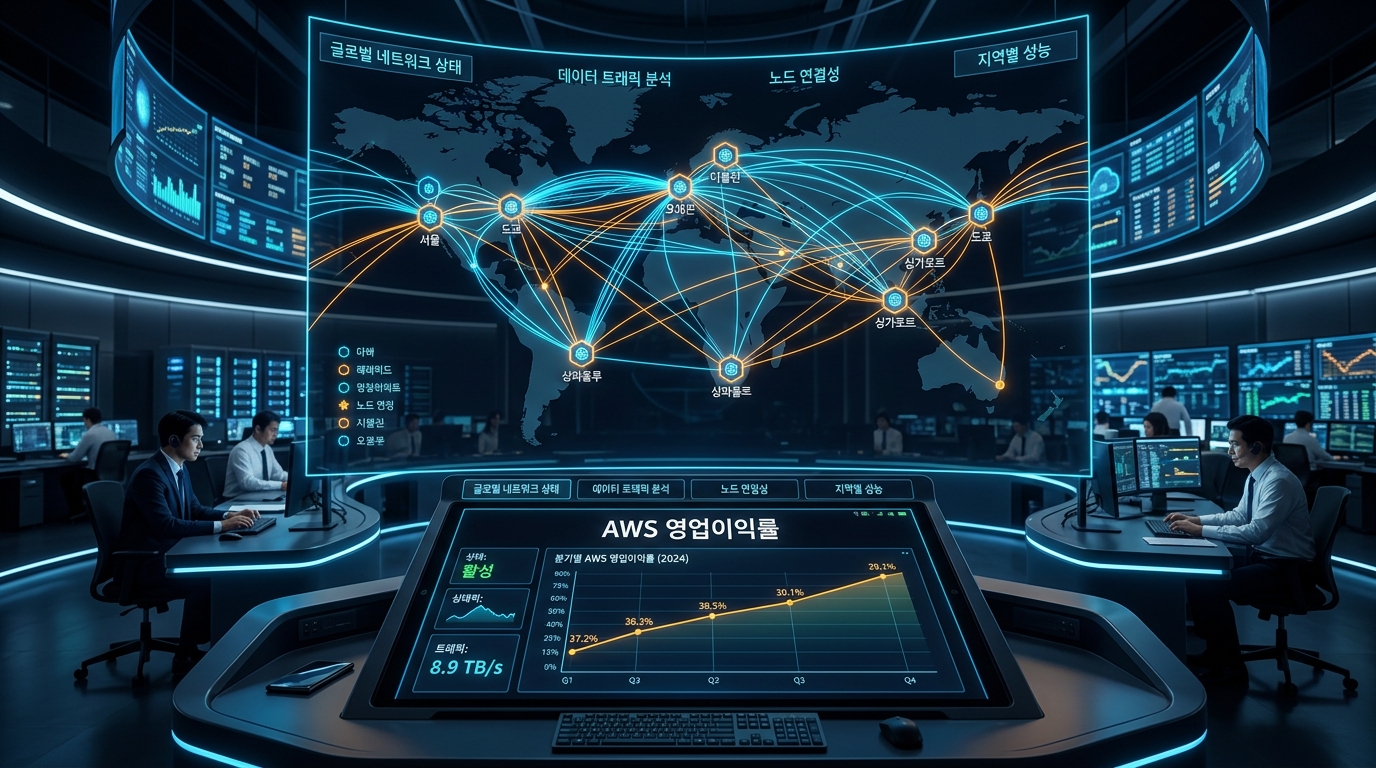
- Based on recent financial results, Amazon's cloud business (AWS) recorded an operating margin of 37.8%, breaking its historical high.
- Infrastructure efficiency, such as the deployment of its in-house AI semiconductor "Trainium" and the extension of server lifespans, drove maximum margins.
- Despite massive capital expenditures (CAPEX) reaching approximately $200 billion annually, AWS's overwhelming cash-generation capability remains key to defending its valuation.
Market Update
Recently, the Nasdaq market has been focusing more on Big Tech's high-margin businesses and AI infrastructure efficiency.
As of intraday trading on June 30, 2026 (tentative), global technology stock multiples are reacting sensitively to the volatility of the US 10-year Treasury yield.
According to Daily Stock's proprietary Fear & Greed Index, the Nasdaq Fear & Greed level currently stands in the "Fear" (27) zone.
This is a slight decrease from the "Fear" (32) level recorded a week ago, and shows that investor sentiment remains subdued compared to the "Neutral" (59.5) level a month ago and the "Greed" (64.8) level three months ago.
In this environment, Amazon (AMZN) is proving its structural transformation into a high-margin cloud giant, moving beyond its identity as a simple e-commerce player.
As of today, while the Korean market recorded KOSPI at 8,383.90 and KOSDAQ at 924.56, the USD/KRW exchange rate is hovering around 1,541.50 won during intraday trading.
Financial Analysis
According to Amazon's recent quarterly (Q1 2026) results, total consolidated revenue rose 17% year-over-year (YoY) to $181.5 billion.
Specifically, AWS revenue—its core growth engine—surged 28% YoY to $37.6 billion, marking its fastest growth rate in the last 15 quarters.
More impressively, AWS operating income reached $14.2 billion, translating to an outstanding operating margin of 37.8%.
This is a substantial improvement compared to the 35.1% operating margin recorded in the preceding quarter (Q4 2025).
The table below shows the financial trends for Amazon's AWS segment and consolidated metrics:
| Segment | Q4 2025 | Q1 2026 | YoY Growth Rate |
|---|---|---|---|
| AWS Revenue | $35.6B | $37.6B | +28% (Based on Q1) |
| AWS Operating Income | $12.5B | $14.2B | +23.5% |
| AWS Operating Margin | 35.1% | 37.8% | +2.7%p (QoQ) |
| Consolidated Operating Margin | 11.7% | 13.1% | +1.3%p (YoY based on Q1) |
This margin improvement is attributed to the success of its custom AI chip, "Trainium," designed to reduce reliance on Nvidia, coupled with maximized utilization of its cloud infrastructure.
[Image: /stdaily/uploads/202606/gen_6a4307763363d1.22051605.png]
Valuation
Amazon has previously faced concerns over slowing cash flows due to its planned capital expenditures (CAPEX) of approximately $200 billion based on 2026 guidance.
However, AWS’s ultra-high operating margin of 37.8% significantly offsets fears over excessive CAPEX.
With AWS's annual run-rate revenue nearing $150 billion, market participants are increasingly looking to value this high-margin engine independently.
In particular, Amazon’s Price-to-Sales (PSR) and Price-to-Earnings (PER) multiples relative to the S&P 500 growth stock average and its competitors have entered a reasonable premium range, supported by AWS's earnings re-acceleration.
Expert & Institutional Analysis
Wall Street and domestic institutional experts believe Amazon's proprietary semiconductor ecosystem (Trainium and Graviton) will serve as a key moat for long-term margin defense.
In particular, the $100 billion cloud spending commitment secured through its partnership with Anthropic enhances the long-term revenue visibility of AWS.
Some global investment banks (IBs) suggest AWS has further room to improve its margins while implementing price adjustments for GPU-based services.
Experts evaluate that despite short-term free cash flow (FCF) pressure, Amazon has ample room for multiple expansion if enterprise AI demand continues to scale over multi-year horizons.
[Image: /stdaily/uploads/202606/gen_6a430780e65850.07747425.png]
Risk Factors
The most prominent risk factor remains the prolongation of massive capital expenditures (CAPEX) on AI infrastructure.
If AI monetization is delayed beyond market expectations, or if bottlenecks like power supply shortages occur, high fixed-cost burdens could erode margins.
Furthermore, potential pricing pressure driven by intensifying competition with Microsoft Azure and Google Cloud is another potential risk.
Additionally, regulatory risks, such as the Federal Trade Commission's (FTC) antitrust lawsuit slated for 2027, continue to cap Amazon's long-term multiples.
Investment Outlook
Amazon's investment attractiveness ultimately depends on the sustainability of AWS's earnings power.
As the Nasdaq index exhibits short-term volatility at 25,820.14, the burden of the USD/KRW exchange rate around 1,541.50 won is also an important factor for Korean domestic investors.
Nevertheless, AWS's 37.8% operating margin is a clear signal re-rating Amazon from a simple e-commerce player to a dominant high-margin tech giant.
A long-term scenario-based investment approach targeting the phase where infrastructure investment payoffs materialize appears viable.
Investment Checklist
- **AWS Revenue Growth Rate**: Monitor whether AWS can maintain high growth above 25% quarterly.
- **Operating Margin Defense**: Verify if the adoption of proprietary custom silicon can firmly defend AWS margins above 35%.
- **CAPEX Scale**: Check the impact of the annual $200 billion capital expenditure plan on free cash flow.
- **Macroeconomic Indicators**: Track the movements of the US 10-year Treasury yield and changes in Nasdaq multiples in real-time.
- **In-house Silicon Utilization**: Keep an eye on the increasing enterprise adoption rate and revenue contribution of 'Trainium'.