The minutes of the May monetary policy decision meeting disclosed by the Bank of Korea (BOK) Monetary Policy Committee (MPC) contain crucial clues to gauge the supply and demand landscape of large-cap stocks in the KOSPI market amid prolonged high oil prices and high exchange rates.
[Image: /stdaily/uploads/202606/gen_6a4369b64dede0.55427602.png]
Executive Summary
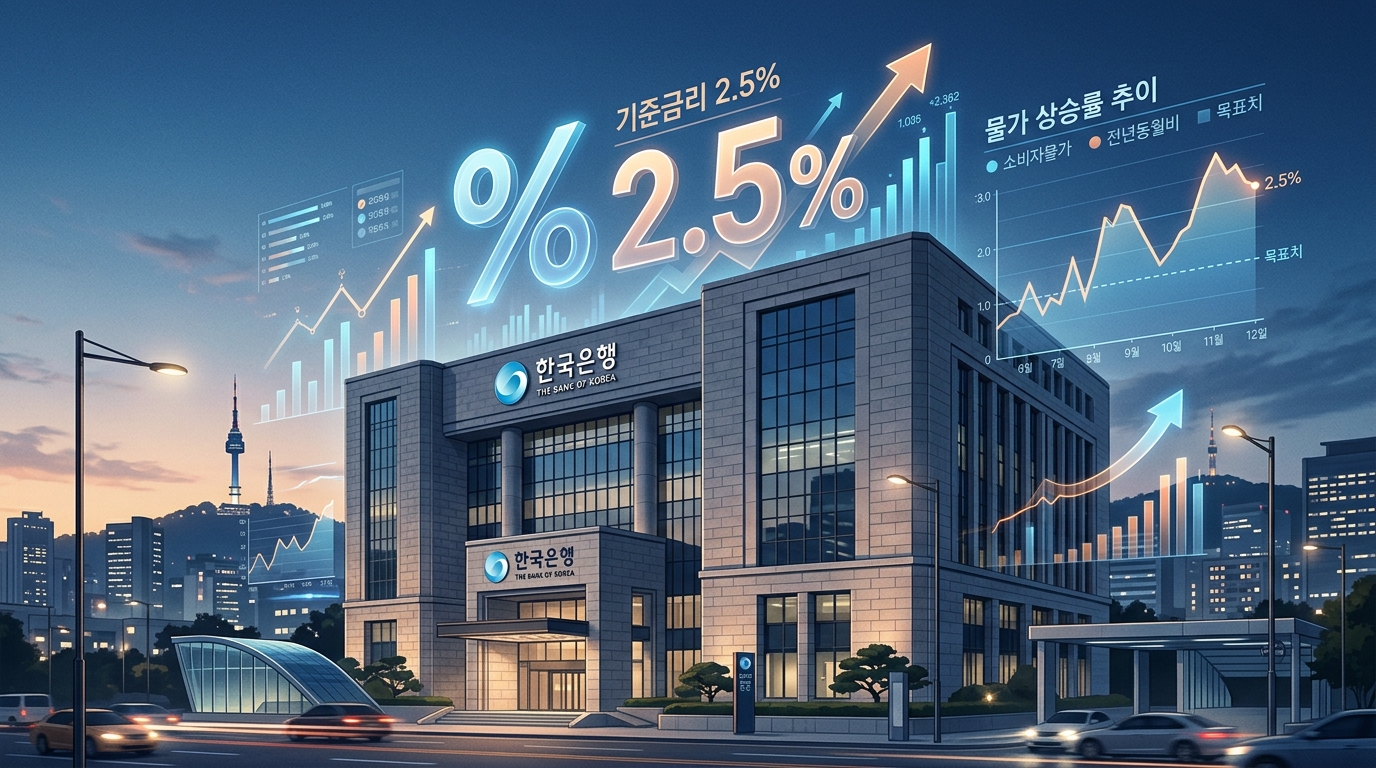
- **8th Consecutive Base Rate Freeze**: The BOK MPC, in its first monetary policy meeting chaired by Governor Shin Hyun-song, decided to maintain the base rate at 2.50% per annum, prolonging its tight monetary policy stance.
- **Upward Adjustment of Growth and Inflation Forecasts**: The real GDP growth forecast for South Korea this year was significantly raised to 2.6%, and the consumer price index (CPI) inflation forecast was adjusted upward to 2.7%, reflecting a crossover of stagflation concerns and economic resilience.
- **KOSPI Impact and Exchange Rate**: With the KRW/USD exchange rate soaring to 1,548.60 won, foreign exchange market instability and external interest rate differentials have emerged as key risk factors that could trigger foreign capital outflows.
Market Overview
As of the close on June 30, 2026, the KOSPI index ended at 8,476.48, while the KRW/USD exchange rate continued its high run at 1,548.60 won.
According to the proprietary Fear & Greed Index, the KOSPI Fear & Greed Index currently stands at 42.7 (Neutral), showing a slight recovery from 28.8 (Fear) a week ago.
On the other hand, global risk appetite remains subdued, with the Nasdaq Fear & Greed Index recording 27.2 (Fear).
As the prolonged Middle East conflict and uncertainties surrounding U.S. reciprocal tariff policies stimulate import prices, the BOK maintains a hawkish freeze stance, remaining reluctant to make a hasty entry into an easing cycle.
Financial Analysis
In its recent report on weighted average interest rates for May, the BOK announced that the savings deposit rate of deposit banks stood at 2.93% per annum and the lending rate stood at 4.19% per annum, up 0.01%p and down 0.01%p month-on-month, respectively.
While market liquidity remains solid, supporting a current account surplus driven by a robust semiconductor export rally, the prolonged high exchange rate is negatively impacting the financial structure of large corporations due to rising import raw material costs.
Particularly, as the high-interest-rate environment persists, the interest coverage ratio for domestic demand-sensitive sectors within the KOSPI, such as construction and retail, is declining. In contrast, financial and banking holding companies have successfully defended their Net Interest Margin (NIM), showing contrasting resilience.
| Classification | Key Macroeconomic Indicators and Forecasts (As of 2026 BOK Announcement) |
|---|---|
| **Base Rate** | 2.50% per annum (8th consecutive freeze decision) |
| **2026 GDP Growth Forecast** | Upwardly revised from 2.0% to 2.6% |
| **2026 CPI Forecast** | Upwardly revised from 2.2% to 2.7% |
| **May Deposit Bank Deposit Rate** | 2.93% per annum (New handling basis) |
| **May Deposit Bank Lending Rate** | 4.19% per annum (New handling basis) |
[Image: /stdaily/uploads/202606/gen_6a4369c1446257.15182647.png]
Valuation
At the current KOSPI level of 8,476.48 points, the overall 12-month forward P/E (Price-to-Earnings) valuation is hovering around 10x, which is near the historical band average.
With the base rate locked at 2.50%, the 3-year Treasury bond yield, a risk-free asset, is recording in the 3.7% range, somewhat reducing the attractiveness of the stock market's yield gap.
However, although a valuation re-rating centered on KOSPI large-caps is being attempted as earnings estimates for the semiconductor sector have been adjusted sharply upward, the high exchange rate risk is limiting the upside.
Expert and Institutional Analysis
Academic and financial market experts point out that dissenting views among board members were exposed in these MPC minutes, suggesting that the BOK's terminal rate will likely maintain its peak for longer than the market expects.
Some private economic research institutes warned that if upward inflationary pressures persist, a scenario in which the base rate is further raised (up to 3.00% to 3.50%) in the second half of the year cannot be ruled out.
Foreign investment banks (IBs) assess that the KRW/USD exchange rate breaching the 1,540 won level is triggering foreign selling of spot and futures contracts, which will likely limit active capital inflows into stocks other than major leading large-caps for the time being.
Risk Factors
The biggest risk is a scenario where "cost-push inflation" becomes entrenched, driven by the combination of rising imported raw material prices and the surging exchange rate.
Amid ongoing sluggish domestic demand, rising default rates among marginal firms unable to withstand the high-interest-rate burden and lingering real estate PF (Project Financing) risks could threaten the soundness of the banking sector.
Furthermore, if the U.S. Federal Reserve's higher-for-longer stance and the BOK's policy decoupling persist, there is a concern that downward pressure on the Korean Won in the foreign exchange market could grow uncontrollably.
Investment Perspective Summary
The BOK's hawkish freeze stance calls for a concentrated portfolio centered on large-cap export stocks with solid fundamental earnings rather than growth stocks and pharmaceutical/biotech names that typically benefit from rate cuts.
Until the exchange rate stabilizes downward below the 1,548.60 won level, it appears necessary to manage volatility by maintaining a certain level of cash.
A defensive approach focusing on semiconductors, which are supported by export earnings, and major financial holding companies, which demonstrate excellent NIM protection in a high-interest-rate environment, could be advantageous in this phase.
Investor Checklist Q&A
Q1. What is the main reason why the Bank of Korea keeps freezing the base rate at 2.50%?
It is due to upward inflationary pressures caused by high oil prices from the prolonged Middle East conflict and the high exchange rate exceeding 1,540 won. Simultaneously, improved growth driven by robust semiconductor exports discourages a hasty transition to an easing policy.
Q2. How does the upward revision of inflation forecasts in the MPC minutes affect the KOSPI?
As the CPI inflation forecast was raised to 2.7%, the likelihood of a high-interest-rate environment persisting for longer has increased. This raises the valuation burden within the KOSPI and adversely affects domestic small- and mid-cap stocks that are sensitive to interest expenses.
Q3. Is there a possibility that foreign investors will continue to buy KOSPI large-caps even under a high exchange rate?
In a high exchange rate environment where the KRW/USD rate reaches 1,548.60 won, overall foreign capital inflows may slow down due to currency loss concerns. However, selective buying may still flow into specific large-cap export stocks, such as semiconductors, which are enjoying a global super-cycle.
Q4. Was the possibility of a rate hike in the second half mentioned in this MPC meeting's minutes?
Officially, a freeze stance was declared. However, according to analysis of the minutes and expert views, a hawkish tone became more pronounced, with scenarios of an interest rate hike within the year being raised if inflation does not stop and the growth rate exceeds the potential growth rate.
Q5. What sectors should individual investors focus on during this rate freeze period?
Rather than highly leveraged growth stocks or construction stocks that are hit hard by delayed rate cuts, an approach focusing on large export stocks (semiconductors, autos) that maintain earnings power even in high-rate environments, as well as large bank/financial stocks that benefit from high interest rates, seems appropriate.