Hello. This is Daily Stock, keeping a sharp eye on global macroeconomics and commodity market trends.
[Image: /stdaily/uploads/202606/gen_6a416fa3978ae2.85318945.png]
Summary
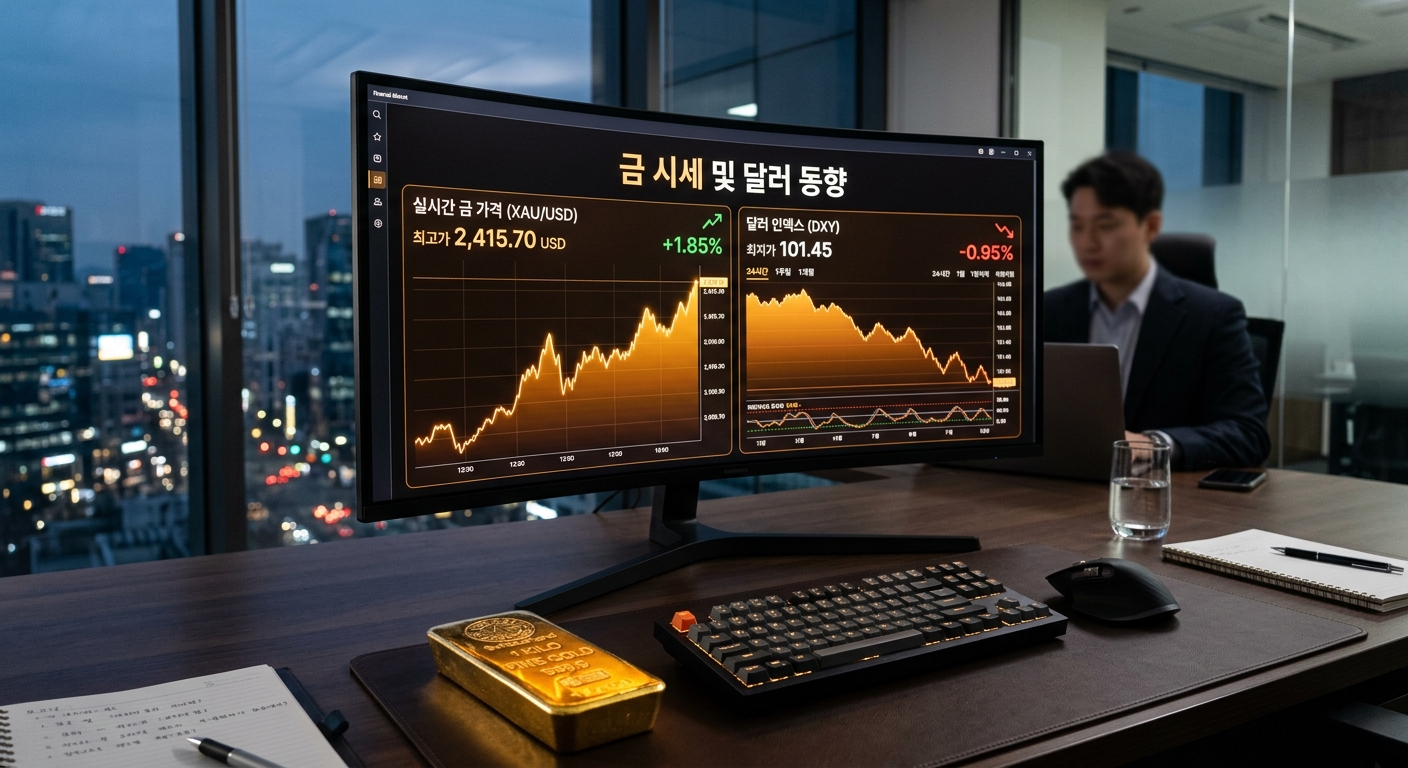
Global gold prices are spark of a potential rebound, regaining the $4,080 per ounce level after undergoing a downward correction.
This recovery takes place as hawkish undertones under the Federal Reserve's new chair, Kevin Warsh, clash with minor pullbacks in the US Dollar Index (DXY).
Fundamental decoupling among the US, Europe, and Asia is deepening, while divergent monetary policies heighten volatility across broader asset markets.
Fluctuations in commodity prices, including WTI crude oil and copper, remain crucial variables that cloud the future path of inflation.
Market Overview
The global gold market is currently showing a short-term recovery, trading at approximately $4,087.01 per ounce (based on the latest updates).
However, this remains a significant correction compared to the historical high of $5,589 to $5,608 registered in January of this year.
Recently, fresh buying interest flowed back into gold as the DXY underwent a brief cooling-off period, sliding to the 101.20 level after hovering near its yearly high above 101.
In contrast, the domestic market continues to feel the squeeze of a high exchange rate, with the USD/KRW remaining elevated at 1,538.00 won.
As of intraday trading on June 29, 2026 (tentative), sentiment across domestic and global indices points to a general risk-off environment.
The KOSPI is at 8,411.21, the KOSDAQ is at 851.37, and the Nasdaq is trading around the 25,297.62 level.
According to Daily Stock's proprietary Fear & Greed Index, the KOSPI Fear & Greed Index is currently in the "Fear" territory at 39.
This shows a rapid cooling of sentiment from the "Neutral" reading of 52.4 a week ago and 57.5 a month ago.
The Nasdaq Fear & Greed Index has also plunged into "Fear" at 24.8.
The optimism that drove the index to "Greed" (60.9) a month ago and "Greed" (63) three months ago has quickly faded, reflecting rising market anxieties.
| Indicator | Current Figure (As of Intraday June 29, 2026) | 1 Week Ago | 1 Month Ago |
|---|---|---|---|
| KOSPI | 8,411.21 | - | - |
| KOSDAQ | 851.37 | - | - |
| Nasdaq | 25,297.62 | - | - |
| USD/KRW | 1,538.00 KRW | - | - |
| KOSPI Fear & Greed Index | Fear (39) | Neutral (52.4) | Neutral (57.5) |
| Nasdaq Fear & Greed Index | Fear (24.8) | Fear (37.6) | Greed (60.9) |
Financial Analysis
The direction of global macro liquidity remains highly mixed due to policy decoupling among major regional central banks.
In the US, consumer price index (CPI) growth for May came in at 4.2% year-on-year, indicating persistent inflationary pressures.
With curbing inflation as his top priority, the new Fed Chair Kevin Warsh is keeping the door open for potential interest rate hikes.
In contrast, the European Central Bank (ECB) is engaging in delicate policy fine-tuning to support its slowing economy, widening the interest rate differential with the US.
In Asia, the Bank of Japan's (BOJ) limited tightening stance and the People's Bank of China's (PBOC) selective liquidity injections have further pressured regional currencies.
While this tri-polar decoupling previously supported a unilateral dollar rally, recent declines in oil prices have eased inflation expectations, putting a temporary brake on the dollar's strength.
[Image: /stdaily/uploads/202606/gen_6a416faca32954.38508710.png]
Valuation
As a non-yielding asset, gold's valuation multiple is largely determined by global real interest rates and the relative strength of the US dollar.
On the technical charts, gold is hovering near a critical threshold where its 50-day moving average is threatening to cross below its 200-day moving average—a potential "Death Cross."
Reclaiming the technical resistance level of $4,300 will be key to signaling a medium-to-long-term trend reversal.
As long as the dollar index holds above the 101 level, global equity valuation multiples may face persistent downward pressure.
Specifically, the domestic stock market remains stuck in undervalued territory relative to book value, as foreign capital inflows are constrained by the prolonged high exchange rate (1,538.00 won).
The Nasdaq has also experienced a compression of its valuation multiple due to fears of higher-for-longer interest rates, dragging its sentiment down to the "Fear" level of 24.8.
Institutional & Analyst Views
Global investment banks, including Goldman Sachs, maintain a long-term bullish outlook, suggesting that gold could target the $5,000 mark by the end of the year.
However, many analysts urge caution, advising that volatility could peak in the short term as the new Fed Chair's hawkish policies take concrete shape.
Some commodity strategists note that easing geopolitical tensions between the US and Iran have stabilized oil prices, thereby reducing gold's safe-haven premium.
The World Gold Council (WGC) points out that while central bank purchasing remains steady, the current price action could turn out to be a mere technical bounce unless aggressive central bank buying resumes.
Risk Factors
First, if US inflation indicators surprise to the upside, a renewed push for Fed rate hikes could drag gold prices down to the $3,400 range.
Second, an abrupt resolution of geopolitical risks in the Middle East could quickly dampen safe-haven sentiment.
Third, rapid normalization of global supply chains and falling energy costs could erode inflation-hedging demand, limiting inflows into the gold market.
Fourth, domestic investors face the risk of poor portfolio allocation between dollar exchange-rate gains and physical gold assets amid the prolonged high-exchange-rate environment.
Investment Perspective
While a minor pullback in the dollar index has given gold breathing room, it is premature to declare the start of a structural dollar downtrend.
Navigating asset allocation is exceptionally difficult in this current decoupling phase, where the fundamentals and monetary policies of the US, Europe, and Asia are pulling in different directions.
Given the heightened volatility in the KOSPI and Nasdaq, which have both entered "Fear" territory, it is advisable to approach defensive safe-havens like gold strictly for capital preservation.
Rather than chasing rallies, a more prudent approach may involve building positions gradually via dollar-cost averaging while monitoring the Fed's policy path and global PMI trends.
Investor Checklist Q&A
Q1. What is the main driver behind gold's recent rebound back to the $4,080 range?
It is primarily due to temporary buying interest triggered by the DXY pulling back to 101.20 from its annual high above 101, alongside some easing of inflation concerns as oil prices cooled.
Q2. How is the transition in Fed leadership affecting gold prices and the dollar?
New Chair Kevin Warsh's hawkish bias keeps concerns about higher-for-longer rates alive. This supports the greenback's strength and caps the upside potential for gold.
Q3. What is the technical background behind the current "Death Cross" concerns?
It stems from technical observations that gold's 50-day moving average is on the verge of crossing below its 200-day moving average, which analysts interpret as a warning of a potential medium-term downward trend.
Q4. How is the US-EU-Asia decoupling affecting the commodity markets?
Monetary divergence—comprising US tightening fears, ECB efforts to counter economic slowdown, and Asia's liquidity injections—is shaking the relative value of the dollar and driving up volatility in commodities like oil and gold.
Q5. What strategy should retail investors adopt under current market conditions?
With sentiment in both the KOSPI and Nasdaq deeply rooted in "Fear," it is recommended to manage exposure to highly volatile assets and take a conservative approach to alternative assets like gold through gradual, staggered purchases.