Hello. This is Daily Stock.
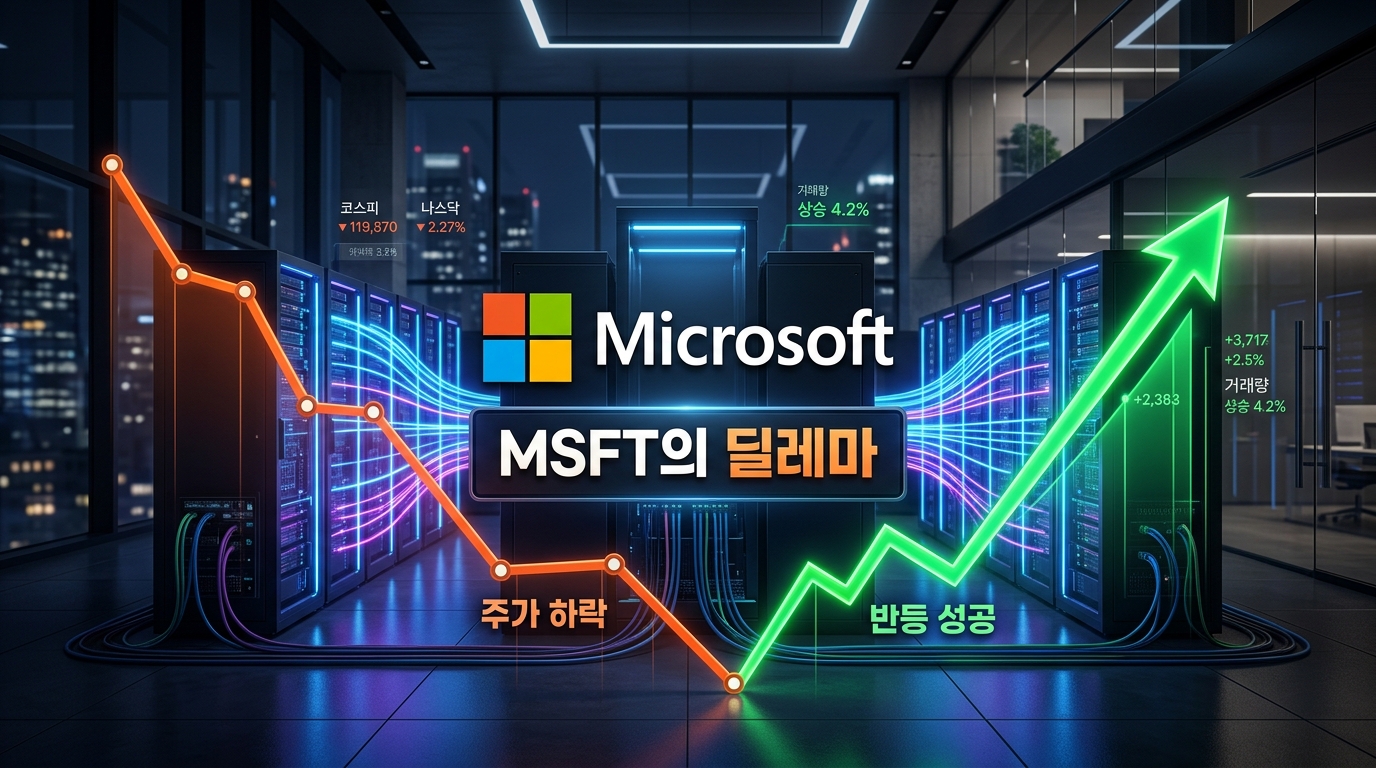
Amid the ongoing volatility in the Nasdaq market, we would like to take a deep look into the recent moves of Microsoft (MSFT), which stands at the forefront of the artificial intelligence (AI) cloud.
[Image: /stdaily/uploads/202606/gen_6a41b62b5371d1.49542793.png]
Executive Summary
Recently, Microsoft (MSFT) once again proved its unrivaled competitiveness in the cloud and AI sectors by delivering outstanding quarterly results.
In particular, revenue growth for Azure and other cloud services, its core growth engine, accelerated strongly, coming in at 40% year-over-year.
However, despite strong market demand, worries over return on investment (ROI) relative to massive capital expenditures (CAPEX) and supply bottlenecks are holding back the stock price.
With the Nasdaq Fear & Greed Index currently hovering in the "Fear" (24.8) stage, reflecting market participants' anxiety, the stock price has undergone a significant correction from its all-time high.
Current Status Overview
Microsoft's stock price is trading in the $365 range, down about 30% from its all-time high of $538.66 reached on October 28, 2025 (provisional as of intraday trading on 2026-06-29).
This comes despite quarterly revenue rising 18% year-over-year to $82.9B and adjusted earnings per share (EPS) coming in at $4.27, comfortably beating market expectations of $4.06.
Behind the stock price decline lies a structural bottleneck that CEO Satya Nadella directly addressed in the earnings call: "Demand is exceeding our available supply."
Although the company plans to double its global data center capacity from 5GW in 2024 to 10GW by fiscal year 2026, it faces a paradoxical situation where the pace of infrastructure completion cannot keep up with demand.
Financial Analysis
Looking at Microsoft's latest quarterly (FY26 Q3) earnings data, the quality of growth itself remains very solid.
The Intelligent Cloud segment revenue reached $34.7B, growing 30% year-over-year and driving overall performance across the board.
| Performance Metric | FY26 Q3 Figure | Year-over-Year (YoY) Growth | Remarks |
|---|---|---|---|
| **Total Revenue** | $82.9B | +18% | Beat market consensus ($81.5B) |
| **Adjusted EPS** | $4.27 | +21% | Beat Wall Street expectations ($4.06) |
| **Azure Growth** | 40% | (Previous quarter: 39%) | Increased 39% in constant currency |
| **AI Business ARR** | $37B+ | +123% | Rapid increase in AI-driven run-rate revenue |
| **Cloud Gross Margin** | 66% | Slid slightly | Affected by depreciation of large-scale AI infrastructure |
The Copilot segment also achieved milestone results, surpassing 20 million paid seats and growing 250% year-over-year.
However, the decline in Microsoft Cloud's gross margin to 66% compared to previous quarters suggests that AI infrastructure operating costs are starting to be fully reflected on the balance sheet.
[Image: /stdaily/uploads/202606/gen_6a41b635e92903.87124384.png]
Valuation
Microsoft's Forward P/E ratio has compressed to around 22x, entering a discount range below its 15-year historical average valuation multiple.
While this makes the multiple highly attractive relative to pure earnings growth, the variable is the impact that massive capital expenditure (CAPEX)—expected to approach $190 billion annually—will have on free cash flow (FCF).
The surge in the 10-year US Treasury yield (US10Y) and the relative strength of the US Dollar Index (DXY) are macroeconomic headwinds pressing down on technology multiples in general.
Compared to other Big Tech growth stocks in the Nasdaq 100 index, MSFT's multiple correction has been somewhat deeper because infrastructure investment costs are leading short-term profit realization.
Expert & Institutional Analysis
Views from global investment banks and research institutions are currently sharply divided.
Bulls interpret the current stock correction as an "active buying opportunity" arising from a disconnect with excellent fundamentals.
Their scenario suggests that once the 10GW data center infrastructure expansion is complete, the massive backlog of enterprise demand will convert into revenue, leading to a re-acceleration of growth.
On the other hand, skeptics warn that massive depreciation costs for AI assets with short useful lives, such as Nvidia GPUs, could eat into operating income (EBIT) margins by up to 500 basis points in the future.
Some independent analysts point out that aggressive CAPEX spending could temporarily lead to a negative ROI, slowing down the pace of shareholder value creation.
Risk Factors
The most critical risk remains the "limit of supply."
Due to delays in securing power grids and supply bottlenecks of high-performance chips, the cycle of converting surging Azure demand into actual revenue could be delayed regardless of how high the demand is.
In addition, if the infrastructure chicken game with competitors (Google, Amazon, etc.) executing massive AI CAPEX is prolonged, margin pressure will be inevitable.
From a macroeconomic perspective, the market's volatility index (VIX) is showing high swings, leaving room for further multiple corrections in mega-cap tech stocks whenever expectations for monetary easing recede.
Investment Outlook Summary
Microsoft's 40% Azure growth clearly demonstrates that the AI business is being proven by concrete numbers rather than just a narrative.
However, the stock price, which has fallen 30% from its peak, can be evaluated as already pricing in concerns over supply chain bottlenecks and margin declines due to massive capital expenditures.
In the short term, a conservative approach of continuing to monitor the progress of the 10GW data center capacity expansion and the easing of the depreciation burden seems valid.
For long-term investors, the valuation discount created by excessive market fears can be used as an opportunity to build a position in installments, while simultaneously checking the macro interest rate path and improvements in CAPEX ROI.
Investor Checklist Q&A
Q1. What drove the acceleration of Azure growth this quarter?
A1. Strong enterprise customer demand for AI services and rapid growth in annual recurring revenue (ARR) from the accelerated AI business were the primary drivers.
Q2. Why did the stock price correct about 30% from its peak despite the solid earnings?
A2. It is due to combined concerns over short-term margin pressures compared to the massive annual CAPEX investment scale of approximately $190 billion, along with growth constraints from physical infrastructure supply bottlenecks.
Q3. What does the 10GW capacity expansion plan signify?
A3. It is a strategy to double the data center footprint from 5GW in 2024 in just two years to quickly convert the current accumulated excess demand into revenue.
Q4. Where does Microsoft's current valuation stand historically?
A4. Due to the recent correction, its Forward P/E has dropped to around 22x, which is considered a reasonable range that is somewhat discounted compared to its 15-year historical average multiple.
Q5. What is the key macro indicator that investors should watch most closely?
A5. Along with the trend of the 10-year US Treasury yield (US10Y), investors should focus on depreciation costs and FCF efficiency relative to CAPEX, which will determine the direction of cloud margins.