Hello, this is Daily Stock, delivering sharp analysis on the global macroeconomy and stock market trends.
Key Summary
On June 16-17, the 17th Chair of the Federal Reserve, Kevin Warsh, who began his term on May 22, 2026, will preside over his first FOMC (Federal Open Market Committee) meeting.
This meeting is expected to be a historic turning point, offering a glimpse into the new chair's policy leanings and future direction.
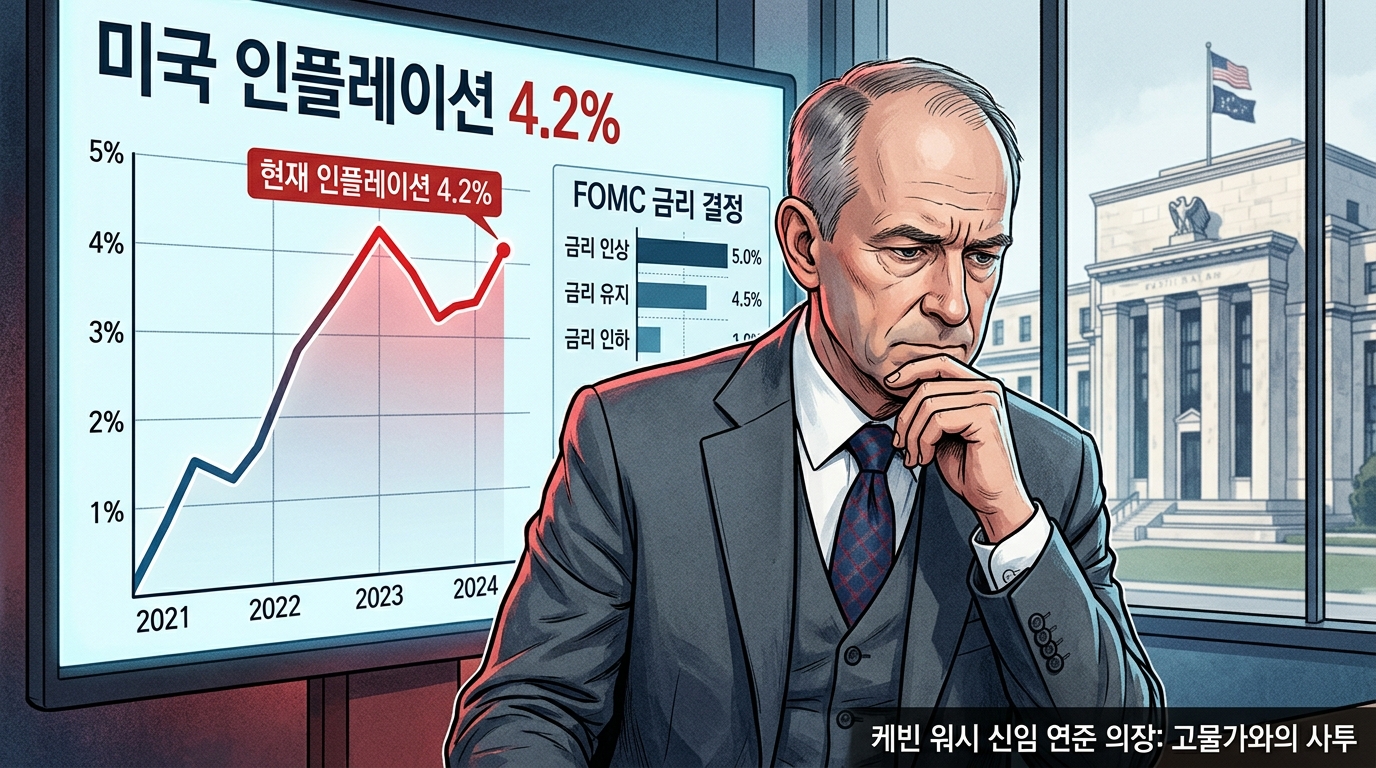
With the recently announced May U.S. Consumer Price Index (CPI) surging to 4.2% year-on-year, marking a three-year high, a major red light has been turned on for the previously expected rate-cut path this year.
While a rate freeze (3.50% to 3.75%) is highly anticipated, market participants are focusing on the stark monetary policy and fundamental decoupling across three major regions: the U.S., Europe, and Asia.
It is time to evaluate the massive shift in global capital flows based on each region's macroeconomic conditions.
Current Situation Summary
[Image: /stdaily/uploads/202606/gen_6a2efaa206ae94.02894416.png]
As of intraday trading on June 15, 2026 (provisional), global financial markets are closely watching the monetary policy debut of Kevin Warsh in extreme suspense. With the U.S. headline CPI jumping to 4.2%, exceeding expectations, the new chair's independence is being put to the test between strong rate-cut pressure from the Trump administration and rising inflation.
Energy shocks caused by geopolitical tensions are sharply driving inflation. This has stalled global liquidity expansion, leading to increased volatility across major stock markets.
Looking at today's intraday financial market movements, the KOSPI is trading around 8,123.62, while the KOSDAQ is at 1,029.05. Meanwhile, the Nasdaq stands at 25,888.84, and the USD/KRW exchange rate continues its high-flying run at 1,519.50 KRW.
Reflecting the overall sentiment of the asset markets, Daily Stock's proprietary Fear & Greed Index captures the market's wariness. The KOSPI Fear & Greed Index is currently in Neutral (43.9), showing a moderate recovery compared to Fear (21.6) one week ago, Greed (65) one month ago, and Fear (32) three months ago.
On the other hand, the Nasdaq Fear & Greed Index points to Fear (34), indicating a visible freeze in investor sentiment compared to Neutral (41.8) one week ago, Greed (65.1) one month ago, and Greed (64.6) three months ago.
Financial Analysis
[Image: /stdaily/uploads/202606/gen_6a2efaab8ff9e2.12806594.png]
Analyzing the details of the economic data, the key driver of this May inflation spike is the energy shock from conflicts in the Middle East. Energy costs surged by 23.5% year-on-year, and gasoline prices rocketed by 40.5%, driving the overall headline inflation rate.
In contrast, Core CPI rose by 0.2% month-on-month, remaining relatively stable. However, as headline inflation reached a three-year high, the struggles of households suffering from a decline in real purchasing power are deepening.
Comparing the macro indicators and policy differences of the three major regions clarifies the decoupling trend. The table below summarizes the latest fundamental and policy alignment data for each region.
| Region | Latest Headline CPI (YoY) | Official Monetary Policy Stance | Economic Fundamentals & Key Indicators | Key Risk Faced |
|---|---|---|---|---|
| **United States (US)** | 4.2% | Freeze Expected (3.50%–3.75%) | Manufacturing/Services PMI remains in expansion | Aftermath of Middle East conflict, oil price surge |
| **Eurozone** | Around 2.5% | Resurging tightening concerns (ECB) | Prolonged contraction in Composite Manufacturing PMI | Stagflation, energy supply disruptions |
| **Asia/China** | Under 1% low inflation | Cautious easing maintained (PBOC) | Delayed domestic demand recovery, manufacturing slowdown concerns | Limits on roundabout foreign investment, tariff barriers |
Valuation
The federal funds rate currently sits at the 3.50% to 3.75% range. As headline CPI climbed to 4.2%, the market's valuation yardstick has adjusted substantially.
Federal funds rate futures in the bond market are currently pricing the probability of a rate cut this year at near-zero. Instead, the market is gradually pricing in the possibility of one or two rate hikes within the year.
This "higher-for-longer" stance supports a strong dollar, pushing the USD/KRW exchange rate up to the 1,519.50 level. As global liquidity accelerates its return to the United States, relative valuations of emerging market equities and fixed-income assets will inevitably face stronger pressure.
Expert & Institutional Analysis
Global investment banks and economists predict that Kevin Warsh's first meeting will trigger a major shift in monetary policy. Anticipation is growing that the Fed will completely remove its long-held "easing bias" phrase from its official policy statement.
Experts believe Warsh is highly likely to take an independent, hawkish path to preserve the Fed's credibility despite rate-cut pressure from President Donald Trump. Scenarios have also emerged suggesting the Fed may overhaul its market communication strategy by ending the release of the Dot Plot or reducing the frequency of press conferences.
Such reform-minded actions could temporarily create information uncertainty in the market. Consequently, many warn this could trigger short-term volatility in bond yields.
Risk Factors
The most direct external risk is a further spike in commodity prices due to supply chain disruptions and geopolitical tensions. Physical clashes between the US and Iran and threats regarding the Strait of Hormuz are squeezing the distribution of key commodities, including oil and copper.
This could morph into stagflation risks that drag down manufacturing fundamentals and continuously fuel global inflation. Additionally, the recurring rumors of either political alignment or discord between the new Fed chair and the White House remain a significant overhang on the market.
If public trust in the central bank's monetary policy is damaged, capital flight from the bond market could materialize. In particular, emerging Asian markets, including South Korea, will face a complex set of challenges, including defending foreign exchange reserves against a surging dollar and coping with shrinking liquidity.
Investment Perspective
We are currently at the peak of a "three-way decoupling" where the US, European, and Asian stock markets are moving entirely independently. While the US economy is weathering high interest rates thanks to its outstanding resilience despite inflation, valuations are somewhat overheated.
Therefore, selective alpha-driven investing is required rather than blindly following market indices. It is reasonable to secure portfolios with high-dividend value stocks that can hedge against rate-hike risks or allocate to inflation-hedging commodity-related assets.
Investors should maintain a conservative position until the Fed's independence and its future policy path are clarified through Chair Kevin Warsh. Rather than chasing rallies based on premature hopes of a rate cut, the best approach is to remain flexible with cash allocations.
Investor Checklist Q&A
[Image: /stdaily/uploads/202606/gen_6a2efab767f2a3.68123135.png]
Q1. What is the policy leaning of the new Fed Chair Kevin Warsh?
A1. Although Warsh has advocated for low interest rates in the past, he is currently assessed as a practical hawk aiming for structural reforms of the Fed and controlling long-term inflation.
Q2. With the May U.S. CPI surging to 4.2%, what is the interest rate decision outlook for the June FOMC?
A2. In this June meeting, the probability of freezing the benchmark rate at the current 3.50% to 3.75% range is overwhelmingly high, and discussions of further cuts are highly likely to be put on hold.
Q3. Why is there such a disparity in investment sentiment between the Nasdaq and the KOSPI under this global decoupling?
A3. The Nasdaq has entered the Fear (34) zone due to valuation pressures on growth stocks from prolonged high interest rates. In contrast, the KOSPI remains in Neutral (43.9), supported by cheap valuations and export expectations, illustrating regional decoupling.
Q4. If the Dot Plot is indeed abolished in the future, what changes will happen to financial markets?
A4. If the Dot Plot disappears, market predictability regarding the future interest rate path will decline, which could significantly increase short-term volatility in bond and foreign exchange markets.
Q5. With the USD/KRW rate surging to 1,519.50 KRW, what risks should individual investors focus on?
A5. Investors must continuously monitor the upward pressure on domestic import prices and the potential of rapid foreign capital outflows, while considering currency-hedged products or foreign-currency assets in their portfolios.