Hello, this is Daily Stock, delivering the core momentum and corporate earnings analysis of the KOSDAQ growth stock market quickly and promptly.
[Image: /stdaily/uploads/202606/gen_6a2fb1885bfb73.04110674.png]
Core Summary
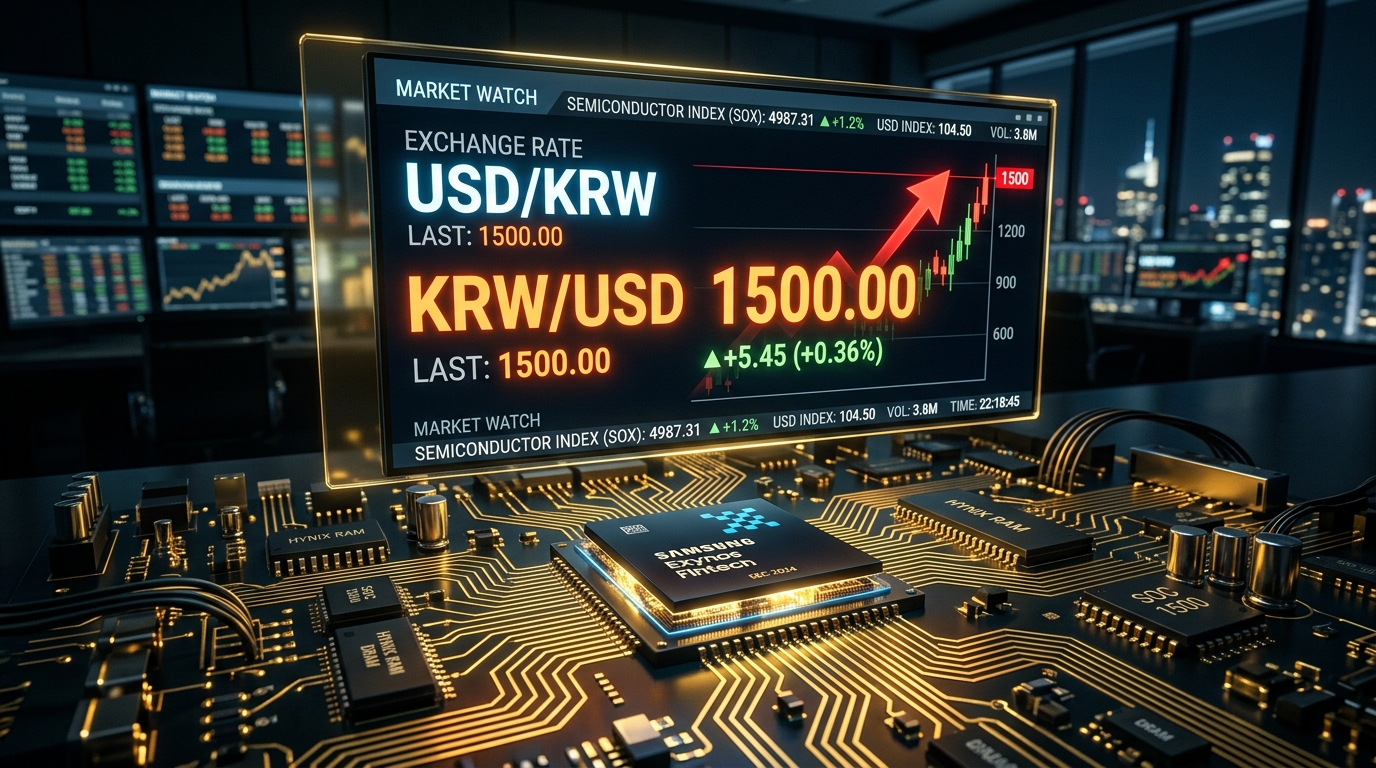
As of June 2026, the ultra-high exchange rate phase continues with the USD/KRW exchange rate hovering around 1,512.20 won. This is reigniting investor interest in export-oriented IT component companies in the KOSDAQ market.
In particular, Simmtech (222800) and MK Electron (033160), which generate 70% to over 90% of their revenues from dollar-based exports, are being compared and analyzed as direct beneficiaries of high-exchange-rate leverage and increased packaging demand driven by global AI and HBM infrastructure rollouts.
Both companies succeeded in turning a profit in terms of operating income in Q1 of this year, emerging from a long slump. However, while Simmtech is focusing on next-generation module boards (SoCAMM) and expanding high-value new products, MK Electron faces the challenge of managing subsidiary-related risks despite its strong bonding wire market dominance, leading to different investment scenarios.
Current Status Summary
Following news of a breakthrough peace agreement between the United States and Iran, domestic stock markets showed strong closing performance on June 15 on resolved uncertainties, with the KOSPI at 8,545.98 and the KOSDAQ at 1,034.03.
The soaring USD/KRW exchange rate eased slightly due to the mitigation of external risk factors, closing at 1,512.20 won for the day. However, it still remains in the historically very high 1,500 won range.
While this high exchange rate trend increases raw material cost burdens, it serves as a key supporting factor for the margins of IT packaging and material export companies that recognize most of their revenue in dollars.
Within the KOSDAQ market, a tectonic shift is being observed as the market cap share of semiconductors and IT hardware surpassed healthcare (biotech)—the previous dominant sector—for the first time. This suggests that investment flows could rapidly concentrate on companies where the external environment aligns with an earnings turnaround.
For reference, according to our proprietary Fear & Greed Index, the KOSPI Fear & Greed Index is currently in the Neutral zone (53.7, compared to 21.6 Fear a week ago, 65 Greed a month ago, and 32 Fear three months ago).
On the other hand, the Nasdaq Fear & Greed Index is currently in the Fear zone (34, compared to 41.8 Neutral a week ago, 65.1 Greed a month ago, and 64.6 Greed three months ago), indicating that investor wariness regarding global macroeconomic variables has not fully dissipated.
Financial Analysis
A comparison of the recent financial performance and key metrics of these two representative KOSDAQ IT component and back-end material companies reveals the following:
| Comparison Item (2026 Outlook & Recent Results) | Simmtech (222800) | MK Electron (033160) |
|---|---|---|
| **Core Product Area** | Memory module PCBs, package substrates (MCP, SiP) | Bonding wires for semiconductor packaging, solder balls |
| **Export & USD Revenue Share** | Over 90% of total revenue | Over 70% of total revenue (Parent & China subsidiary combined) |
| **Q1 2026 Results** | Revenue: 422.4B KRW / Operating Income: 13.7B KRW (Turned to profit) | Revenue: 450.1B KRW / Operating Income: 15.1B KRW (Turned to profit) |
| **Full-Year 2026 Outlook (E)** | Revenue: 1.75T–1.89T KRW / Operating Income: 130B–170B KRW range | Revenue: Over 1.5T KRW / Firm turnaround to profitability led by core business |
| **Core Growth Driver** | Full-scale mass production of next-gen SoCAMM module boards, expanding GDDR7 share | Expanding share of high-reliability materials for HBM and automotive |
Simmtech put an end to its long stagnant phase in Q1 of this year by recovering to revenue of 422.4 billion won and an operating income of 13.7 billion won, beginning a full-scale turnaround.
Despite ongoing pressure from raw material cost increases, the company is evaluated to have entered a structural earnings recovery phase by adjusting its exposure to low-value products like Tenting and strengthening its product mix with high-performance memory modules and mobile substrates.
MK Electron also achieved a joint turnaround, posting consolidated Q1 revenue of 450.1 billion won and operating income of 15.1 billion won.
However, while MK Electron is driving robust growth in its core business utilizing its position as the global No. 1 in bonding wire market share, its financial structure involving subsidiaries still poses non-operating volatility.
[Image: /stdaily/uploads/202606/gen_6a2fb195355b38.90523873.png]
Valuation
Simmtech's historical PER was temporarily obscured by accumulated losses from the past industry downturn. However, applying the consensus 2026 estimated earnings per share (EPS) of 3,551 won puts its forward PER at approximately 37.5x.
Market analysts note that a performance-driven scenario could play out where forward valuation pressures rapidly ease as 2027 estimated EPS is projected to grow to 4,612 won.
Currently, Simmtech's PBR stands at around 7.09x, reflecting a somewhat high premium for securing a dominant position in the next-generation substrate market early on.
In the case of MK Electron, its current PBR is around 1.55x, which remains undervalued on paper compared to its asset value and global top-tier component technology.
However, this valuation discount is considered to reflect investor concerns regarding non-semiconductor risks associated with its subsidiaries rather than its core business, requiring a conditional investment approach.
Expert & Institutional Analysis
Securities analysts predict that Simmtech's growth momentum in the second half of the year depends on the speed of mass production in the SoCAMM market, a low-power substrate standard for mobile devices.
SoCAMM is highlighted as an unprecedented growth opportunity in terms of addressable market (TAM), fueled by the trend of applying mobile DRAM to servers and high-performance devices.
Furthermore, as a cyclical substrate powerhouse with the world's top three memory makers—Samsung Electronics, SK Hynix, and Micron—as core clients, Simmtech is positioned to show the strongest operating leverage as upstream utilization rates recover.
For MK Electron, experts view the portfolio improvement favorably, driven by the expansion of ancillary memory structures for HBM, silver-alloy bonding wires, and high-margin automotive materials.
Nonetheless, the consensus is that a genuine valuation normalization will require stabilizing the contingent liabilities of its construction and finance subsidiaries, which have been dragging down consolidated earnings regardless of the core business's healthy cash flow.
Risk Factors
Since both companies have substantial raw material import shares, abnormal surges in international gold and copper prices act as cost-increasing risks that could partially erode the benefits of a weak Korean won.
If the USD/KRW exchange rate rapidly falls from the 1,512 won level to the mid-1,400 won level or lower due to easing geopolitical tensions, the scenario of smaller-than-expected currency translation gains cannot be ruled out.
For MK Electron, despite the favorable earnings recovery in its semiconductor business, the potential realization of real estate contingent liabilities from its subsidiary Korea Land Trust and the drop in its current ratio (under 100%) due to surging short-term borrowings remain pressures on internal cash flow.
For Simmtech, if the commercialization and mass production of new products are delayed, there is a risk of short-term volatility relative to the high growth expectations already priced into the substrate market.
Investment Outlook Summary
The unusual high exchange rate environment of the 1,500 won range is acting as a powerful profit buffer for domestic memory packaging substrate and front-end/back-end equipment, parts, and materials stocks, which have dominant dollar-denominated settlement shares.
Simmtech is structured to benefit from a typical, pure semiconductor substrate turnaround, acting as an industry leader highly correlated with next-generation standard transitions and legacy utilization rate recoveries.
Conversely, MK Electron exhibits a complex structure where its stock price moves in tandem with the resolution of short-term financial risks in its construction and trust subsidiaries, despite its exceptional core business improvement supported by high exchange rates and unrivaled market share.
A two-track monitoring approach—closely observing foreign exchange market trends, upstream semiconductor line utilization rates, and the resolution of company-specific risks—appears appropriate.
[Image: /stdaily/uploads/202606/gen_6a2fb1a02e08e3.47923298.png]
Investor Checklist Q&A
Q1. How much does the high USD/KRW exchange rate affect the operating profit of IT component companies?
A1. Export contracts are settled in USD, meaning that when the exchange rate rises, the revenue recognized in KRW expands, and direct foreign exchange gains are added directly to operating margins, maximizing leverage.
Q2. Is Simmtech's next-generation module board (SoCAMM) growth actually viable?
A2. As low-power memory for mobile devices expands into high-spec product groups like servers, substrate adoption is accelerating. Once full-scale mass production begins in the second half of this year, it is analyzed as a structural momentum that will drive a large portion of revenue growth.
Q3. Why are consolidated financial risks being highlighted for MK Electron compared to its parent-only performance?
A3. While the semiconductor materials division, including silver-coated wires and alloy materials, is performing well, its subsidiary Korea Land Trust (active in construction and trust business) has recognized large bad debt provisions on loan receivables, making the refinancing of short-term borrowings a key checklist item.
Q4. Besides exchange rate benefits, what is a common cost burden factor for both companies?
A4. If global prices for gold and copper—essential for maximizing substrate conductivity and manufacturing precious metal bonding wires—skyrocket, cost increases will follow. Whether they can adequately pass this on to selling prices is key to defending margins.
Q5. If the exchange rate falls further, will the turnaround momentum of both companies be halted?
A5. While there would be some impact from the reduction of bonus margins from a high exchange rate, the fundamental earnings driver lies in volume increases from inventory reductions in the upstream semiconductor industry and the AI memory investment boom. Therefore, volume trends besides the exchange rate should also be carefully monitored.