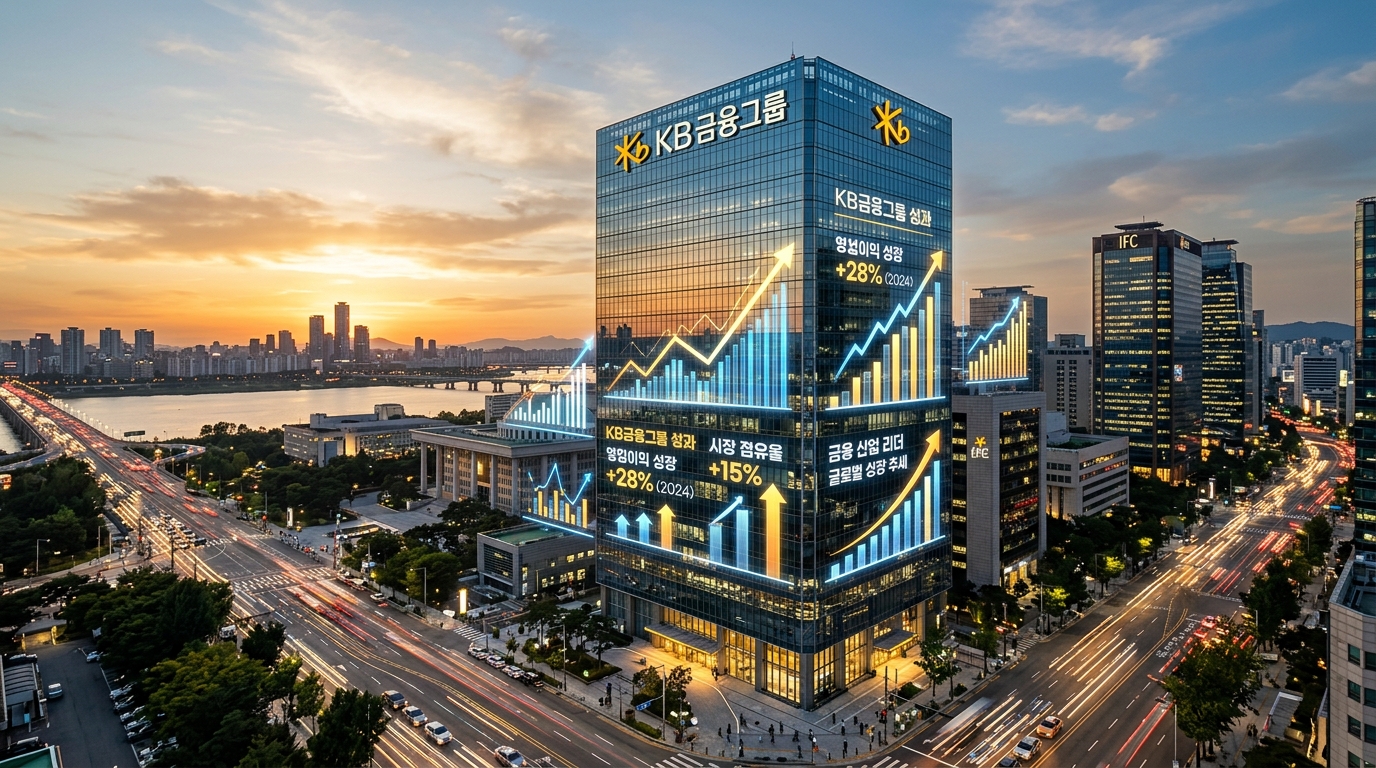
Hello, this is Daily Stock, where we precisely analyze corporate value amid the massive flow of capital markets and the government's Value-up policies.
[Image: /stdaily/uploads/202606/gen_6a2e51ea086659.35112920.png]
Executive Summary
KB Financial Group (105560), which has recently emerged as a leader in the financial sector's 'Value-up' initiative, is showing unprecedented steps in shareholder return, including the full cancellation of its remaining treasury shares of approximately 3.8%.
At the same time, the group announced its net profit for the first quarter of 2026 reached KRW 1.8924 trillion, achieving its highest-ever quarterly performance.
With additional treasury stock buybacks and cancellations of over KRW 600 billion highly anticipated for the second half of the year, this year's total shareholder return rate is expected to exceed 55%.
However, the super-high exchange rate environment with the USD/KRW rate hovering at 1,519.50 KRW and whether credit costs can be kept under control will remain key variables for future stock price volatility.
Current Market Status
As of the market close on June 12, 2026, KB Financial Group's share price closed at 161,200 KRW, jumping 6.40% from the previous trading day.
On this day, the KOSPI closed at 8,123.62 and the KOSDAQ at 1,029.05, with large-cap banking stocks strongly driving the rally amid an overall index surge.
According to Daily Stock's proprietary Fear & Greed Index, the KOSPI Fear & Greed level currently stands at a neutral 43.9.
While this indicates a recovery in buying sentiment compared to the "Fear" level (21.6) recorded a week ago, it is still below the "Greed" level (65) from a month ago, suggesting that investors are continuing to take a wait-and-see approach.
In the global market, the Nasdaq Fear & Greed Index is currently pointing to "Fear" (34), meaning macroeconomic tensions remain elevated.
Under these circumstances, KB Financial Group is forming a solid defense against supply-demand headwinds, supported by expectations of reversing provisions/fines related to Hong Kong H-Index ELS (equity-linked securities) and the government's tax incentive policies for corporate value-up programs.
Financial Analysis
KB Financial's Q1 2026 net profit rose 11.5% year-on-year to KRW 1.8924 trillion, once again proving its robust fundamental strength.
In particular, commission income in the securities division surged, expanding the non-banking subsidiaries' contribution to group net profit to 43% and demonstrating the benefits of a well-balanced portfolio.
In 2025, cumulative net profit reached KRW 5.8430 trillion with an ROE of 10.86%.
This year, supported by moderate loan asset growth and improvements in Net Interest Margin (NIM), the adjusted ROE is projected to surpass 11%, potentially breaking a 15-year record.
| Classification | FY 2025 Cumulative (Actual) | Q1 2026 (Actual) | Q2 2026 (Forecast) |
|---|---|---|---|
| Net Profit | KRW 5.8430 trillion | KRW 1.8924 trillion | Approx. KRW 1.9700 trillion |
| CET1 Ratio | 13.79% | 13.63% | Approx. 13.73% |
| Quarterly Dividend per Share (DPS) | 1,605 KRW (Q4) | 1,143 KRW | TBD (Before closing) |
| Core Shareholder Return Policy | Achieved annual total shareholder return of 52.4% | Resolved to cancel all remaining 3.8% treasury shares | Expectations of additional treasury buybacks in H2 |
[Image: /stdaily/uploads/202606/gen_6a2e51f3d8d4e7.42182518.png]
Valuation
KB Financial Group possesses the most advanced Common Equity Tier 1 (CET1) ratio management capability among major financial holding companies, justifying a valuation premium.
The Q1 dividend was resolved at 1,143 KRW per share, and because the number of outstanding shares will decrease by more than 6% compared to the end of last year due to the treasury stock cancellation, earnings per share (EPS) is expected to show a sharp upward trajectory.
Although its market capitalization has fluctuated recently due to the stock rally, Korean financial stocks' PBR still hovers around 0.81x compared to the average PBR of banking holdings in developed nations, leaving the stock widely considered undervalued.
If tax-free dividends through the reduction of statutory capital reserves—amounting to roughly KRW 12 trillion—are executed in earnest, the actual dividend yield for individual investors could rise substantially over the long term.
Expert & Institutional Analysis
Securities market experts project that KB Financial's Q2 net profit will reach KRW 1.9700 trillion, marking the highest performance since the establishment of the holding company and significantly beating the consensus.
Hana Securities, in a recent report, raised its target price for KB Financial by 10% from 200,000 KRW to 220,000 KRW, maintaining its "Top Pick" recommendation.
LS Securities also presented a scenario where approximately KRW 110 billion of the ELS fines, which acted as a one-off negative factor in Q1, will be reversed in Q2, indicating extremely high earnings momentum.
Hanwha Investment & Securities shared the view that due to the overlapping effects of treasury stock buybacks and cancellations, this year's EPS growth rate could reach nearly 22%, significantly outperforming peer banking holding groups.
Risk Factors
The most immediate risk is the super-high exchange rate, which remains at 1,519.50 KRW.
If the exchange rate fails to stabilize downward from its current level, mechanical net selling by foreign investors due to the rebalancing of Korean large-cap portfolios could put downward pressure on the stock price.
Additionally, if financial authorities tighten household loan restrictions and intensify pressure on "win-win financial contribution" programs, the Net Interest Margin (NIM), which is the core profit engine of banks, may slow down in the second half of the year.
The burden of setting aside bad debt provisions due to residual risks from real estate Project Financing (PF) and concerns over global credit crunches must also be closely monitored in long-term investment scenarios.
[Image: /stdaily/uploads/202606/gen_6a2e5200009e90.55466901.png]
Investment Perspective Summary
Beyond being a simple dividend stock, KB Financial is evolving into a global-standard corporate model for maximizing shareholder value by combining treasury stock buybacks/cancellations with solid earnings power.
However, in the short term, the price of 161,200 KRW, which rose 6.40% rapidly, may trigger profit-taking demands, indicating that dispersing entry points would be prudent.
In the medium to long term, a high ROE of around 10% and a total shareholder return rate target of over 55% will serve as a strong support floor for the valuation. Even in a scenario of exchange rate volatility and supply-demand slowdowns in the macroeconomic environment, the decrease in outstanding shares from treasury stock cancellations will remain a powerful defense weapon.
Investor Checklist Q&A
Q1: What is KB Financial's Q1 2026 dividend per share and its recent dividend schedule?
A1: KB Financial's Q1 cash dividend was 1,143 KRW per share. The ex-dividend date was May 7, 2026, and the payment date was May 21, 2026.
Q2: What is the significance of the decision to cancel all remaining treasury shares?
A2: The group resolved to cancel all 14.26 million shares (approximately 3.8% of outstanding shares). This represents the largest cancellation in the industry, reflecting management's strong commitment to enhancing shareholder value.
Q3: What are the specific reasons behind the expectation of a significant net profit increase in Q2 2026?
A3: This is due to bank won-denominated loans growing by 0.9% quarter-on-quarter, NIM expected to improve by about an additional 2bp, and a scenario involving the partial reversal of the Hong Kong ELS fines, which could push net profit to nearly KRW 1.97 trillion.
Q4: What is the expected total shareholder return rate for 2026?
A4: Even excluding the special treasury stock cancellation effect, the ordinary shareholder return rate based on expected additional treasury buybacks and dividend resources this year is projected to reach approximately 55% to a maximum of 57%.
Q5: What impact does the high exchange rate (1,519.50 KRW) have on KB Financial's stock price?
A5: A surging exchange rate leads to a weaker Won, raising foreign exchange loss concerns among foreign investors. This is a prominent external risk factor that can increase supply-demand selling pressure on large-cap stocks.