Hello, this is the financial writer for Daily Stock.
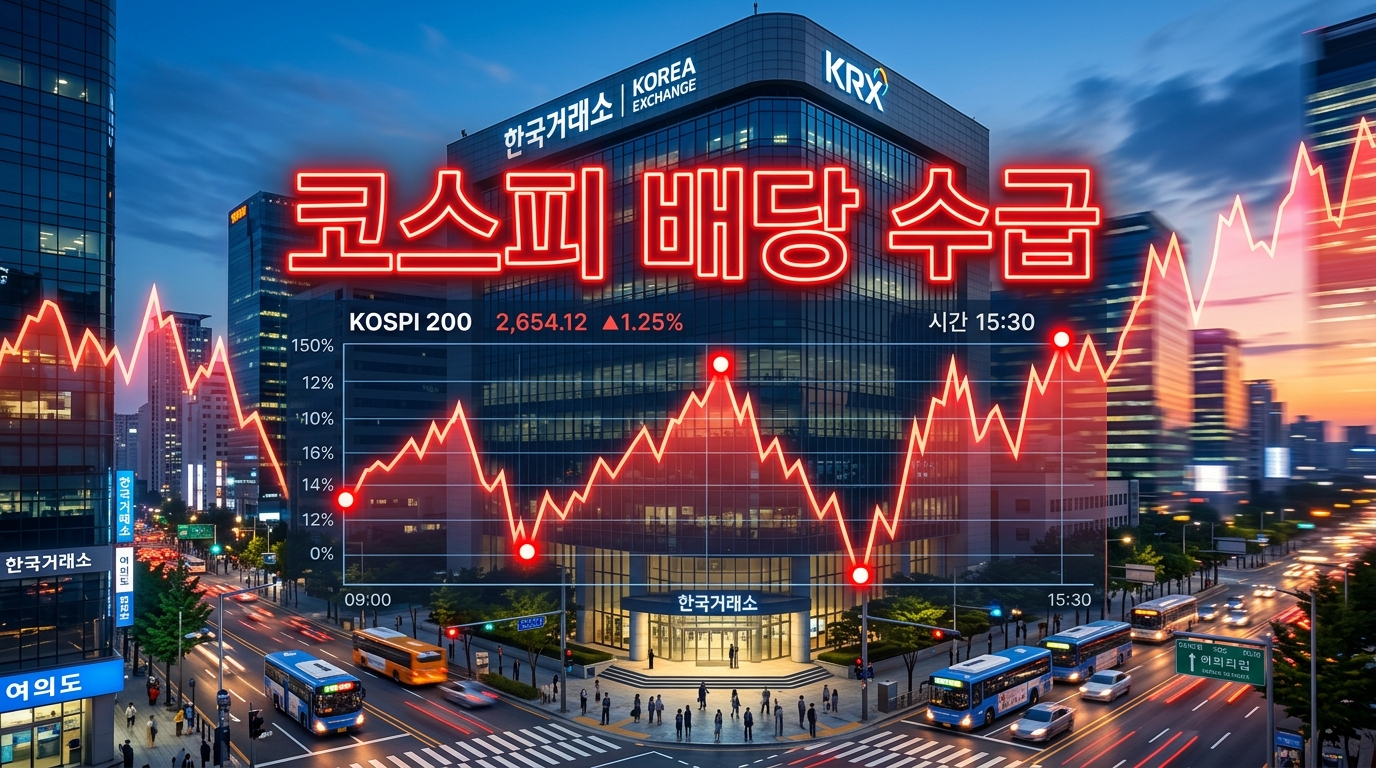
Today (June 26, 2026), the Korean stock market entered a breathing spell, with the KOSPI closing at 8,411.21 amid a fierce tug-of-war between foreign and institutional investors ahead of the semi-annual dividend record date.
[Image: /stdaily/uploads/202606/gen_6a3e23f38f2426.41822396.png]
Key Summary
- **Last Train for Semi-Annual Dividends**: To meet the dividend record date of June 30, today (June 26)—based on the T+2 settlement cycle—was the final day to purchase shares to receive dividends.
- **Institutional Arbitrage Patterns**: Around the ex-dividend date (June 29), institutions (especially financial investment firms) tend to execute buying program trades in the spot market and sell futures (short arbitrage trading), then unwind these positions after the ex-dividend date.
- **Sidelined High-Dividend ETFs**: Due to the concentration of liquidity into leading sectors like semiconductors and interest rate burdens, high-dividend ETFs experienced short-term weakness, recording double-digit declines in June.
- **Macro & Investor Sentiment**: Under a high exchange rate environment where the USD/KRW rate reached 1,538.30 won, the futures-linked supply and demand of foreign investors is acting as a factor amplifying stock market volatility.
Market Overview
On June 26, 2026, the KOSPI index closed at 8,411.21 after a minor correction compared to the previous day.
The USD/KRW exchange rate remained at a elevated level, hovering around 1,538.30 won.
Market volatility has heightened further due to overlapping geopolitical uncertainties and global portfolio rebalancing issues.
At the same time, the KOSDAQ index also closed at 851.37, as liquidity shifts quickly unfold in the small-to-mid-cap market.
Particularly, ahead of the semi-annual and quarterly dividend record dates set for June 30 by major conglomerates, the battle for supply and demand was intense until the end of today's (26th) trading session, which is the actual deadline to acquire shares.
Normally, funds should flow into high-dividend stocks during this period. However, a unique pattern is being observed where traditional high-dividend stocks and related ETFs are instead weakening due to the continued concentration in AI semiconductor sectors and the prolonged high-exchange-rate environment.
According to Daily Stock's proprietary Fear & Greed Index, the KOSPI Fear & Greed Index currently stands at 41.7, indicating a "Neutral" stage.
This is slightly contracted compared to "Neutral (53.4)" a week ago and "Neutral (56.2)" a month ago, but maintains a stable footing compared to the "Extreme Fear (17)" observed three months ago.
On the other hand, the Nasdaq Fear & Greed Index is currently at 25.5, entering the "Fear" territory.
This reflects a more frozen sentiment than last week's "Fear (31.6)", contrasting sharply with the "Greed (60.9)" of a month ago and "Greed (63)" of three months ago, which is also putting pressure on domestic tech stock flows.
Financial Analysis
The fundamental financial health and earnings power of major KOSPI dividend stocks and high-dividend ETFs remain sound.
However, during the month of June, high-dividend ETFs heavily weighted with financial and brokerage stocks suffered sharp price corrections exceeding 10%.
The following table summarizes the performance of major high-dividend ETFs and the short-term stock price trends of their constituent stocks in June.
| ETF & Stock Name | June Return (As of June 25) | Key Features & Financial Factors |
|---|---|---|
| HANARO Stock High Dividend TOP3 Plus | -19.15% | Concentration of short-term profit-taking in brokerage stocks |
| PLUS High Dividend Stock | -13.40% | Vulnerable to interest rate volatility due to high exposure to financial holdings |
| KB Financial Group (Major Component) | Intraday drop to 145,000 won range | Correction of about 19% from its peak (182,700 won) |
| Hyundai Motor (Quarterly Dividend) | Increased short-term volatility | Strong earnings and expectations for India unit IPO, but affected by short-term supply/demand |
This weakness in the high-dividend sector is attributed to institutional program selling mediated through the futures market and the flow concentration in semiconductors, rather than any damage to corporate earnings outlooks.
In particular, because the separate taxation of dividend income and the Corporate Value-up Program serve as long-term drivers, the free cash flow (FCF) and dividend payout ratios of individual companies remain robust.
Valuation
Ironically, due to the recent decline in the stock prices of high-dividend KOSPI companies, the expected dividend yield has risen to a more attractive level.
As the transition from the traditional December-focused payout to quarterly payouts (March, June, September) accelerates, the index distortion effect caused by the year-end ex-dividend drop has eased somewhat compared to the past.
Nonetheless, ahead of the late June semi-annual ex-dividend date (June 29), the theoretical cash ex-dividend index evaluated by the market still acts as a short-term stock price adjustment factor.
Particularly, with the high exchange rate of 1,538.30 won, foreign investors are taking short positions in the futures market instead of the spot market to hedge against foreign exchange losses, creating opportunities for program arbitrage trading.
While the Nasdaq index increases volatility around the 25,358.60 level, the price-to-earnings ratio (PER) and price-to-book ratio (PBR) of large Korean value stocks remain at historical lows compared to global valuations, securing downside support.
Expert & Institutional Analysis
Major securities analysts define the supply-demand pattern before and after this June ex-dividend date as "mechanical trading by financial investment institutions linked to changes in the basis between futures and spot prices."
Institutional investors, particularly financial investment firms, establish "short arbitrage trades" by purchasing spot shares and simultaneously selling KOSPI 200 futures before the dividend record date to secure the dividends.
[Image: /stdaily/uploads/202606/gen_6a3e240226e794.75822596.png]
On the ex-dividend date (29th), as unpaid dividends are added to the Net Asset Value (NAV) or the index opens lower by the theoretical ex-dividend amount, they unwind their existing short futures and long spot positions.
During this process, large-scale program selling is highly likely to hit the market, exerting temporary downward pressure on the index.
However, major institutions such as Meritz Securities evaluated that "this is merely a temporary phenomenon due to year-end global portfolio rebalancing and ETF supply-demand mismatches, and the resulting decline in the index does not mean the long-term trend is damaged."
In other words, a scenario is gaining ground that the mechanical selling on the ex-dividend day actually provides a "contrarian buying opportunity" to cheaply acquire large-cap stocks with solid fundamentals.
Risk Factors
The biggest risk factor is the acceleration of foreign capital outflows due to the prolonged high-exchange-rate environment.
With the USD/KRW exchange rate well above the 1,530 won range, foreign investors may face exchange losses that outweigh their dividend yields, which could lead them to sell off stocks before receiving dividends.
In addition, in a highly volatile market where the KOSPI fluctuates around 8,411.21, if margin loan balances remain high, there is a risk that temporary stock price drops on the ex-dividend date could trigger margin calls, further amplifying volatility.
Although tax reform plans such as the separate taxation of dividend income are being implemented, avoidant selling by major individual shareholders due to financial income tax thresholds remains an influential variable.
[Image: /stdaily/uploads/202606/gen_6a3e2410737493.22007178.png]
Investment Perspective Summary
Supply-demand changes around the semi-annual ex-dividend date are a unique seasonal feature of the Korean stock market and a window for arbitrage opportunities.
Since the temporary program selling pressure that may occur on the ex-dividend date (29th) is a mechanical supply-demand distortion rather than fundamental damage, a scenario of utilizing this as an opportunity to buy high-quality, high-dividend stocks at a low price remains valid.
However, investors must monitor exchange rate trends and whether foreign investors pivot to net buying in the futures market. It is also necessary to carefully check the individual schedules of companies with diversified quarterly dividend record dates.
Focusing on large-cap value stocks with sufficient mid-to-long-term shareholder return capacity based on stable dividend payout tendencies can serve as an alternative defensive strategy in a volatile market.
Investor Checklist Q&A
Q1. By when exactly do I need to buy stocks to receive the June semi-annual dividend?
A1. If the dividend record date is June 30, you must hold the stock by the close of the market on June 26 (today), which is two business days prior, to be normally registered on the dividend shareholder list.
Q2. Why does the stock price drop on the morning of the ex-dividend date (June 29)?
A2. Since new buyers no longer have the right to receive the semi-annual dividend, the opening price is artificially adjusted downward by the expected dividend amount.
Q3. Why did high-dividend ETFs plunge recently despite the strength of the KOSPI?
A3. Capital exited high-dividend ETFs, which have a heavy concentration of traditional value stocks like financials, because market liquidity excessively rotated into large-cap growth stocks like AI and semiconductors.
Q4. How does institutional program trading around the ex-dividend date affect the market?
A4. Institutions show net buying in the spot market until just before the ex-dividend date. On the ex-dividend day, they begin to unwind these positions, triggering large program selling that temporarily depresses the index.
Q5. How does the foreign dividend flow change when the exchange rate is high (above 1,530 won)?
A5. Under a high exchange rate, foreign exchange loss concerns grow. Foreign investors may choose hedging transactions through the futures market or reduce their stock exposure rather than receiving dividends, adding pressure to the supply-demand balance.