Hello, this is Daily Stock.
Today, we provide an in-depth analysis of the recent Azure growth rate and the massive infrastructure investment trends of Microsoft (MSFT), a leader in the global cloud market and artificial intelligence (AI) innovation.
Executive Summary
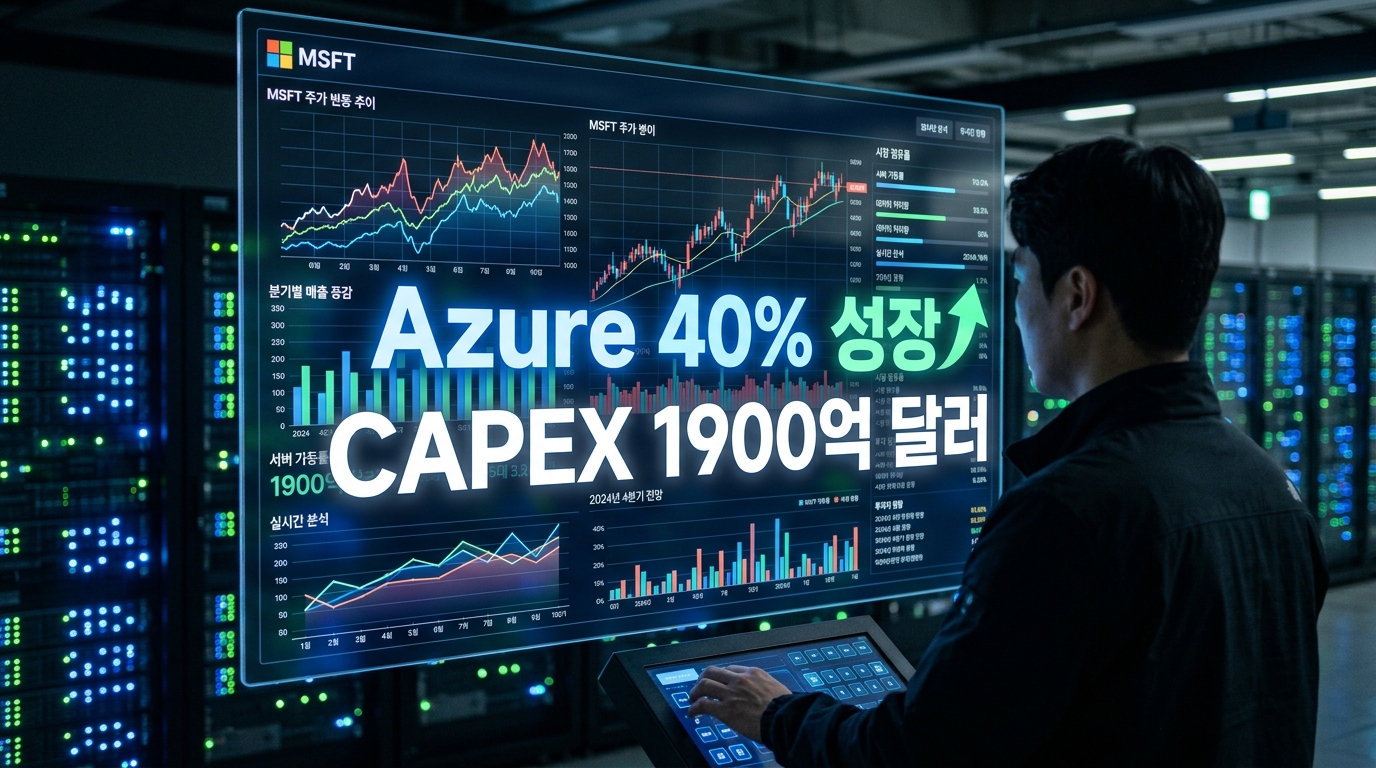
In its latest earnings release, Microsoft dispelled market concerns as its Azure cloud division recorded a growth rate of 40%.
However, with the announcement of a record-breaking capital expenditure (CAPEX) plan reaching approximately $190 billion annually, market doubts regarding long-term cost burdens have also been raised.
The key debate is whether aggressive investment in AI infrastructure will drive Microsoft's future growth acceleration or act as a short-term margin drag.
Current Status Overview
As of the close on June 12, 2026, Microsoft (MSFT) shares closed at $388.21.
This represents a significant correction from its 52-week high of $555.45, bringing its market capitalization on that day to approximately $2.754 trillion.
Currently, the Nasdaq Fear and Greed Index stands at the 'Fear (34)' level.
Market sentiment, which was Neutral (41.8) one week ago and Greed (65.1) one month ago, appears to have weakened recently in tandem with the correction in technology stocks.
On the other hand, the domestic KOSPI Fear and Greed Index is currently at a 'Neutral (43.9)' level.
Some analysts suggest that concerns over global interest rate volatility and excessive infrastructure spending have fueled the tech-heavy Nasdaq sell-off.
[Image: /stdaily/uploads/202606/gen_6a2c9df1698ed7.69677024.png]
Financial Analysis
For the third quarter of fiscal year 2026 (January–March), Microsoft’s total revenue increased 18% year-over-year to $82.9 billion.
This was a robust performance that easily exceeded the market consensus of $81.4 billion.
Azure and other cloud services revenue, which garnered the most attention, led the performance with high growth of 39% in constant currency and 40% in reported terms.
The company's annual AI business revenue run rate also surged 123% year-over-year to exceed $37 billion.
| Indicator | FY26 Q3 Actual | Consensus | Year-over-Year (YoY) |
|---|---|---|---|
| **Total Revenue** | $82.9 billion | $81.4 billion | +18% |
| **Earnings Per Share (EPS)** | $4.27 | $4.06 | +21% (Non-GAAP) |
| **Azure Revenue Growth** | 40% | 39% | Sequential Acceleration |
| **AI Business Run Rate** | $37 billion+ | - | +123% |
| **Quarterly CAPEX** | $31.9 billion | - | Continuous Expansion |
However, behind this immense growth, rapidly climbing infrastructure costs are emerging as a risk factor.
The company deployed $31.9 billion in CAPEX in this quarter alone and guided for a total investment of around $190 billion for the full fiscal year 2026.
In particular, rising component costs and high-bandwidth memory prices are expected to add approximately $25 billion in expenses.
Still, the massive commercial remaining performance obligation (RPO) balance of $627 billion provides a stable foundation for long-term contracts.
Valuation
Due to the recent stock correction, Microsoft's forward price-to-earnings (P/E) ratio has eased to a range of 23x to 26x.
Compared to the multiples seen during the peak of the previous AI rally, overvaluation concerns have been largely alleviated.
Notably, the stock's consolidation within a strong support band between the mid-$370s and $410s demonstrates its technical defensiveness.
If the AI infrastructure, where vast capital has been deployed, begins to prove its material contribution to revenue, there is room for a rerating of the multiple.
[Image: /stdaily/uploads/202606/gen_6a2c9dfdd303f4.64900669.png]
Expert & Institutional Analysis
Amid high expectations from the market, portfolio adjustments by major institutional investors have diverged sharply.
Pershing Square, led by Bill Ackman, executed a massive new purchase of approximately $2 billion, viewing the long-term valuation as compelling.
Ackman believes Microsoft is highly likely to be a monopolistic beneficiary under a long-term cloud dominance scenario.
Conversely, David Tepper's Appaloosa Management slashed its stake by 82%, wary of the heavy pressure from infrastructure depreciation costs.
Most Wall Street analysts maintain a 'Strong Buy' rating.
This is because Azure's growth rate has the potential to accelerate further in the second half of 2026 and beyond, when capacity supply constraints are expected to ease gradually.
Risk Factors
The most direct risk factor is a decrease in CAPEX efficiency due to supply bottlenecks and rising prices of memory semiconductors.
Approximately $25 billion of the projected increase in capital expenditures for 2026 is evaluated as a cost burden driven by higher component unit prices.
Despite explosive pent-up demand from enterprises, the physical speed of hardware supply failing to keep up is another challenge to overcome.
If the monetization of generative AI service models lags behind the pace of infrastructure spending, margin pressure could persist.
Additionally, the fact that global regulatory bodies are closely scrutinizing big tech companies' monopoly power in the AI market remains a factor that could cap long-term multiples.
[Image: /stdaily/uploads/202606/gen_6a2c9e090752a3.02823293.png]
Investment Outlook Summary
Microsoft's Azure growth has returned to the 40% range, proving once again the viability of its powerful cloud moat.
However, it is clear that an unprecedented CAPEX plan of $190 billion will place a temporary burden on short-term free cash flow.
Nonetheless, the growth rate of agentic AI businesses and the paid subscriber base for Copilot, which has surpassed 20 million, cannot be ignored.
Investors will need to carefully weigh the short-term depreciation and cash flow slowdown scenario against the long-term AI infrastructure leadership scenario.
Investment Checklist
- **What is Azure’s recent quarterly growth and future guidance?**
The company recently achieved a growth rate of 40%, and guided that next quarter's growth will remain solid at around 39% to 40% in constant currency.
- **What is the actual projected total CAPEX for fiscal year 2026?**
Total capital expenditure for this year is projected to be around $190 billion, with surging component unit prices being one of the major drivers of cost pressure.
- **How are the recent movements of global institutional investors diverging?**
Bill Ackman purchased approximately $2 billion worth of shares, while David Tepper reduced his position by 82% due to margin concerns.
- **Is there tangible progress in generative AI monetization?**
The number of paid subscribers for Microsoft 365 Copilot surpassed 20 million, marking a 250% increase year-over-year.
- **Is the current valuation (P/E) attractive compared to historical bands?**
Following the recent stock price correction, the forward P/E has stabilized to a range of 23x to 26x, reducing the relative multiple premium.