Hello. This is Daily Stock.
We provide clear insights to investors by delivering in-depth analyses of key global financial market issues.
[Image: /stdaily/uploads/202607/gen_6a4458d4cbc3f9.11190556.png]
---
Executive Summary
Tesla (TSLA) is putting its artificial intelligence (AI) and energy storage system (ESS) businesses at the forefront to break through the stagnation in the electric vehicle (EV) market.
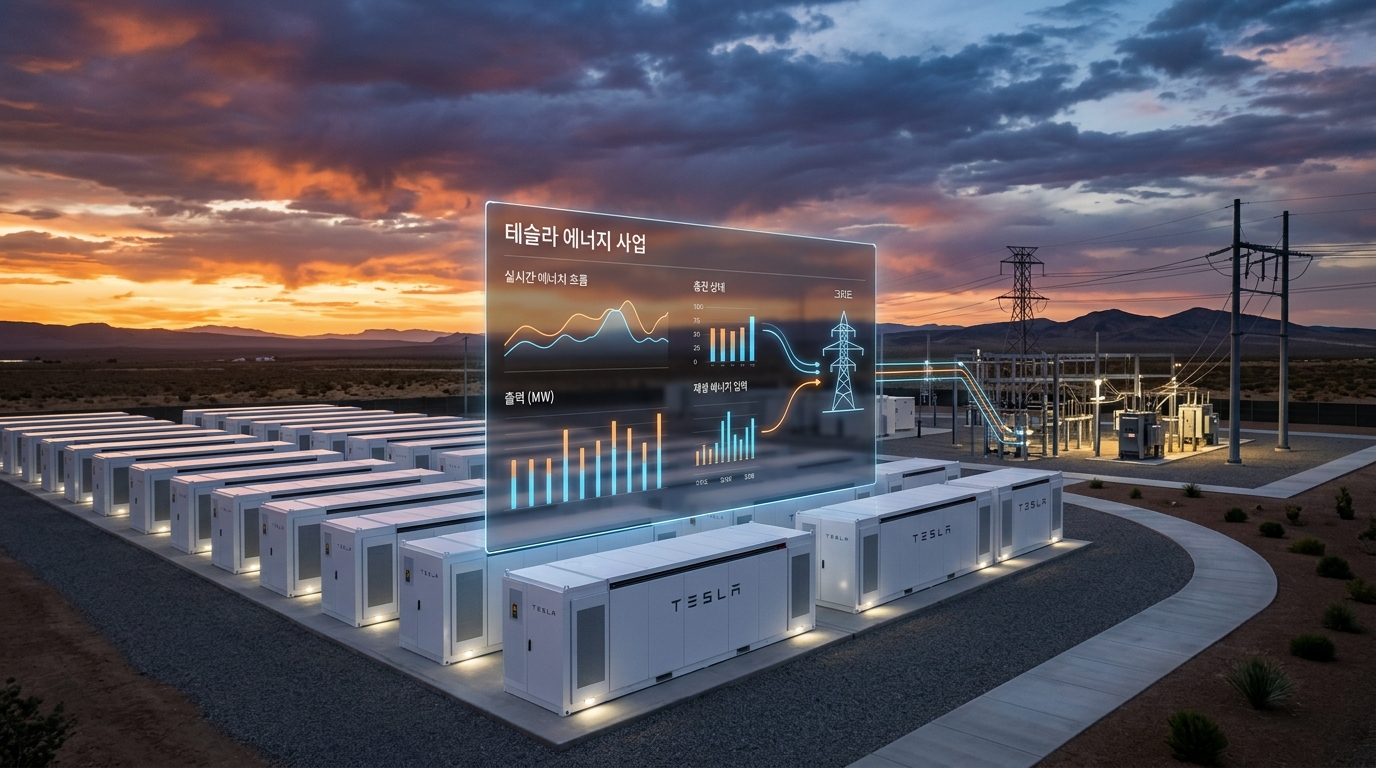
Its recent $5 billion, 25GWh Megapack supply deal with European energy developer NatPower proves Tesla Energy's unrivaled position in the market.
The ESS segment, driven by Megapack and Powerwall, is emerging as a new cash cow, posting robust gross margins exceeding 28% annually.
For Q2 2026, the energy segment's consensus expects 13.8GWh of installations, forecasting a strong V-shaped recovery compared to the previous quarter.
---
Market Update
As of intraday trading today on July 1, 2026 (provisional), the South Korean financial market shows the KOSPI at 8543.20, the KOSDAQ at 921.82, and the USD/KRW exchange rate trading at 1549.00 KRW.
The US Nasdaq index stands at 26213.72, maintaining a tight trading range.
According to Daily Stock's proprietary Fear & Greed Index, the KOSPI Fear & Greed is currently in the Neutral (43) stage, showing a wait-and-see sentiment similar to last week (40.2) and a month ago (59.1).
On the other hand, the Nasdaq Fear & Greed Index is currently in the Fear (31.2) stage, slightly improved from last week's Fear (27.5) stage, but showing a visibly dampened investor sentiment compared to the Greed (69.2) stage three months ago.
While Tesla's stock price for the day is unconfirmed (based on the latest confirmed June 30 US closing price of $421.04), it has recently reclaimed the $420 level, reflecting strong expectations ahead of the upcoming Q2 delivery and ESS installation figures scheduled for release on July 2.
In particular, the massive Megapack supply agreement with NatPower, targeting large-scale ESS projects in Italy and the UK, drove short-term market momentum.
---
Financial Analysis
Tesla's energy division is playing a vital role as a key buffer, offsetting the slowdown in electric vehicle sales.
In 2025, Tesla installed a record 46.7GWh of energy storage, achieving explosive growth of nearly 50% year-on-year.
Although Q1 2026 saw a temporary correction due to seasonal weakness and government budget cycles, with installations dropping 38% quarter-on-quarter to 8.8GWh, the business is analyzed to return to a growth path from Q2 onwards, driven by the full operation of the Shanghai Megafactory and additional line ramp-ups in the US.
[Image: /stdaily/uploads/202607/gen_6a4458dd731563.87408534.png]
| Period | Energy Storage System (ESS) Installed Capacity (GWh) | Year-on-Year (YoY) Change | Key Highlights |
|---|---|---|---|
| **Full Year 2024** | 31.4 GWh | +114% | Megafactory Lathrop ramp-up in full swing |
| **Full Year 2025** | 46.7 GWh | +48.7% | Record-high annual installations recorded |
| **Q1 2026 (Actual)** | 8.8 GWh | -15.4% | Affected by seasonal off-season and guidance adjustments |
| **Q2 2026 (Consensus)** | 13.8 GWh (Est.) | +34.5% (vs. previous quarter) | Shanghai Megafactory shipments fully reflected |
The most positive financial signal is profitability.
The gross margin of Tesla's energy business exceeds 28%, higher than the automotive segment's margins, which are pressured by price-cut competition.
---
Valuation
Tesla's current valuation goes beyond the multiple of a simple automaker and has reached the domain of a technology and infrastructure enterprise.
Its current Price-to-Earnings (P/E) ratio forms an ultra-high multiple of over 300x, as the value of decentralized energy infrastructure (Virtual Power Plants, or VPPs) is priced in alongside AI autonomous driving.
Due to these high-multiple attributes, Tesla is highly sensitive to the US 10-year Treasury yield (US10Y) trend and Dollar Index (DXY) volatility.
Under scenarios where Nasdaq fear spreads amid rising macroeconomic tightening concerns, valuation re-rating pressure remains an ongoing conditional risk.
Nevertheless, the surging demand for data center power and renewable grid integration are key variables that will serve as a long-term multiple defense line for Megapack.
---
Expert & Institutional Analysis
Wall Street investment banks are gradually shifting their weight toward Tesla's energy transition strategy.
Goldman Sachs analyst Mark Delaney recently analyzed that Q2 vehicle deliveries could exceed consensus, supported by solid demand in China and Europe.
Morgan Stanley and others project that the ESS business, combined with Full Self-Driving (FSD) and Robotaxi services, will account for a significant portion of Tesla's long-term enterprise value.
However, Scion Asset Management, led by Michael Burry—the real-life protagonist of 'The Big Short'—sounded a short-term overheating warning by announcing on June 30 that it had opened a new short position on Tesla near the $416.22 level.
Michael Burry is targeting excessively inflated multiples, raising concerns about potential bubbles across the AI and semiconductor value chains, including Tesla.
[Image: /stdaily/uploads/202607/gen_6a4458e5a240b2.54678350.png]
---
Risk Factors
The most immediate risk is short-term free cash flow (FCF) pressure.
Tesla management has significantly raised its 2026 capital expenditure (CAPEX) forecast from the previous $20 billion to over $25 billion to accelerate autonomous driving compute chips, robotics, and 4680 battery mass production.
As a result, the possibility of free cash flow temporarily turning negative during the second half of the year has emerged, which may act as downward pressure on the stock price.
Additionally, cost management issues and geopolitical tariff barrier risks during the supply chain diversification of LFP (lithium iron phosphate) battery cells used in Megapacks cannot be ignored.
With high export dependency on the Shanghai Megafactory, any strengthening of trade regulatory barriers in the European and North American markets could significantly increase the volatility of shipment forecasts.
---
Investment Perspective
In conclusion, Tesla's energy business is not just a minor subsidiary, but a pivotal growth driver that defends against the EV downturn cycle and reshapes the company's entire fundamental structure.
This massive agreement with NatPower suggests that Tesla could be the largest beneficiary of the global renewable energy infrastructure investment cycle.
In the short term, investors must prepare for a scenario with heightened volatility due to concerns over Michael Burry's short entry and temporary cash flow deterioration from massive CAPEX.
For long-term investors, the top priority is tracking whether the actual Q2 installation data, scheduled for release around July 2, breaks through the expected 13.8GWh line to recover from the Q1 slump and re-prove its rebounding momentum.
---
Investor Checkpoint Q&A
Q1. What are the main product lineups and uses of Tesla's energy business?
A1. The main products are 'Megapack' for large-scale grid and commercial utility stability, and 'Powerwall,' a home ESS solution.
Q2. What are the details of the recently agreed $5 billion contract with NatPower?
A2. Announced in late June 2026, it is a mega-project in which Tesla will sequentially supply a total of 25GWh of Megapacks to stabilize grids in Italy and the UK.
Q3. What is the current operation status and production capacity of the Shanghai Megafactory?
A3. Completed in late 2024 with pilot production starting in 2025, the Shanghai plant has achieved a production run rate of 10,000 Megapacks per year (approximately 40GWh capacity), establishing itself as a global export hub.
Q4. Is it true that the energy segment's margin rate is superior to that of the automotive segment?
A4. Yes, unlike the automotive segment, which is facing margin compression due to price-cut competition, the energy business centered on Megapacks consistently maintains an excellent gross margin rate of over 28% annually.
Q5. What is the impact of Michael Burry's short entry announcement on Tesla's stock price?
A5. He revealed a short position established near $416.22 per share, betting against high valuations and a potential AI bubble, which could act as a downward volatility factor for short-term investor sentiment.
---