Hello, this is the financial content editor for Daily Stock.
![Image: /stdaily/uploads/202606/gen_6a2a08ee826774.58780911.png]
Key Takeaways
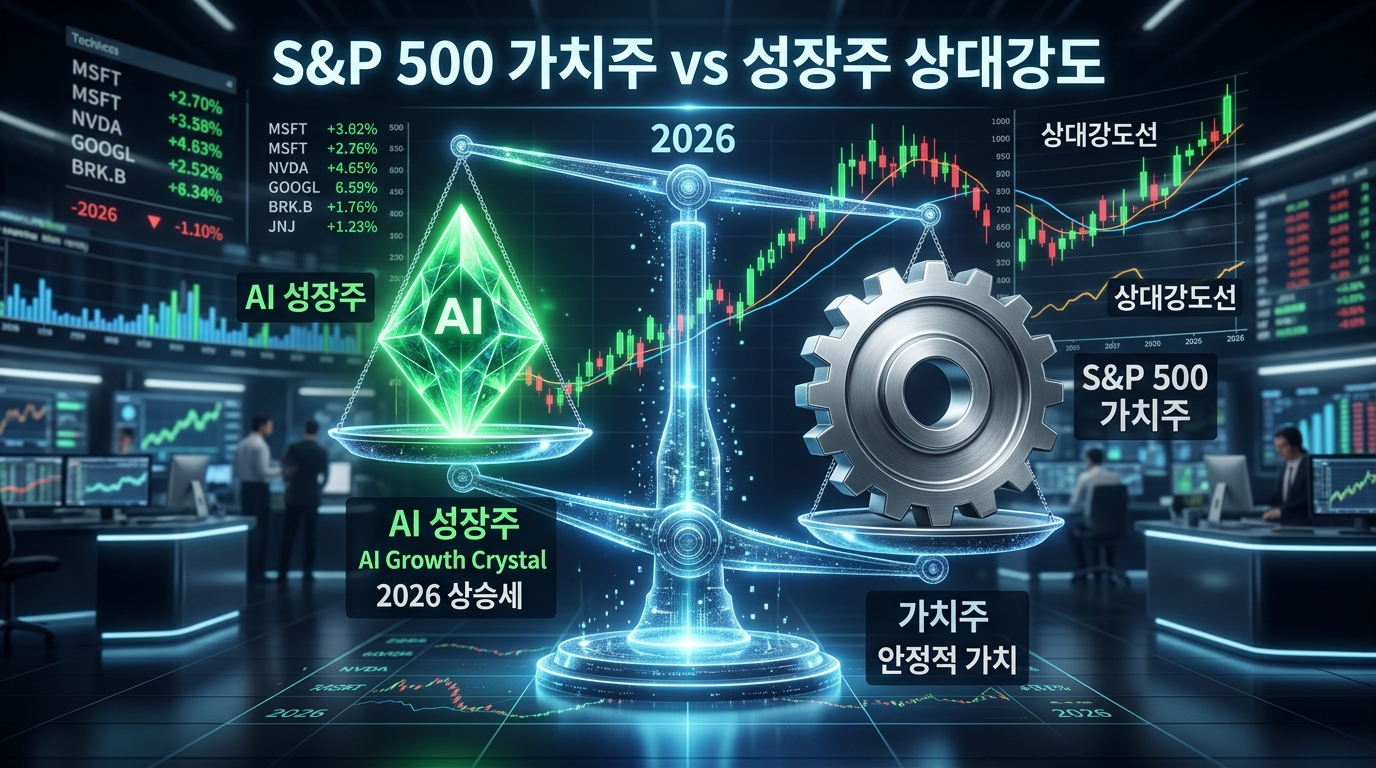
While U.S. equities have recently been dominated by growth stocks riding the AI infrastructure boom, the relative strength of value-style stocks is gradually gaining attention due to prolonged high interest rates and geopolitical tensions.
With the Forward Price-to-Earnings (P/E) ratio gap between the S&P 500 Growth Index and the Value Index widening to approximately 25x and 16x respectively, signs of style rotation by institutional investors concerned about valuation pressures are starting to emerge.
In this analysis, we examine the relative strength trends of both styles in response to changes in the macroeconomic environment and evaluate conditional portfolio diversification strategy scenarios for the current juncture.
Market Overview
As of June 11, 2026, at 10:00 AM KST (provisional intraday), domestic and international financial markets are experiencing volatility due to profit-taking pressure in tech-heavy sectors and rising interest rate sensitivity fueled by Middle East tensions.
According to Daily Stock's proprietary Fear & Greed Index, the KOSPI Fear & Greed Index stands at 26.6 (Fear) and the NASDAQ Fear & Greed Index at 27.5 (Fear), indicating a sharp contraction in investor sentiment.
| Index & Indicator | Intraday Real-time Data (Provisional) | Trend vs. Prior Period |
|---|---|---|
| **KOSPI** | 7,611.75 | Increased Volatility |
| **KOSDAQ** | 958.90 | Slightly Weak Range |
| **NASDAQ** | 25,169.50 | Profit-taking Pressure |
| **USD/KRW** | 1,525.20 KRW | Continued FX Rate Rise |
| **KOSPI Fear & Greed Index** | 26.6 (Fear) | Sharp drop from 56.6 (Neutral) a week ago |
| **NASDAQ Fear & Greed Index** | 27.5 (Fear) | Sharp drop from 53.0 (Neutral) a week ago |
Recently, the S&P 500 has been fluctuating around the 7,500–7,600 level, entering a cooling-off phase to resolve short-term overbought conditions (RSI above 70).
While mega-cap growth ETFs that led the market in the first half of the year yielded high returns of over 20% year-to-date, value ETFs saw only single-digit growth. However, June has seen divergence as tech stocks undergo temporary corrections while defensive value sectors like consumer staples and healthcare rebound.
![Image: /stdaily/uploads/202606/gen_6a2a08f7002af1.22765720.png]
Financial Analysis
The fundamental driver determining the relative strength of S&P 500 growth versus value stocks ultimately lies in the trajectory of Earnings Per Share (EPS) estimates.
According to recent guidance revisions from major investment banks such as Goldman Sachs, the S&P 500's annual EPS forecast for 2026 is trending upward to approximately $340–$354, with a significant portion concentrated in the AI hardware supply chain.
However, the earnings recovery for companies outside of Big Tech remains relatively modest. Furthermore, sluggish consumer purchasing power due to persistent high inflation acts as a headwind for margin expansion in value sectors.
While the growth camp boasts high operating margins and solid balance sheets to defend earnings, the impact of rising Capital Expenditure (CapEx) burdens on corporate cash flows requires close monitoring.
In the value sector, the performance of financials, energy, and industrials forms a solid downside cushion, supported by oil price fluctuations and reshoring (manufacturing repatriation) order cycles.
Valuation
The S&P 500's consolidated 12-month Forward P/E ratio is currently sitting around 20–21x, which is significantly above its 20-year historical average of 16x.
When broken down by style, a stark valuation polarization is visible.
The S&P 500 Growth Index trades at a Forward P/E of 25x, keeping concerns about an AI bubble and peak valuation elevated. In contrast, the S&P 500 Value Index remains at a more defensive 16x, exhibiting solid downside support.
Notably, the S&P 500 Value Index now includes several mega-cap "blend" companies that possess both growth and value characteristics—such as Apple, Amazon, and Tesla. This means the underlying composition of the index differs from historical norms.
If the valuations of these companies undergo even minor corrections, it could alter their weights within the value index, potentially causing the relative strength curve between growth and value to shift abruptly.
Expert & Institutional Analysis
J.P. Morgan Asset Management noted in a recent report that as the extreme market concentration in mega-cap growth stocks gradually eases, capital flows into value stocks—which offer both attractive valuations and high dividend yields—could accelerate in the second half of 2026.
BlackRock also suggests that although inflation concerns have peaked and are stabilizing, a gradual slowdown in the labor market is expected. Consequently, they recommend a diversified portfolio that blends high-quality value stocks with strong cash flows rather than unconditionally chasing growth stocks.
On the other hand, Morgan Stanley expressed caution, stating that even amid macro slowdown signals like weakening consumer purchasing power, the relative dominance of tech growth stocks may remain intact as long as the AI infrastructure spending cycle continues.
According to S&P Global’s June Investment Manager Index (IMI) survey, institutional investors' risk appetite plummeted by nearly half compared to the previous month due to high valuation burdens and geopolitical noise.
Risk Factors
First, uncertainty remains over the Federal Reserve's monetary policy path. Persistent inflation data and strong employment figures have pushed back rate cut expectations, with some even whispering about further tightening, exerting immediate pressure on growth multiples.
Second, escalating geopolitical conflicts in the Middle East and scenarios of rebounding oil prices pose risks. Rising energy costs squeeze corporate margins while acting as a catalyst for style rotation by driving short-term strength in value sectors (energy, materials).
Third, market-wide consolidation and liquidity absorption events have had an impact. Large-scale capital raises and IPOs by major corporations have temporarily drained overall market liquidity, disproportionately affecting high-multiple growth stocks.
Fourth, there is a risk of a hard landing for the real economy. If cracks beneath the surface of consumer metrics—such as rising household debt and credit card delinquency rates—deepen, both cyclical value stocks and growth stocks will struggle to avoid downward earnings revisions.
Investment Perspective
Investing based on the relative strength between growth and value is more reasonably approached through a "conditional allocation adjustment" scenario aligned with macroeconomic indicators, rather than an all-or-nothing binary choice.
While mega-cap growth stocks will continue to drive the index upward as long as AI momentum is sustained, defensive value stocks with low P/B ratios and high dividend yields can serve as crucial buffers to reduce portfolio volatility during periods of hawkish Fed stances and geopolitical uncertainty.
For investors, this is a juncture to avoid extreme style concentration and instead consider a hybrid, diversified allocation while monitoring interest rate levels and sector-specific EPS upward revisions in real-time.
Investor Checklist Q&A
Q1. How does the S&P 500 differentiate between growth and value stocks?
A1. The S&P 500 classifies style indices by measuring three growth factors (sales growth, ratio of earnings change to price, and momentum) and three value factors (book value-to-price, earnings-to-price, and sales-to-price).
Q2. Why are tech giants like Apple and Tesla included in the S&P 500 Value Index?
A2. Under S&P's index methodology, if a stock does not exhibit extreme growth or value characteristics, its market capitalization is distributed between both style indices. Consequently, blend companies like Apple can end up among the top holdings of the Value Index.
Q3. What is the likelihood that the relative strength of value stocks will overtake growth stocks at this stage?
A3. If the Fed delays rate cuts or discusses rate hikes due to inflation stickiness, the multiples of highly valued growth stocks may contract, potentially leading to a temporary or medium-term reversal in favor of relatively undervalued value stocks.
Q4. What is the difference between the Russell 2000 Value Index and the S&P 500 Value Index?
A4. The S&P 500 Value Index is composed of large, stable blue-chip companies, offering high defensive qualities. In contrast, the Russell 2000 Small-Cap Value Index is highly sensitive to the domestic economy and borrowing costs, leading to much higher volatility.
Q5. What is the most practical strategy for retail investors in this style rotation phase?
A5. A flexible strategy involves adjusting the mix of large-cap quality stocks that share both growth and value traits, or combining growth (SPYG) and value (SPYV) index ETFs at a balanced ratio (e.g., 6:4 or 5:5) to adapt to changing market conditions.