Hello, this is Daily Stock, delivering core trends and in-depth analysis of global financial markets.
[Image: /stdaily/uploads/202606/gen_6a246e77e401d9.89664257.png]
Executive Summary
- Just three days after the S&P 500 index crossed the historic 7,600 mark for the first time, a strong employment data shock and a big tech sell-off pushed the index down to the 7,300 level (7,383.74).
- With the US Department of Labor reporting 172,000 new jobs in May—nearly double market expectations—hopes for rate cuts within this year have completely vanished, and the possibility of an additional hike is starting to be priced in.
- Following the regular rebalancing scheduled for June 22, Marvell Technology (MRVL) and Flex (FLEX) will be added to the S&P 500, while Pool Corporation (POOL) and Campbell Soup Company (CPB) will be removed.
---
Market Overview
On June 2, the S&P 500 index hit an all-time high of 7,609.78 points, showing strong upward momentum.
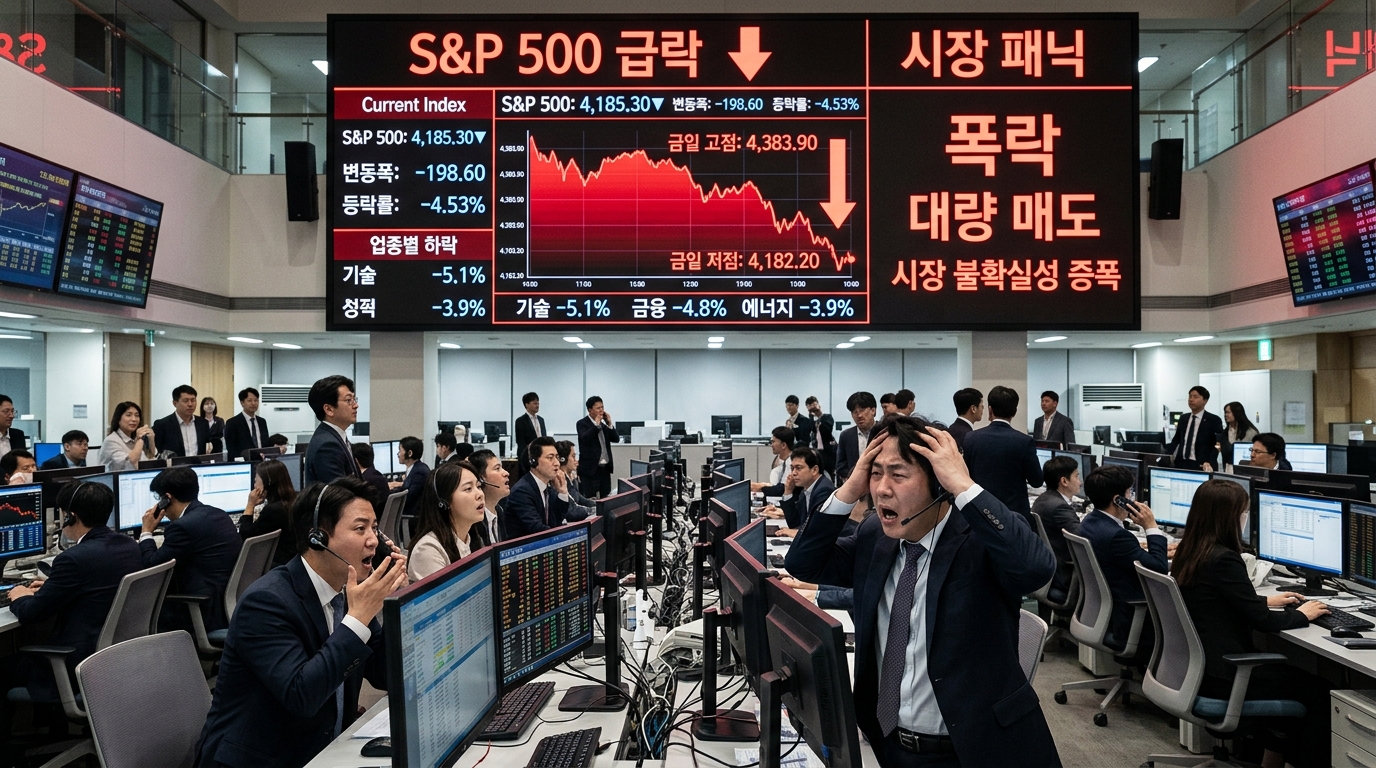
However, on Friday, June 5, stronger-than-expected labor market data shattered market expectations. The index plummeted 2.64% (-200.57pt) in a single day, closing at 7,383.74 and abruptly cooling investor sentiment.
[Image: /stdaily/uploads/202606/gen_6a246e823b73f0.07917447.png]
Currently, the global stock market is experiencing a deepening fundamental decoupling among the three major regions: the US, Europe, and Asia.
The US is facing prolonged tightening pressure due to an ultra-strong labor market, while Europe is stuck in a monetary easing dilemma amid recession worries. Meanwhile, Asian markets are navigating their own paths amid a cautious stance by the People's Bank of China (PBOC).
On top of this, military tensions between the US and Iran have pushed oil prices to settle around $95 per barrel, adding supply-side inflationary pressure and driving volatility in global asset markets.
---
Financial Analysis
The quarterly rebalancing scheduled for June 22 signals a massive shift in passive funds alongside changes in sector weights within the index.
Newly added Marvell Technology (MRVL) and Flex (FLEX) are expected to further boost the Information Technology (IT) sector's dominance in the index, driven by their solid financial structures and expanding AI infrastructure.
| Index / Asset | Current Price (As of June 7, 2026) | Weekly Change | Year-to-Date (YTD) |
|---|---|---|---|
| **S&P 500** | 7,383.74 | -2.60% | +7.90% |
| **Nasdaq Composite** | 25,709.43 | -4.70% | +10.60% |
| **KOSPI** | 8,160.59 | Market Closed | Market Closed |
| **KOSDAQ** | 1,002.44 | Market Closed | Market Closed |
| **USD/KRW** | 1,559.70 KRW | Market Closed | Market Closed |
Conversely, Pool Corporation (POOL) and Campbell Soup Company (CPB), hard hit by weakening consumer spending, suffered removals from the list of the 500 largest companies due to stagnant revenue growth.
Although overall Q1 earnings per share (EPS) for S&P 500 companies were decent, future guidance is being adjusted downward to reflect the high-interest-rate environment, highlighting a distinct polarization.
---
Valuation
When the S&P 500 first surpassed the 7,600 mark, its 12-month forward P/E (Price-to-Earnings) ratio soared to approximately 23x, approaching historical highs not seen since the dot-com bubble.
With the 10-year US Treasury yield surging back to 4.518%, the yield gap—which measures the expected return of stocks relative to risk-free assets—has narrowed significantly.
As a result, high-multiple mega-cap AI tech stocks like NVIDIA and Broadcom were the first to face valuation de-rating pressure, leading the index's sharp decline.
---
Expert & Institutional Analysis
Major Wall Street institutions are locked in a debate over whether this adjustment is a temporary "June Swoon" scenario or the formation of a medium-to-long-term market top.
Some technical analysts warn that the S&P 500's sharp daily drop represents an overbalance of buying momentum, which could sustain downward pressure toward subsequent Fibonacci retracement support levels.
On the other hand, optimists, including Morgan Stanley, advise that the potential inflow of temporary portfolio adjustment funds following the June rebalancing could act as a downward support factor.
---
Risk Factors
- **Fed's Higher-for-Longer Stance & Hike Potential**: Strong labor data has effectively wiped out expectations for rate cuts, bringing the downside risk of further rate hikes back into focus.
- **Oil Price Volatility from Geopolitical Risks**: Prolonged geopolitical conflict between the US and Iran, along with logistics disruptions near the Strait of Hormuz, are driving up commodity prices and amplifying stagflation concerns.
- **In-house Fear & Greed Index Turns Neutral**: According to Daily Stock's proprietary analysis, the Nasdaq Fear & Greed Index stands at 42.1 and the KOSPI at 51.8. Both are in neutral territory, reflecting a cautious psychological phase with ambiguous market direction.
---
Investment Perspective Summary
As the S&P 500 enters a phase of rapid cooling from overbought territory, it is time to check portfolio defenses rather than chase the market blindly.
An effective scenario would involve trimming exposure to high-growth tech stocks that are highly sensitive to interest rate volatility, focusing on concentrated positions in stocks expected to benefit from the rebalancing, or securing cash reserves.
Investors must closely track macro indicators to see if the relative strength of the US will persist amid the global tri-polar decoupling, or if the index floor will drop further under the weight of monetary tightening.
---
Investor Checklist Q&A
Q1. What was the main reason behind the sharp drop right after the S&P 500 broke 7,600 for the first time?
A1. The US May employment data came in at double the market consensus, causing Treasury yields to spike. This triggered heavy profit-taking in mega-cap tech stocks, which had already faced valuation concerns.
Q2. Which key stocks are being added or removed in the June S&P 500 rebalancing?
A2. Marvell Technology (MRVL) and Flex (FLEX) will be added, while Pool Corporation (POOL) and Campbell Soup Company (CPB) will be removed from the index.
Q3. Why did the stock market plunge despite strong employment figures?
A3. A robust job market gives the Fed justification to keep interest rates higher for longer or even hike them further, which acts as a headwind for the stock market.
Q4. What exactly does the US-EU-Asia "tri-polar decoupling" mean?
A4. It refers to the divergent paths of asset markets across continents: the US is dealing with a strong economy and high-rate pressures; Europe is stuck in a monetary easing dilemma amid economic uncertainty; and Asia is moving independently with accommodative policies led by China and Japan.
Q5. What is the most reasonable investment approach for retail investors for the time being?
A5. It is advisable to remain flexible with cash reserves, accounting for potential further declines, and gradually accumulate high-quality defensive stocks with strong fundamentals and cash flows that can withstand a high-interest-rate environment.
---