Hello, this is Daily Stock, your reliable guide to the asset markets.
Key Summary
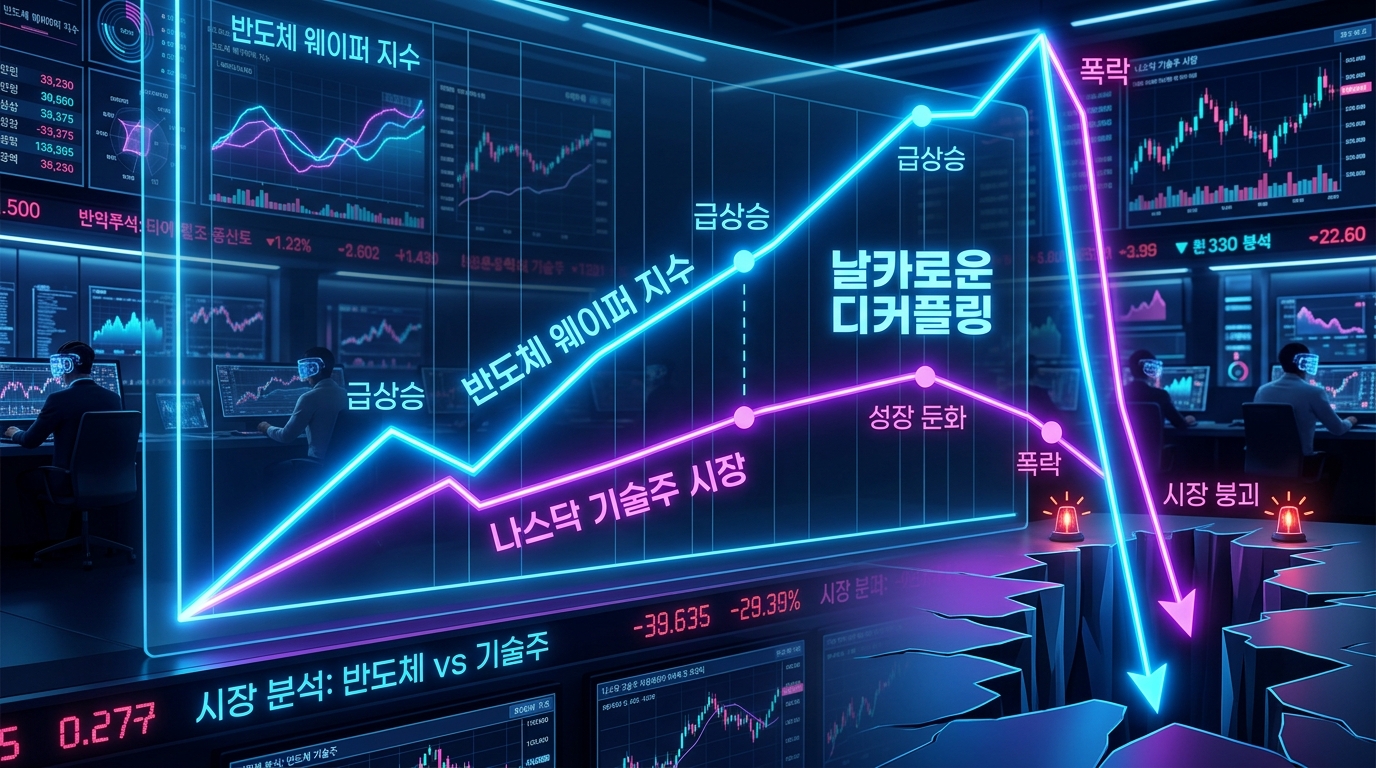
The hottest topic in the US stock market recently is the unprecedented "decoupling" between the Philadelphia Semiconductor Index (SOX) and the Nasdaq Composite Index, followed by a shocking downturn.
The SOX index, which recorded a historic bull run by skyrocketing a whopping 83% in just five months of 2026, lit a powerful warning flare for the market by plunging 10.26% in a single day on June 5.
With the 10-year US Treasury yield (US10Y) surging due to a US employment surprise, combined with doubts over big tech earnings guidance, the semiconductor monopoly is facing rapid cracks.
Current Market Summary
On June 5, the New York stock market suffered a deep correction as a powerful macroeconomic shock combined with profit-taking across AI tech stocks.
The US Department of Labor reported that May nonfarm payrolls increased by 172,000, more than doubling the market consensus of 80,000 to 85,000, effectively extinguishing hopes for a rate cut.
As a result, the 10-year US Treasury yield surged to 4.53%, while the policy-sensitive 2-year yield also broke above 4.13%.
Broadcom (AVGO), a bellwether leading optimism in the semiconductor industry, triggered the decline by presenting a conservative AI-related revenue outlook of $16 billion for the next quarter, falling short of high market expectations.
Additionally, rumors that Nvidia might reduce the memory configuration of its next-generation Rubin NVL72 platform fueled anxiety in the memory sector.
Consequently, the SOX index plummeted 10.26% to close at 12,220.76, while the Nasdaq Composite also fell 4.18% to end at 25,709.43, demonstrating a synchronized collapse.
[Image: /stdaily/uploads/202606/gen_6a23636a60c819.50145928.png]
| Major Market Indicators (As of 2026-06-06) | Current Price / Close | Change (%) | Remarks |
|---|---|---|---|
| **KOSPI Index** | 8,160.59 | - | As of daily close |
| **KOSDAQ Index** | 1,002.44 | - | As of daily close |
| **Nasdaq Composite Index** | 25,709.43 | -4.18% | US market close on June 5 |
| **Philadelphia Semiconductor Index (SOX)** | 12,220.76 | -10.26% | US market close on June 5 |
| **US 10-Year Treasury Yield (US10Y)** | 4.53% | +5.5bp | Highest since May 21 |
| **USD/KRW Exchange Rate** | 1,559.00 KRW | - | As of daily close |
| **CBOE Volatility Index (VIX)** | 21.57 | +40.06% | Reflecting rapid risk aversion |
Financial Analysis
The unusual rally of the semiconductor index has been deeply rooted in the massive capital expenditures (CAPEX) of hyperscalers.
The combined 2026 CAPEX forecast for the four major big tech companies—Google (Alphabet), Amazon, Microsoft, and Meta—is reaching a record high of approximately $725 billion.
In response, Micron Technology has shown explosive financial growth, with its quarterly revenue increasing by 74.9% quarter-on-quarter.
However, Broadcom's guidance shock demonstrates that the rate at which big tech's massive investments translate into semiconductor revenue may not keep pace with market expectations.
In particular, Broadcom's decision not to significantly raise its previous guidance despite strong AI growth signals conservative supply chain management and cautious client behavior.
While the structural environment where demand exceeds supply remains, the potential slowdown in short-term earnings growth is driving conservative adjustments to financial estimates.
Valuation
Amidst the explosive rally, the forward P/E ratio of the SOX index temporarily surged to around 40x, entering historical peak territory.
The semiconductor index's multiple premium relative to the Nasdaq 100 index was significantly outside its historical standard deviation range.
In terms of supply and demand, the excessive concentration of leveraged funds into 3x semiconductor ETFs and related derivatives abnormally inflated multiples.
Analysts suggest that this plunge of over 10% is the prelude to a painful price correction aimed at narrowing the valuation gap.
Indeed, Micron plummeted 13.25% on the day, while high-multiple stocks like Marvell Technology (-16.74%) and Rambus (-14.20%) bore the brunt of the re-rating.
With Nasdaq's Fear & Greed Index pulling back to 42.1 (Neutral), the pressure to unwind overheated semiconductor valuations could persist for some time.
[Image: /stdaily/uploads/202606/gen_6a236377e004b2.51546566.png]
Expert & Institutional Analysis
Major Wall Street institutions are sharply divided over whether to view this correction as a temporary bout of profit-taking or as a sign of cracks in the AI bubble.
Bank of America (BofA) provided an analysis stating, "This is merely a conservative outlook due to temporary supply constraints at clients, and the expansion trend of AI infrastructure itself remains on track."
Conversely, some hedge fund strategists warn, "This closely resembles the mania seen in March 2000 at the peak of the dot-com bubble, and if accompanied by macroeconomic tightening, it could lead to a deep recession."
In particular, investment banks point out that the US Treasury yield breaking the 4.5% threshold is increasing the discount rate burden on growth stocks.
There is also a growing consensus that market capital is rapidly shifting away from chasing ambiguous growth potential and toward value stocks or traditional industries with "guaranteed cash flow."
Risk Factors
The most immediate risk is that concerns over prolonged high interest rates have resurfaced due to strong US employment data.
The retreat of expectations for rate cuts within the year and the opened possibility of prolonged tightening is the most fatal variable for high-valuation tech stocks.
Second is the potential delay in the actual monetization of AI businesses and hyperscalers adjusting the pace of their investments.
Conservative guidance approaches or rumors of specification changes in key components could put short-term downward pressure on unit prices across the component supply chain.
Lastly, geopolitical tensions and the resulting macroeconomic volatility pose risks. Prolonged geopolitical conflicts in the Middle East could trigger volatility in global oil prices and a stronger dollar, increasing the cost burden on global big tech companies.
Investment Perspective Summary
In a phase where both the semiconductor index and the Nasdaq are declining sharply together, investors should avoid excessive leverage and focus on risk management.
While short-term buying pressure aiming for a technical rebound may enter the market, high volatility is likely to persist for the time being unless pressure from Treasury yields is resolved.
Investors should keep in mind that the internally calculated Nasdaq Fear & Greed Index is at 42.1 (Neutral), showing a clear contraction compared to a week ago (59.5, Neutral) and a month ago (67.3, Greed).
While maintaining long-term confidence in the AI paradigm's growth, it seems wise for investors to observe the deflation of the overextended valuation bubble and adopt a split-buying approach.
Investment Checklist
* Whether the US 10-Year Treasury Yield (US10Y) settles above 4.5%: If yields remain high for a long period, it will act as continuous downward pressure on high-valuation semiconductor tech stocks.
* Changes in investment guidance from big tech companies: Monitor whether Microsoft, Google, Meta, and others signal CAPEX reductions in their upcoming earnings calls.
* Cross-checking rumors about key chip platform specs and unit prices: Analyze in detail whether changes in Nvidia's new platform configurations could harm the actual profit margins of the supply chain.
* Global semiconductor ETF fund flows: Check if passive funds, which previously acted as an inflow channel, turn to redemptions, inducing supply-demand instability.
* Macroeconomic geopolitical variables and oil price trends: Keep a close eye on whether developments in Iran and the Middle East stimulate inflationary pressures, prompting the Fed to extend its tightening stance.