[Image: /stdaily/uploads/202606/gen_6a2274476ca7c2.56098786.png]
Today, the domestic stock market underwent a sharp correction, weighed down by weakening global sentiment in hardware investment and heavy selling by foreign investors.
Below, we review the closing market trends and provide an urgent check on the shipment status of SK Hynix, a key pillar in AI memory semiconductors.
Key Summary
On June 5, 2026, the KOSPI market experienced a major correction due to disappointment over earnings guidance from global Big Tech companies.
Profit-taking pushed down major large-cap semiconductor stocks, triggering a program-selling sidecar on the overall market during the session.
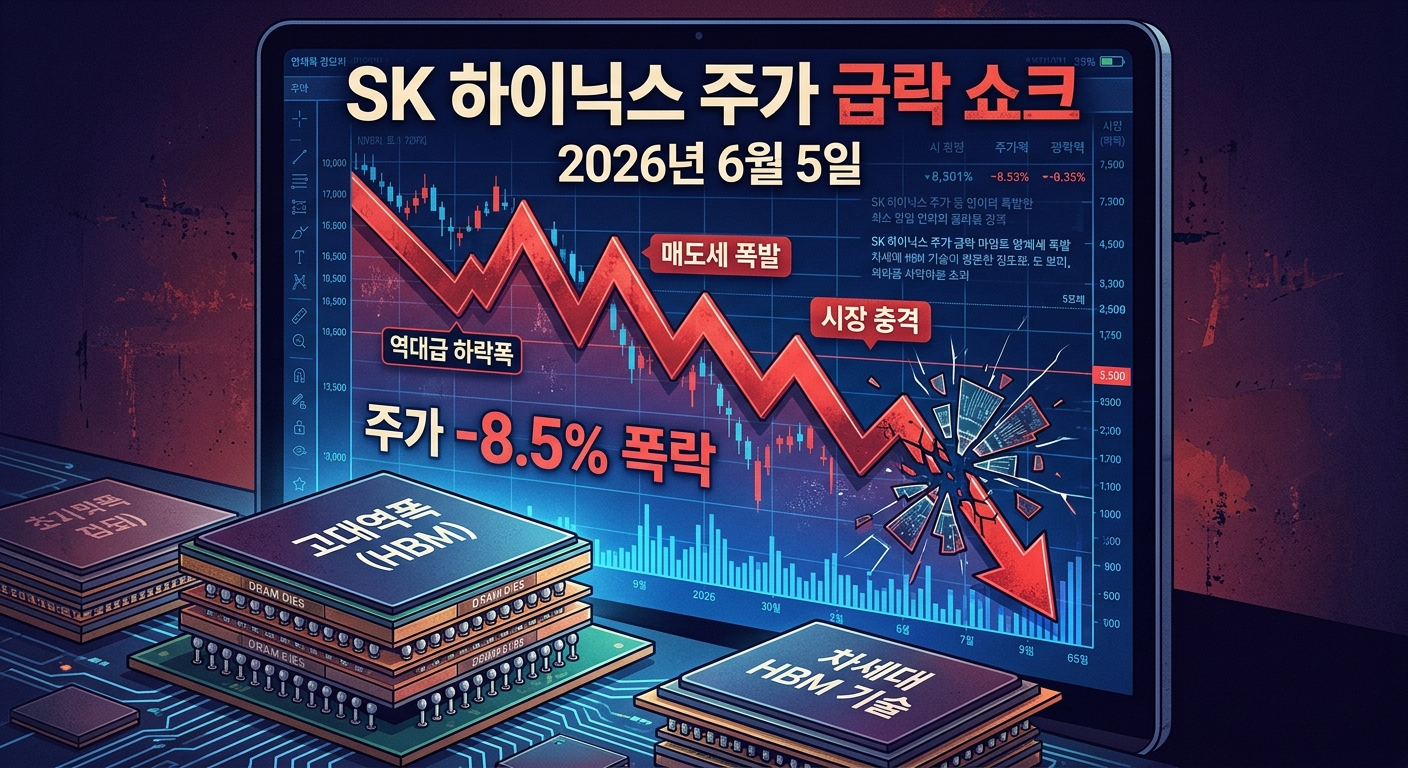
SK Hynix closed the regular session at 2,070,000 KRW, down 9.92% from the previous day.
Despite this short-term price shock, the shipment roadmap for HBM4 and the next-generation HBM4E—recently showcased at events like 'Computex 2026'—is understood to be progressing smoothly as planned.
Market Overview
Today, the KOSPI index closed at 8,160.59, dragged down by heavy combined selling from foreign and institutional investors.
The KRW/USD exchange rate also soared to the 1,539.40 KRW level, piling profit-taking pressure on foreign capital.
In New York, Broadcom plummeted 12.59% after releasing weaker-than-expected guidance, and the shock wave spread directly to large-cap domestic chipmakers.
This triggered a sell-off across the global memory sector, causing Micron Technology to drop 7.74% as well.
According to Daily Stock's proprietary Fear & Greed Index, the KOSPI Fear & Greed Index currently stands at 49.8, indicating a "Neutral" stage.
This shows a rapid cooling of investment sentiment compared to one week ago (56.2) and one month ago (66.5).
Meanwhile, the Nasdaq Fear & Greed Index also maintains a neutral stance, currently at 54.7.
| Classification | June 5, 2026 Value | Change Rate (vs. Prev. Day) | Remarks |
|---|---|---|---|
| KOSPI Index | 8,160.59 | - | Sell Sidecar triggered during trading |
| KOSDAQ Index | 1,002.44 | - | Closed lower in tandem |
| KRW/USD Exchange Rate | 1,539.40 KRW | - | High exchange rate trend continues |
| SK Hynix Closing Price | 2,070,000 KRW | -9.92% | Hit by concentrated foreign/institutional selling |
| Samsung Electronics Closing Price | 329,000 KRW | -6.40% | Sharp drop in tandem |
| KOSPI Fear & Greed Index | 49.8 | - | Entered Neutral territory |
[Image: /stdaily/uploads/202606/gen_6a227453519bd6.36575913.png]
Financial Analysis
According to securities industry sources, SK Hynix's annual revenue for 2026 is projected to increase by 72% year-on-year to 163.201 trillion KRW, with operating profit rising 130% to 102.949 trillion KRW.
This growth is driven by an unprecedented surge in enterprise SSD (eSSD) demand and the sustained premium pricing of HBM.
In terms of sector-specific operating profit forecasts, the DRAM division is expected to record 90 trillion KRW, while the NAND division is projected to reach approximately 13 trillion KRW.
With sales of the 6th-generation product, HBM4, set to scale up in earnest starting in Q2 2026, the company's overall blended average selling price (ASP) is being driven upward.
Valuation
Despite the record-breaking earnings forecasts, short-term supply-demand imbalances are exacerbating valuation volatility.
Some market analysts point out that the stock has entered an undervalued zone, trading at around 6x forward Price-to-Earnings (Forward PER).
However, the recent surge in open interest in single-stock leveraged ETFs and stock futures acts as a double-edged sword.
SK Hynix's stock futures open interest stands at around 40 trillion KRW, a scale that can abnormally magnify price swings when macroeconomic variables arise.
Expert & Institutional Analysis
Semiconductor analysts agree that this sharp drop is not due to deteriorating memory industry fundamentals or entry into a downcycle.
The prevailing consensus is that the decline is a temporary consolidation driven by profit-taking, after expectations rose too high following a string of record-high prices.
Indeed, at Computex 2026 held in Taiwan, SK Hynix unveiled for the first time its high-performance NAND solution 'HBF' and the specifications for its 6th-generation next-memory 'HBM4E'.
Its exclusive supply chain status and partnership tailored to Nvidia's latest accelerator lineups (GB300, Vera Rubin 200) remain solid.
Risk Factors
The most concerning risks are the short-term exchange rate pressures and the possibility of continuous foreign capital outflows.
If the KRW/USD exchange rate remains anchored in the mid-1,500s, automated passive selling from foreign funds looking to avoid currency translation losses could persist.
Changes in the competitive landscape also warrant close monitoring.
At Computex 2026, Samsung Electronics unveiled its mockup for the 8th-generation 'HBM5' featuring HPB (thermal management technology) for the first time, signaling its strong intent to capture next-generation tech leadership.
Additionally, the short-term volatility risks stemming from the liquidation of excessively accumulated futures leverage positions must be kept in mind.
Investment Outlook
While short-term sentiment has taken a hit and dragged down the stock price, the medium-to-long-term growth of the AI infrastructure market remains robust.
Given SK Hynix's technological leadership and strong order backlog, a solid, earnings-backed downside support level is highly likely to form.
Therefore, a phased accumulation strategy—waiting until short-term derivative-driven supply-demand noise subsides and the KRW/USD exchange rate stabilizes—appears valid.
The key will be to continuously track Q3 HBM shipment data linked to customers' next-generation chipset launch schedules.
[Image: /stdaily/uploads/202606/gen_6a22745f1c1e02.78252923.png]
FAQ
Q1. What was the main reason behind SK Hynix's 9.92% drop today?
A1. A combination of global semiconductor sell-offs sparked by disappointing guidance from US AI infrastructure firm Broadcom, coupled with a surging KRW/USD exchange rate, led to a concentration of profit-taking by foreign and institutional investors.
Q2. What does the KOSPI sell sidecar triggered today signify?
A2. When KOSPI 200 futures decline by 5% or more compared to the previous close and stay there for one minute, program selling orders are temporarily suspended. This indicates that short-term supply and demand became extremely one-sided.
Q3. What technological milestones did SK Hynix showcase at Computex 2026 in early June?
A3. The company revealed detailed specifications for its 6th-generation 'HBM4E' for the first time and introduced its proprietary NAND solution, 'HBF (High Bandwidth Flash)', reinforcing its full-stack AI memory leadership.
Q4. Is SK Hynix's 2026 annual operating profit forecast reliable?
A4. Major brokerages project annual operating profit to exceed 100 trillion KRW, supported by tight DRAM supply and surging eSSD prices. Despite short-term volatility, the company's financial fundamentals remain strong.
Q5. How does high open interest in the futures market affect the stock price?
A5. With SK Hynix's single-stock futures open interest reaching nearly 40 trillion KRW, it acts as a potential risk factor. In a declining market, margin calls or forced liquidations can amplify the downward movement of the stock price.