Hello. This is Daily Stock.
Summary
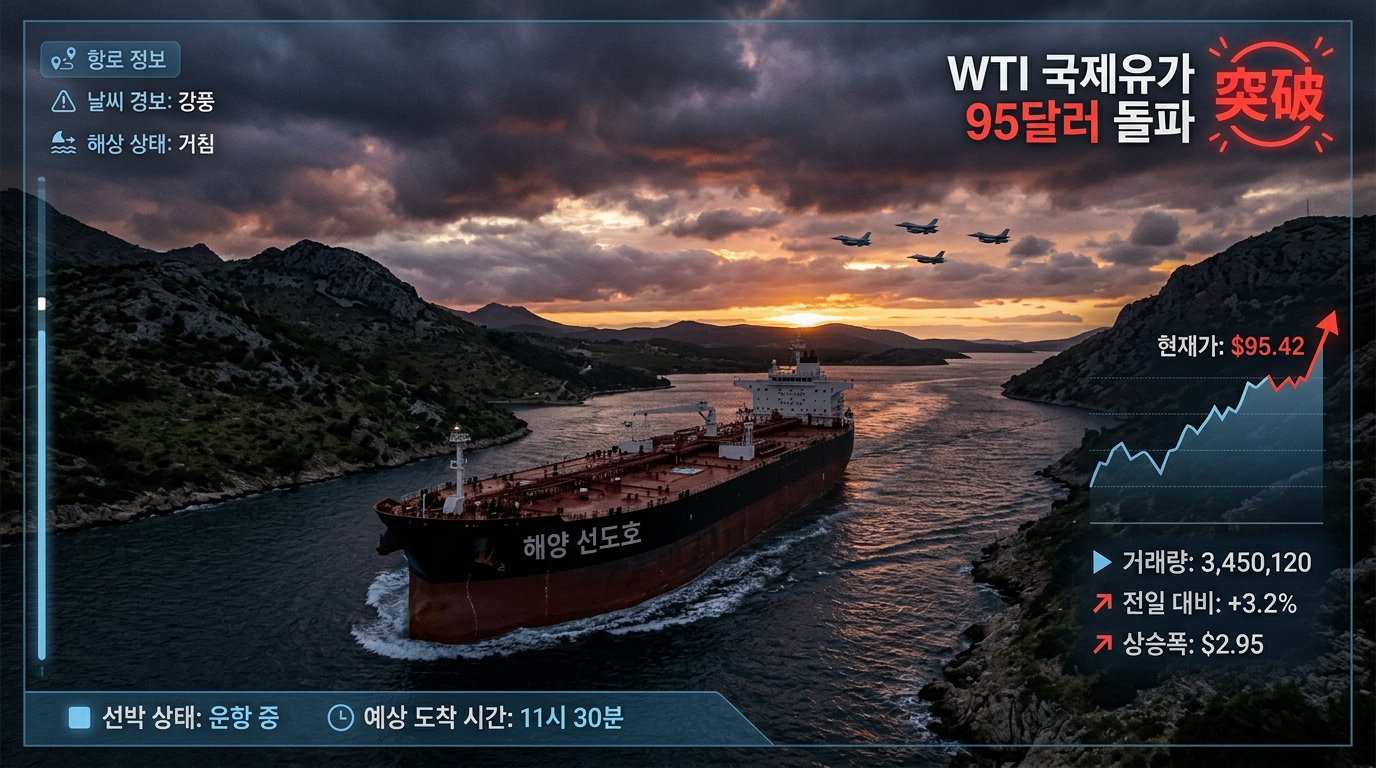
With military tensions in the Middle East escalating to extreme levels, West Texas Intermediate (WTI) crude oil prices have surpassed the $95 per barrel mark.
Direct military clashes between the US and Iran and concerns over supply disruptions in the Strait of Hormuz are once again fueling global inflation.
This shift in the macroeconomic environment has emerged as a major variable further deepening the fundamental decoupling among US, European, and Asian stock markets.
Indeed, the gap in relative strength between the US, which boasts energy self-sufficiency, and Europe and Asia, which are highly dependent on energy imports, is becoming increasingly pronounced.
[Image: /stdaily/uploads/202606/gen_6a207a0ddb4c81.96893215.png]
Current Situation Overview
As of intraday trading on June 4, 2026 (provisional), WTI crude oil prices are exhibiting high volatility in the upper $95 range, surging more than 2% from the previous day.
This was triggered by foreign media reports that the US military launched airstrikes on an Iranian military base on Qeshm Island, a strategically crucial point in the Strait of Hormuz.
Following Iranian provocations involving missile launches toward Kuwaiti and Bahraini territorial waters, the US immediately responded with retaliatory strikes, causing the impact of the armed conflict to spiral out of control.
With concerns over supply disruptions in the Strait of Hormuz—which handles approximately 20% of global maritime crude oil transport—about 14 million barrels of crude oil per day are exposed to immediate market threats.
[Image: /stdaily/uploads/202606/gen_6a207a18cff976.12543277.png]
Financial Analysis
The tight supply in the crude oil market is also demonstrated by objective crude inventory indicators.
According to the US Energy Information Administration (EIA), recent weekly US crude inventories fell sharply by 7.97 million barrels, nearly doubling the market expectation of a 4-million-barrel draw.
This marks the sixth consecutive week of inventory declines, while refined product (distillate) inventories are also nearing their lowest levels since 2003, compounding the supply crunch.
With oil prices sustained in the high $95 range, the quarterly earnings outlook and share buyback capacity of global oil majors such as ExxonMobil (XOM) and Chevron (CVX) are expected to strengthen further.
| Category | Recent Indicator | Market Estimate | Actual Record | Impact |
|---|---|---|---|---|
| **US Crude Inventory Change** | Weekly Inventory Trend | -4.0M bbl | -7.97M bbl | 6th consecutive weekly drop; heightened supply anxiety |
| **Refined Product Inventory** | Distillate Inventories | - | Lowest since 2003 | Upward pressure on diesel and jet fuel prices |
| **Maritime Oil Supply** | Strait of Hormuz Impact | - | 14.0M bbl/day disrupted | Surge in global shipping and logistics costs |
Valuation
The global equity market is currently facing a "tri-polar decoupling" where the US, Europe, and Asia are following distinct fundamental paths.
The Nasdaq index is hovering around 26,915.07 intraday, while the Daily Stock Fear & Greed Index points to 57, indicating a "Neutral" phase.
Backed by robust economic indicators (PMI) and energy self-sufficiency, the US possesses the resilience to partially defend its equity market multiples even in a high oil price environment.
In contrast, European equities, which are heavily dependent on oil and natural gas imports, are bearing the direct brunt of this energy inflation, suffering from a relative valuation discount.
Asian markets are similarly struggling under the dual pressure of rising raw material import costs and foreign exchange pressures.
South Korea's KOSPI stands at 8,801.49 intraday, and the KOSDAQ is at 1,026.03, with the USD/KRW exchange rate rising to 1,537.20 won, maintaining strong pressure from a high exchange rate.
Currently, the KOSPI Fear & Greed Index is in the "Neutral" zone at 58.3, but the oil price risk weighing on the export profitability of manufacturing-heavy nations could gradually expand.
[Image: /stdaily/uploads/202606/gen_6a207a2535bfd5.26807763.png]
Expert & Institutional Analysis
Energy research institutions analyze that even if a short-term resolution scenario for the Middle East conflict emerges, it will be difficult to instantly resolve the accumulated supply-demand imbalances.
S&P Global Energy expressed concern that commercial crude oil inventories and Strategic Petroleum Reserves (SPR) of major countries, which previously served as price buffers, have reached their limits.
Bernstein Research projected that if this geopolitical standoff drags on until July, Brent crude—the global benchmark—could skyrocket to the $150–$160 per barrel range.
On the monetary policy front, concerns over sticky inflation in the US have significantly raised the likelihood of the Federal Reserve (Fed) keeping rates higher for longer.
This clash in monetary policies—with the European Central Bank (ECB) contemplating rate cuts to boost its manufacturing sector and the Bank of Japan (BOJ) pursuing gradual rate hikes—is further amplifying stock market volatility.
Risk Factors
The most concerning aspect is a scenario where prolonged transit disruptions in the Strait of Hormuz lead to a sharp contraction in maritime logistics margins.
As vessel charter rates surge due to detour routes and marine insurance premiums skyrocket for transiting hostile zones, stagflationary pressures are mounting across import-dependent manufacturing industries.
Jet fuel and diesel prices, which have already surged year-on-year, pose a practical risk of eroding the margin structures of the global aviation, shipping, and logistics industries.
If the military standoff between the US and Iran expands into the wider Middle East, including Syria and Iraq, there is a risk that supply chain disruptions in the commodities market could spread to non-ferrous metals.
Investment Perspective Summary
Investment decisions under the current macroeconomic setup must remain flexible, guided strictly by "conditional scenarios."
If oil prices maintain a box pattern rally in the $90 to $100 range, beneficiaries such as oil refining and defense sectors are highly likely to secure relative strength.
However, if the high-interest-rate environment triggered by elevated oil prices persists, growth sectors with overly inflated multiples could face severe valuation corrections.
Amidst the deepening fundamental decoupling of the three global regions, rather than chasing rallies aggressively, it seems prudent to secure a certain amount of cash within portfolios to prepare for volatility.
FAQ
Q1. What is the direct cause of this US-Iran military clash triggering the surge in international oil prices?
A1. It is largely driven by fears of a full-scale geopolitical war after the US military launched direct airstrikes on Qeshm Island, an Iranian military outpost near the Strait of Hormuz, in response to Iranian missile provocations.
Q2. Why is the concern over supply disruptions in the Strait of Hormuz such a critical variable?
A2. Because approximately 14 million barrels of crude oil per day—equivalent to one-fifth of the world's maritime oil shipments—transit through the Strait of Hormuz, control over this area acts as an immediate trigger for driving up global prices.
Q3. What signal does the sharp decline in US crude inventories send?
A3. The announcement of a 7.97-million-barrel drop, far exceeding the projected 4-million-barrel decline, proves that refined product inventories have tightened to multi-decade lows, strongly supporting the price floor.
Q4. What does the stock market decoupling among the three major global regions (US, Europe, Asia) have to do with oil prices?
A4. While the US maintains solid growth thanks to its high energy self-sufficiency, Europe and Asia (which face high exchange rate pressures, with the USD/KRW reaching 1,537.20 won) have large manufacturing sectors and depend heavily on oil imports, meaning they face much greater hits to trade balances and inflation when oil prices surge.
Q5. What risk management path should retail investors take under this high oil price scenario?
A5. Investors should closely monitor the limited momentum flowing into the refining and defense sectors while adjusting exposure to high-valuation assets and diversifying portfolios to prepare for a prolonged high-interest-rate scenario triggered by high oil prices.