Hello, this is Daily Stock, delivering the most rapid and objective trends in the global stock market's core earnings performance.
![Image: /stdaily/uploads/202606/gen_6a1f7d4e916771.97319912.png]
Key Summary
- **Record-Breaking Earnings Surprises**: With 97% of S&P 500 companies having reported, the Q1 earnings per share (EPS) growth rate reached 28.6% year-over-year, significantly beating the market forecast of 13.1%.
- **Exceptionally Positive Guidance Ratio**: In corporate guidance, which is typically conservative, an unusual trend emerged where companies issuing positive outlooks for Q2 (56 companies) outnumbered those with negative outlooks (46 companies).
- **Upward Revisions to Annual EPS and Target Prices**: Major investment banks, including Goldman Sachs, have raised their 2026 annual EPS forecasts for the S&P 500 to around $340, supporting the likelihood of an earnings-driven rally.
Market Overview
As of intraday on June 3, 2026 (provisional), global financial markets are focusing on the overwhelming earnings resilience of corporations despite macro uncertainties of high inflation and high interest rates.
Looking at domestic and major global indices for the day, the KOSPI is at 8801.49, the KOSDAQ is at 1026.03, the tech-heavy NASDAQ is at 27093.90, and the USD/KRW exchange rate is fluctuating around 1519.00 KRW.
According to Daily Stock's proprietary Fear & Greed Index, the NASDAQ Fear & Greed stands at 'Neutral (57)', slightly easing from 'Greed (60.9)' a week ago and 'Greed (71.2)' a month ago.
The KOSPI Fear & Greed index is currently at 'Neutral (58.3)', indicating that overall market sentiment is maintaining a tight balance between further upside momentum and valuation burdens.
In this environment, the most critical driver shaping the market's direction is the robust EPS growth of the S&P 500 and forward-looking positive changes in corporate guidance, which are dampening concerns over slowing macro indicators.
Financial Analysis
The final report card for this first-quarter earnings season was a continuous series of earnings surprises.
Among S&P 500 companies, 97% have reported actual results, with 85% beating market EPS expectations and 81% posting revenue surprises.
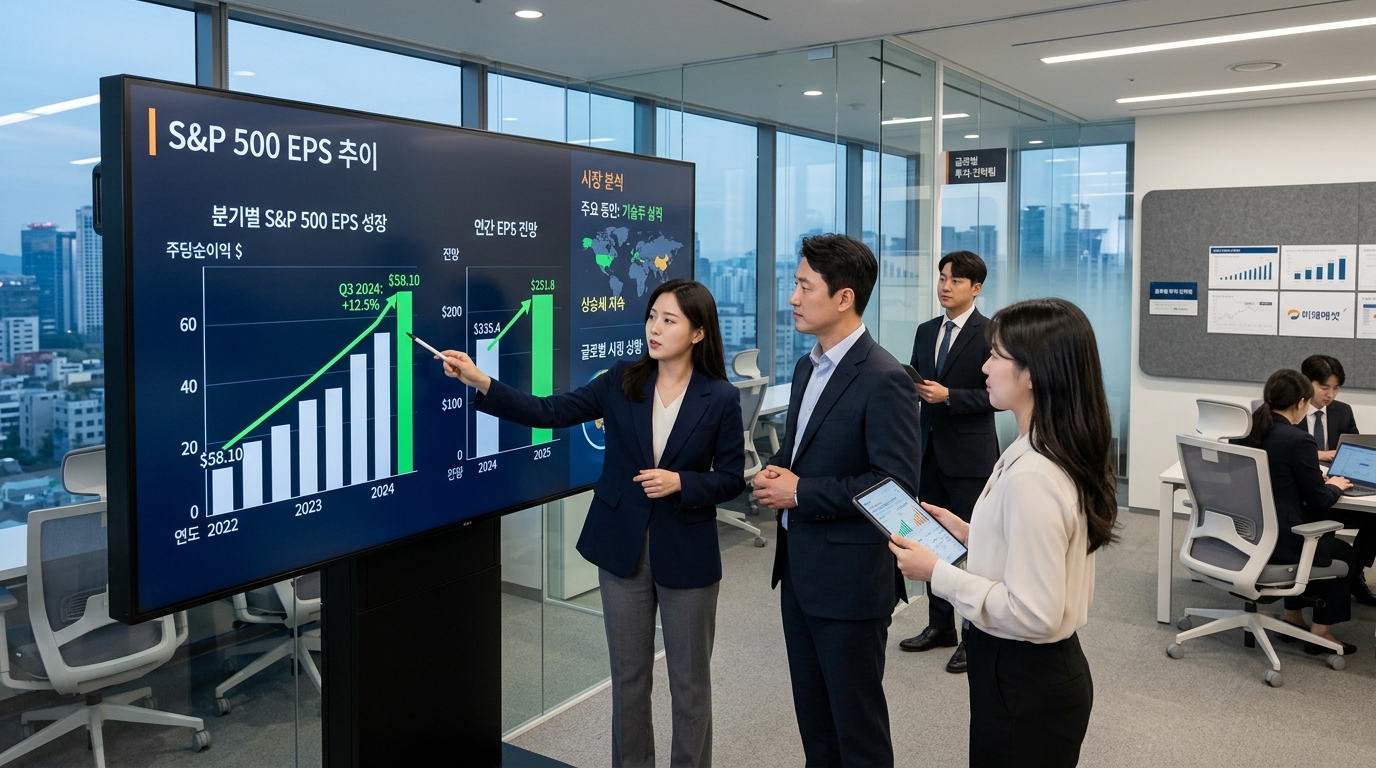
In particular, the consolidated year-over-year EPS growth rate for Q1 is provisionally calculated at a whopping 28.6%.
This is more than double the estimate of 13.1% at the end of March and represents the highest growth rate since the fourth quarter of 2021 (32.0%).
At the same time, the average net profit margin for these companies reached 14.8%, marking the highest level since 2009 as tracked by FactSet, proving excellent cost control and pricing power.
However, it remains important to note that a significant portion of this earnings growth is heavily concentrated in megacap (Big Tech) companies within the information technology (IT), communication services, and consumer discretionary sectors.
In fact, the IT sector posted a stunning 54% growth, but that figure drops to around 30% when excluding NVIDIA and Micron. Similarly, the communication services sector shifts to negative growth when Alphabet and Meta are excluded, highlighting this concentration.
| Category | End of March Forecast | Current June Confirmed (Prov.) | Surprise Ratio (EPS) | Net Profit Margin (NPM) |
|---|---|---|---|---|
| **S&P 500 Total** | 13.1% | 28.6% | 85.0% Beaten | 14.8% |
| **Information Technology (IT)** | High growth expected | 54.0% | Megacap-driven | Maintained peak levels |
| **Communication Services** | Limited growth expected | 49.0% (Alphabet/Meta driven) | - | - |
![Image: /stdaily/uploads/202606/gen_6a1f7d4e916771.97319912.png]
Valuation
Currently, the S&P 500's forward 12-month price-to-earnings (P/E) ratio stands at 21.2x.
This exceeds both the 5-year average of 19.9x and the 10-year average of 18.9x, indicating that valuations have entered somewhat stretched territory by historical multiple standards.
However, compared to previous valuation peaks, the current multiple reflects rapid upward revisions in earnings estimates (EPS), meaning it is difficult to dismiss it as a simple bubble.
The 2026 annual EPS forecast for the S&P 500 has recently been rapidly upgraded from the previous ~15% growth to a high double-digit growth rate of around 21% (estimates ranging from roughly $332 to $340).
Consequently, the rapidly expanding denominator (earnings per share) is justifying the rising stock prices (the numerator), and companies are effectively diluting the valuation overhang with their own operating performance.
Expert & Institutional Analysis
Major global investment banks and economic analysts have raised their expectations for further upside potential in stock indices following this earnings season.
Goldman Sachs strategist Ben Snider and his team recently upgraded their 2026 annual EPS estimate for the S&P 500 to $340 and projected 2027 EPS at $385, expressing optimism about solid fundamentals.
At the same time, they raised their year-end S&P 500 target from 7,600 to 8,000. Deutsche Bank and Morgan Stanley have also joined the 8,000-point target club based on earnings growth.
Asset manager DWS also raised its 2026 annual EPS forecast for the S&P 500 to the $335 level, driven by productivity improvements in AI and big data, lifting the market's overall consensus.
Experts generally agree that major corporations demonstrating high return on equity (ROE) and exceptional margin control amid prolonged high interest rates supports a soft-landing scenario.
Risk Factors
Despite the rosy market outlook, structural risk factors remain that warrant caution.
First, there is vulnerability from megacap concentration.
While explosive growth from a few Big Tech and major semiconductor firms is lifting the entire S&P 500 index, if this momentum fails to broaden to the remaining 493 mid-to-small cap companies, downside pressure on the index could escalate.
Second, there is the question of actual monetization speed relative to massive capital expenditures (CapEx).
With major tech firms raising guidance on billions of dollars in spending to build out AI data centers and infrastructure, any delay in real revenue generation that satisfies the market could trigger multiple compression.
Third, there are geopolitical tensions in the Middle East and concerns over supply chain disruptions.
With 211 S&P 500 companies mentioning 'Middle East' in their Q1 earnings calls—the highest number in a decade—geopolitical risks that reignite inflation and supply chain costs remain a significant wild card for earnings growth.
![Image: /stdaily/uploads/202606/gen_6a1f7d5b9654e4.53473592.png]
Investment Perspective
This U.S. Q1 earnings season has reaffirmed the robust cash-generation capability and underlying strength of major U.S. corporations, despite persistent inflation and high interest rates.
The historically rare increase in companies providing 'positive guidance' is a signal that the stock market is likely transitioning from a liquidity-driven environment to a soft landing anchored in earnings and fundamental value.
However, considering the demanding forward P/E multiple of over 21x and the strict standards the market applies to AI infrastructure spending, a portfolio diversification strategy focused on quality stocks backed by solid earnings is advisable rather than blind momentum chasing.
As long as uncertainty over the timing of rate cuts persists, the polarization between companies capable of defending their margins and those that cannot is expected to become even more pronounced in upcoming quarterly earnings.
Frequently Asked Questions
Q1. What was the final Q1 2026 S&P 500 EPS growth rate?
A1. Based on the 97% of companies that have reported, the blended Q1 EPS growth rate for the S&P 500 is provisionally calculated at 28.6% year-over-year. This is an earnings surprise that is more than double the 13.1% growth expected at the beginning of the quarter.
Q2. What is the sentiment regarding corporate guidance for Q2?
A2. It is highly encouraging. Among the S&P 500 companies that officially issued Q2 EPS guidance, 56 companies gave positive outlooks, while only 46 issued negative guidance, representing an uncommon upward trend.
Q3. Is the current forward P/E ratio of the S&P 500 in bubble territory?
A3. The current forward 12-month P/E is around 21.2x, which is higher than the 5-year average (19.9x) and 10-year average (18.9x). However, because it is accompanied by robust earnings growth and continuous upward revisions to annual EPS estimates, the consensus is that the market's valuation is backed by stronger fundamental health compared to previous bubble-bursting eras.
Q4. Is AI-related investment actually supporting earnings?
A4. Yes. Strong margins in the IT sector and capital spending on infrastructure by big tech companies are driving a major portion of the S&P 500's overall earnings growth. Institutions like Goldman Sachs project that AI infrastructure beneficiaries will drive nearly half of all profit growth this year.
Q5. What is the biggest risk factor that investors should watch closely?
A5. Investors should watch out for extreme polarization, where index gains are concentrated in only a tiny handful of megacaps, alongside potential inflationary pressure from geopolitical risks in the Middle East. Whether the massive CapEx spent by companies translates directly into near-term revenue is also a key monitorable factor.