Hello, I am a global macro expert writer for Daily Stock.
[Image: /stdaily/uploads/202605/gen_6a149cdc0bfe56.60645228.png]
Core Summary
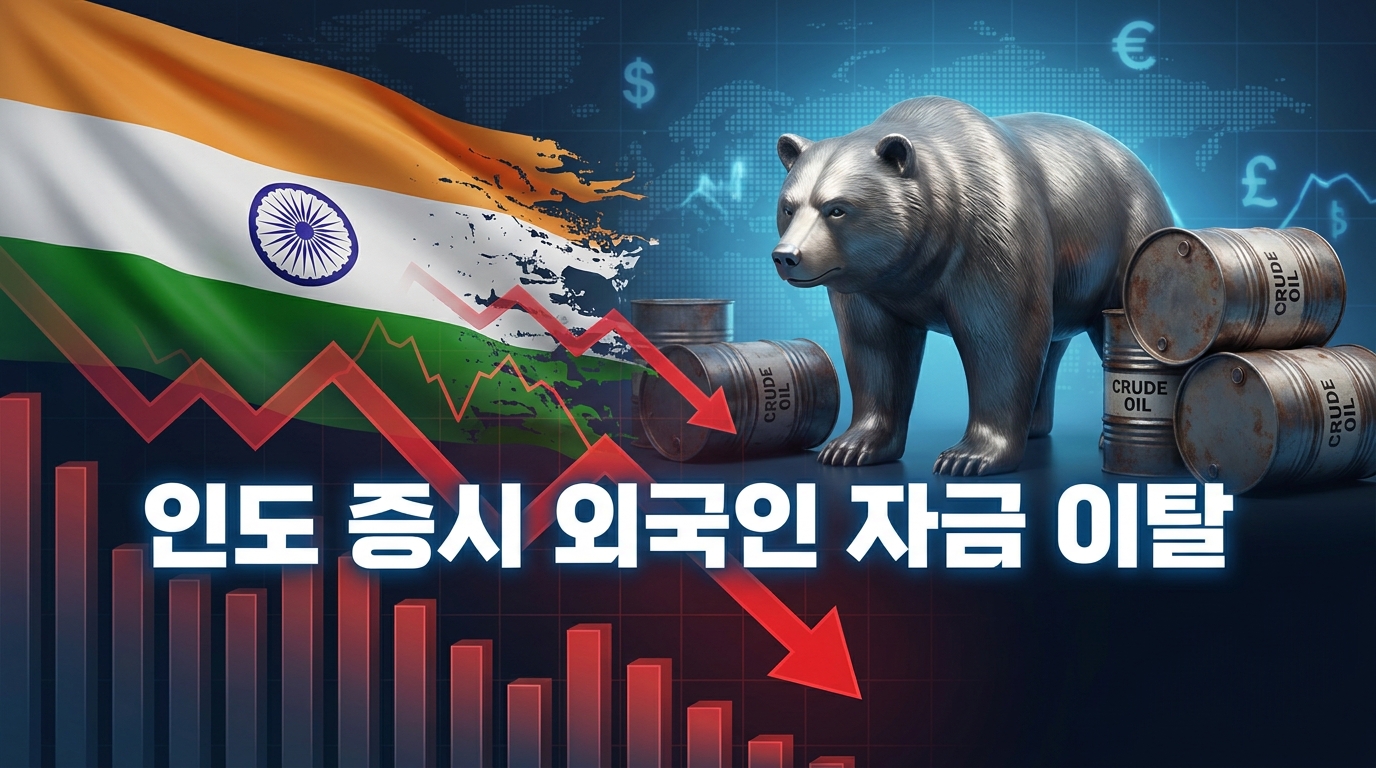
As a record-breaking outflow of foreign investors' funds continues in the Indian stock market (SENSEX), its status as a leading emerging market is cracking.
Amid the double whammy of surging oil prices and a weak rupee, a clear trend is emerging where global capital is leaving India and moving to AI-benefiting countries such as South Korea and Taiwan.
This capital shift is acting as a key driver deepening the fundamental decoupling among the US, Europe, and Asia.
Amid changing global macro environments, we examine the structural limitations and future scenarios of India, once dubbed the 'Next China.'
Current Situation Summary
On the day, the KOSPI index is recording an intraday (provisional) 7847.71, while the USD/KRW exchange rate is showing a high level of 1,512.50 KRW.
The NASDAQ index is also pointing to an intraday (provisional) 26343.97, and as a tech-driven market unfolds, the polarization in global stock markets is reaching its peak.
In the Indian stock market recently, foreign portfolio funds worth approximately $20 billion have flowed out in just over two months, showing signs of breaking the record for the largest annual outflow [1].
This is the result of India, which depends on imports for 90% of its energy demand, taking a direct hit from geopolitical risks in the Middle East and the widening upward surge in international oil prices.
According to Daily Stock's proprietary Fear & Greed Index, the shift in market participants' sentiment is evident.
The KOSPI Fear & Greed Index is currently Neutral (57.3), which has somewhat cooled compared to Neutral (58.9) a week ago, Greed (64.8) a month ago, and Greed (63.4) three months ago.
The NASDAQ Fear & Greed Index has also entered a volatility alert zone, currently recording Neutral (58.6), down from Greed (63.2) a week ago, Greed (68.5) a month ago, and Greed (66.8) three months ago.
Financial Analysis
[Image: /stdaily/uploads/202605/gen_6a149ceeea60e9.34634269.png]
Top listed companies in the Indian stock market are facing intense input cost pressures due to rising raw material prices and the rupee hitting an all-time low.
Selling pressure has been particularly concentrated in the financial, auto, and consumer goods sectors—which have a high proportion of foreign ownership—as concerns over earnings deterioration grow.
Above all, India suffers from a critical weakness: the absence of large tech stocks and a semiconductor ecosystem capable of leading the global AI capital expenditure (CAPEX) cycle [4].
This contrasts sharply with key IT companies in South Korea and Taiwan, which are directly benefiting from AI infrastructure expansion and raising their earnings estimates.
Valuation
Despite the recent short-term correction, the Indian SENSEX index, which previously enjoyed a high growth premium as the 'Next China,' still faces a significant valuation burden within emerging markets.
India's weight in the Morgan Stanley Capital International (MSCI) Emerging Markets Index has noticeably shrunk recently due to positioning changes by fund managers [5].
Conversely, the US is justifying high multiples based on solid Big Tech earnings, while Europe is attempting a value-stock-centric re-rating amidst entrenched low growth.
Even within Asia, India's relative strength has sharply declined, whereas a 'Rotation' to East Asian markets—where valuation appeal is highlighted—shows a distinct tri-polar decoupling.
| Fundamental Decoupling Comparison by Region | United States (US) | Europe (EU) | Asia (Centered on India) |
|---|---|---|---|
| **Market Characteristics** | AI tech-driven fundamental superiority market | Value stock re-rating based on valuation appeal | Heightened supply-demand and exchange rate burdens due to oil spikes |
| **Key Indicators/Policies** | Federal Reserve (Fed) prolonged high interest rates | European Central Bank (ECB) preemptive rate cuts | Reserve Bank of India (RBI) and Asian central banks struggling with forex defense |
| **Foreign Supply/Demand** | Continuous inflow of passive and AI fund capital | Selective portfolio inflows amid range-bound trading | Record capital outflows due to AI absence and profit-taking |
| **Global Relative Strength** | Top tier (Leading global bull market) | Mid tier (Securing downward rigidity and dividend appeal) | Bottom tier (Massive expansion of short-term volatility and relative exclusion) |
Expert & Institutional Analysis
Global investment banks (IBs) and large asset managers are accelerating moves to tactically reduce their weightings in India within global portfolios [5].
According to Goldman Sachs' data, foreign ownership of Indian equities recently fell to its lowest level in over a decade, suggesting this is not a mere temporary correction.
Experts point out that as global liquidity strongly realigns around Artificial Intelligence (AI) and advanced data center infrastructure, India—lacking innovative tech companies—is highly likely to remain sidelined for the time being.
However, some analysts diagnose that India's massive domestic liquidity and funds from Domestic Institutional Investors (DII) are partially offsetting the foreign exodus, potentially paving the way for a self-sustaining bottoming out in the mid-to-long term.
Risk Factors
[Image: /stdaily/uploads/202605/gen_6a149d01b78031.89136773.png]
The biggest macroeconomic risk currently threatening the Indian stock market is undoubtedly the prolonged geopolitical crisis originating in the Middle East and the resulting global supply chain disruptions.
Given an industrial structure with absolute dependence on energy imports, a spike in international oil prices inevitably leads straight to an expanding trade deficit and surging import prices.
Furthermore, the existing 'supply chain diversification' scenario—where India was expected to easily gain windfall benefits amid the US-China hegemonic rivalry—is highly likely to be delayed as it hits realistic barriers.
If the Reserve Bank of India (RBI)'s monetary policy flexibility weakens in its effort to curb high inflation, a scenario intertwining slowed domestic growth and falling stock prices must also be kept open.
Investment Perspective Summary
At the present juncture, rather than blindly bargain-hunting in the Indian market where macroeconomics and foreign supply-demand tangles overlap, cautious observation is required.
This is because it is difficult to go against the macro trend of global capital being reallocated to East Asian regions that possess the core value chain of the AI industry.
Investors must closely track the diverging monetary policy trends of central banks (Fed, ECB, BOJ/RBI, etc.) amidst the fundamental decoupling across the US, EU, and Asian regions.
Consequently, this is a time when a sophisticated asset allocation strategy is essential—balancing between innovative developed markets that guarantee earnings visibility and regions that can ride the interest rate cut cycle.
Investor Checkpoints Q&A
Q1. What is the fundamental reason for the recent massive outflow of foreign funds from the Indian stock market?
A1. The core causes are surging oil prices and downward pressure on the rupee due to prolonged Middle East risks. Additionally, as global active funds shift capital to South Korean and Taiwanese markets where semiconductor and AI benefits are concentrated, India's relative appeal has diminished.
Q2. What is the structural background behind India being thoroughly excluded from the global AI rally?
A2. This is because India significantly lacks a large-scale advanced semiconductor and hardware manufacturing ecosystem capable of directly benefiting from the global AI capital expenditure (CAPEX) cycle, unlike the US or East Asian regions.
Q3. How is the policy decoupling among the US, European, and Asian stock markets unfolding currently?
A3. The US Federal Reserve (Fed) is prolonging high interest rates based on a robust economy, while Europe (ECB) is weighing preemptive rate cuts for economic defense. Meanwhile, Asian emerging markets are walking their own survival paths, focusing all efforts on defending exchange rates and stemming capital outflows.
Q4. Can Indian domestic funds (DII) completely defend against the massive foreign exodus?
A4. While India's abundant domestic retail/institutional liquidity is supporting the short-term downside of the stock market, the prevailing analysis is that stabilizing the global macro environment and the return of foreign capital are ultimately essential for the market to revert to a trending rally.
Q5. How is it advantageous to readjust a global stock portfolio at this point?
A5. It is advisable to comply with global capital flows and diversify assets into AI ecosystem-leading markets with visible earnings growth, and markets benefiting from policy rate cuts. On the other hand, the weighting of emerging markets—which are vulnerable to raw material price volatility and have high valuation burdens—needs to be managed conservatively for the time being.