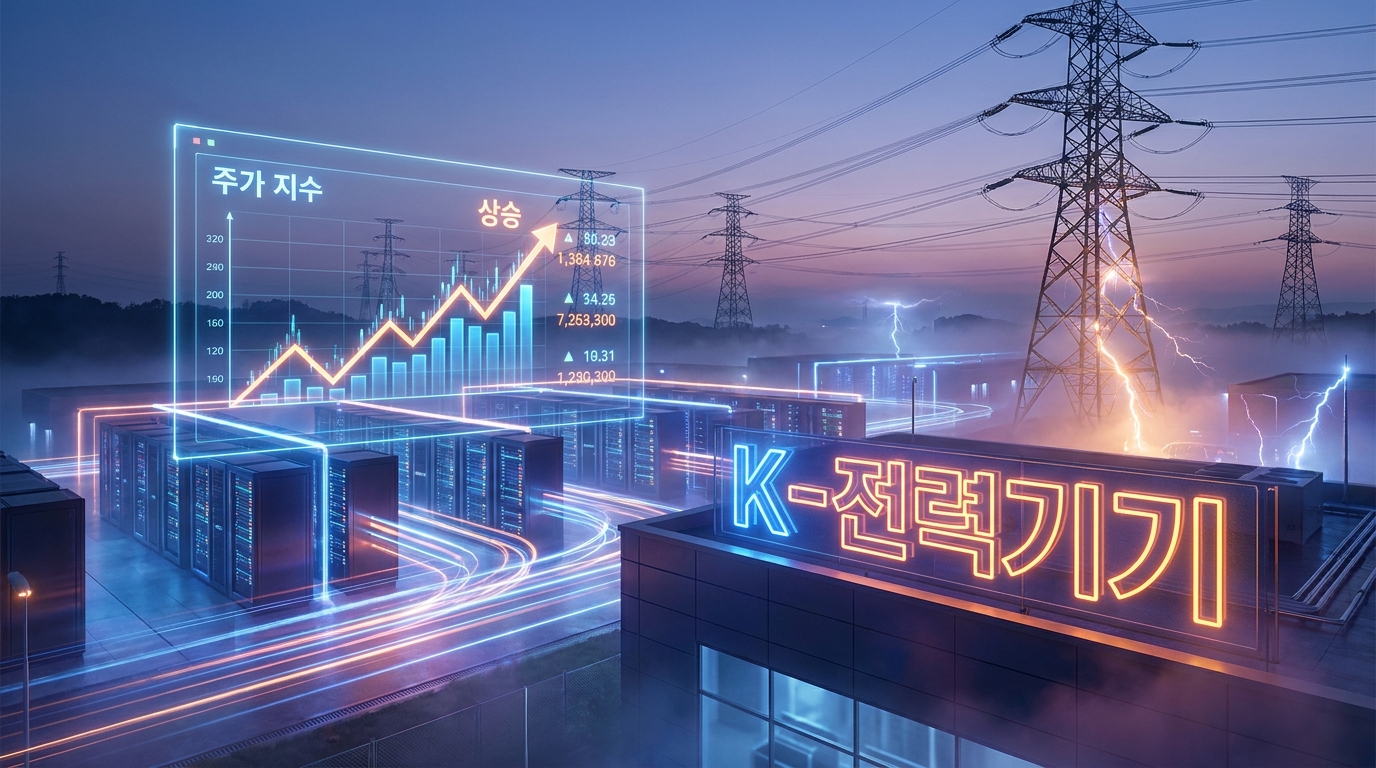
Hello, I am a professional writer for Daily Stock. Today, we will examine the current status of the power equipment sector, which has established itself as a leading industrial stock on the KOSPI based on massive artificial intelligence (AI) infrastructure demand even in the super-strong dollar environment in the 1,500 won range.
[Image: /stdaily/uploads/202605/gen_6a0eae0f81bf32.94965940.png]
Core Summary
The KOSPI closed at 7,815.59, and a large-cap export stock market led by foreign spot and futures supply and demand is unfolding.
Domestic power equipment companies are continuing a relay of orders due to the explosive increase in power demand for AI data centers driven by North American big tech.
The fundamental upgrade and margin maximization scenario of the industrial sector, created by the KRW/USD exchange rate surpassing 1,505.60 won, stands out.
Current Situation Summary
As of the market close on May 21, 2026, the KOSPI index recorded 7,815.59, maintaining a solid trend.
The KOSDAQ closed at 1,105.97, and the NASDAQ at 26,270.36, while the core macro indicator, the KRW/USD exchange rate, soared to 1,505.60 won, solidifying the super-strong dollar trend.
According to the proprietary Fear & Greed Index compiled by Daily Stock, the KOSPI is currently in the 'Neutral (57.9)' stage.
This is a slight stabilization from the 'Greed (65)' level a week ago and 'Greed (60.2)' a month ago, representing market sentiment similar to 'Neutral (57.3)' three months ago.
On the other hand, the NASDAQ's Fear & Greed Index is currently recording 'Greed (60.9)'.
Although slightly lower than a month ago (67.6), it has steadily maintained a greed phase since a week ago (65) and three months ago (66.2), driving the global preference for risky assets.
Amid this macro environment, news of North American orders for K-power equipment companies has been a daily hot topic in the Korean stock market recently.
In mid-May alone, LS Electric consecutively announced contracts worth 105 billion won for power distribution equipment for US big tech data centers and 96 billion won for high-voltage switchboards for microgrids.
Financial Analysis
The financial indicators of Korea's large power equipment companies are showing steep margin improvements driven by rising unit prices in the North American market and the trend of longer delivery times.
In particular, as the proportion of North American sales rises steeply, the high exchange rate exceeding 1,505 won directly leads to an increase in the operating profit margin.
In the case of HD Hyundai Electric, the high-profit product mix effect in North America has materialized in earnest, with its operating profit margin reaching the high 20% level (today's quote unconfirmed, based on the latest confirmed value).
The increase in power density due to the expansion of AI infrastructure is strongly driving the demand for high-value-added extra-high voltage transmission network equipment.
| Company Name | Recent Key Order Momentum (As of May 2026) | Main Export Regions & Characteristics |
|---|---|---|
| **LS Electric** | 105 billion won contract for US big tech data center switchboards, 96 billion won for microgrids | North American data centers, microgrids, and high-end distribution equipment |
| **HD Hyundai Electric** | Expanded orders for 765kV extra-high voltage transformer packages, participated in Hannover Messe for the first time in 7 years | North American extra-high voltage power grids, European BESS, and eco-friendly power solutions |
The leap forward in the European market, as well as in North America, is also worth noting.
As the European Union's (EU) carbon neutrality goals and the demand for replacing aging power grids coincide, domestic power solution companies' long-term order backlogs for 400kV and higher extra-high voltage transformers are thickening.
Valuation
[Image: /stdaily/uploads/202605/gen_6a0eae2519aac2.63338519.png]
The valuation of the KOSPI industrial sector, especially power facility stocks, is undergoing a re-rating to the level of growth stocks, escaping the limitations of past economically sensitive stocks.
Since massive order backlogs will be recognized as revenue over the medium to long term from 2026 to 2030, future earnings visibility is evaluated to be clearer than ever.
Although the 12-month forward price-to-earnings ratio (PER) has risen due to the recent sustained rally, they are still often traded at a discount compared to the multiples of major global competitors in North America and Europe.
Particularly, in the super-strong dollar environment in the 1,500 won range, the firm profit capability centered on overseas subsidiaries has been proven, and foreign investors are observed structurally expanding their weightings.
At the root of this valuation re-evaluation is the 'investment linkage' with the semiconductor-centric IT hardware industry.
A virtuous cycle where increased AI chip investment in data centers leads to an exponential increase in power consumption, directly resulting in orders for transformers and power distribution systems, justifies the valuation rise.
Expert & Institutional Analysis
Securities industry experts unanimously say that the nature of North American power infrastructure investment has evolved beyond mere replacement of aging facilities into 'essential spending for the survival of the AI ecosystem'.
According to recent institutional reports such as Korea Investment & Securities, there is a prominent trend among global big tech companies to prefer long-term package contracts that bundle entire distribution equipment, rather than simple contracts for individual power transformers.
Another key point is the increasing demand for the construction of 765kV transmission networks to resolve power bottlenecks in data center-dense areas and to connect with distant renewable energy sources.
It is the common view of experts that Korean companies, which can supply these by securing lines in advance, hold a firm negotiating advantage in the global market.
Foreign investors are also showing a tendency to incorporate power equipment industrials as an essential portfolio along with semiconductors and automobiles when net-buying large-cap stocks in the KOSPI 200 as a basket.
This stems from the belief that a definitive seller's market will serve as a profit defense shield even amid prolonged inflation or macro uncertainty.
Risk Factors
The first key risk to check is the possibility of a sharp expansion in the volatility of raw material prices, especially non-ferrous metals like copper.
If the price of copper, the main raw material for transformers, switchboards, and wires, skyrockets beyond expectations, there is room for short-term cost burdens due to the time gap in passing on sales prices.
Whether major exporting countries like the US strengthen protectionism is also a variable that must be monitored.
To prepare for the possibility of strengthened local component mandate trends or past anti-dumping tariff impositions, companies with local production plant (greenfield investment) capabilities must be selected.
Additionally, if the high-interest-rate environment of the Bank of Korea and the US Federal Reserve is prolonged due to higher-than-expected inflation, new facility investments in private commercial real estate or general industries may be temporarily delayed.
Investment Perspective Summary
The super-strong dollar environment, currently recording 1,505.60 won, is acting as a powerful 'earnings booster' for K-power equipment leading stocks boasting an overwhelming export proportion.
Although there are voices expressing concern over short-term stock price overheating in some quarters, it is forecasted that the order backlog secured for the next several years will strongly support the downward rigidity of earnings.
In addition to the three major power equipment companies leading the KOSPI, it is necessary to consistently track the trickle-down effect to small and mid-cap stocks supplying parts, gas-insulated switchgear (GIS), and wires belonging to the lower value chain.
In particular, the expansion of the microgrid trend, which is the independent power grid of big tech companies, is highly likely to create new beneficiaries related to high-voltage switchboards.
In conclusion, if you are looking for tangible earnings growth stocks even amidst the sharp fluctuations of global macro indicators like the exchange rate, the power infrastructure sector can be the backbone of your portfolio.
However, if market sentiment enters an overheated phase or the exchange rate sharply turns downward, short-term profit-taking volume may emerge, so a long-term approach strategy of buying in installments during corrections is suggested.
FAQ
Q1. Why is AI data center investment good news for the power equipment industry?
High-performance GPUs used for AI calculations consume overwhelmingly more power than existing general cloud servers. To handle this, the demand for essential power grid infrastructure, such as high-efficiency switchboards, extra-high voltage transformers, and microgrids connecting power plants to data centers, is explosively increasing.
Q2. What is a 765kV transformer and why is it important?
kV stands for kilovolt, a unit of voltage, and 765kV is an extra-high voltage transmission equipment designed to send large-capacity power over very long distances with minimized loss. Recently, as large-scale power transmission is required due to AI infrastructure expansion and renewable energy connection, orders for 765kV equipment, which require highly advanced design technology, are structurally surging.
Q3. The KRW/USD exchange rate has exceeded 1,500 won. Is this advantageous for power equipment stock prices?
Yes, it generally works very advantageously. Domestic large-cap power equipment companies have overseas sales proportions in North America, the Middle East, and Europe accounting for more than half. Since payment is received in dollars, they directly benefit from foreign exchange gains where operating profit and net profit units greatly increase when converted into Korean won.
Q4. How are Korean companies responding to US protectionism risks?
Major large companies have already experienced trade barriers such as anti-dumping tariffs in the past and have been preparing proactively. They are wisely hedging policy risks by proactively establishing local production bases in places like Alabama and Utah in the US and expanding large-scale lines to increase the proportion of direct deliveries within the US (Made in USA).
Q5. Is it okay to buy power equipment stocks when the index is high like now?
These companies have their order backlogs filled until around 2030, so their medium- to long-term fundamentals are very strong. However, in phases where stock prices have surged in a short period, taking a breather due to supply and demand imbalance may occur. Therefore, an installment buying perspective of increasing the weighting during every correction by utilizing macro policy changes or short-term downward phases of the exchange rate can be reasonable.