Hello, I am an expert writer for Daily Stock.
Today, we will examine the robust May 2026 import and export trends amid the ultra-strong dollar environment of the 1,506 KRW range, and explore portfolio strategies for non-IT leading stocks on the KOSPI based on this data.
[Image: /stdaily/uploads/202605/gen_6a0d5c7fa62790.44502966.png]
Core Summary
As of May 20th, 2026, the KOSPI closed at 7,208.95 and the KOSDAQ at 1,056.07, continuing a differentiated market between large-cap and small-to-mid-cap stocks.
With the USD/KRW exchange rate hitting 1,506.80 KRW, expectations of earnings improvement for export-driven companies enjoying currency effects are acting as a key driver defending the market.
According to Daily Stock's proprietary Fear & Greed Index, the KOSPI currently shows a Neutral (50.3) level, escaping overheating and entering a breather phase.
In contrast, the NASDAQ remains in the Greed (60.3) zone amidst a high index level of 25,870.71, supporting global risk-on sentiment.
Current Situation Summary
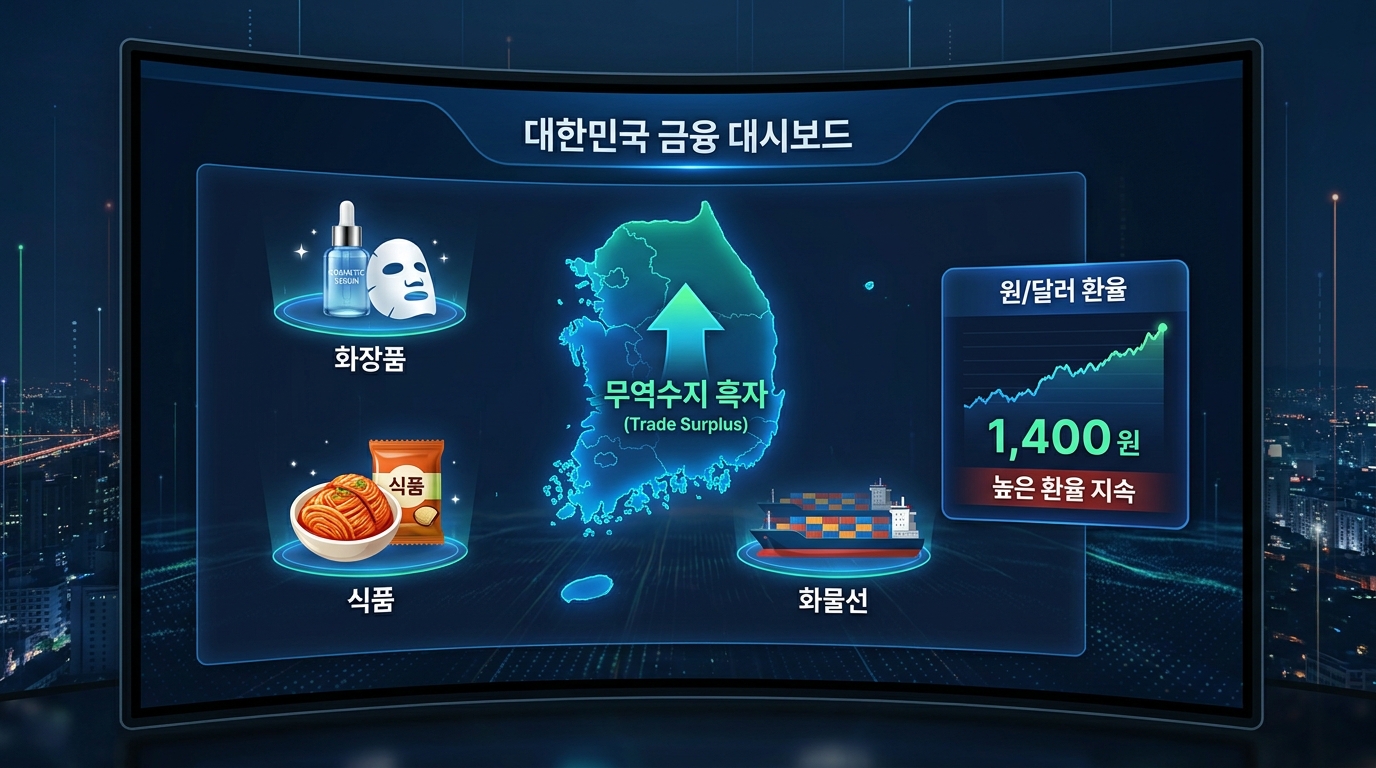
Ahead of the Korea Customs Service's release of provisional import/export statistics for May 1-20, the market estimates that strong exports in the cosmetics, K-Food (ramen and processed foods), and defense sectors will lead the trade surplus trend [1].
As South Korea's export portfolio, which was previously concentrated on IT and semiconductors, diversifies into consumer goods and machinery, positive signs of gradually decreasing dependence on specific industries are being detected.
In particular, the ultra-strong dollar phenomenon exceeding 1,500 KRW poses a burden of rising import prices, but it simultaneously provides price competitiveness and foreign exchange gains to export companies with a high proportion of dollar settlements.
Reflecting this macro environment, foreign investors are highly likely to show a net buying trend focused on export consumer goods with high earnings visibility in the KOSPI spot market.
| Index/Indicator | Current Price (Close on 26.05.20) | Fear & Greed Index (Current) | 1 Week Ago | 1 Month Ago | 3 Months Ago |
|---|---|---|---|---|---|
| **KOSPI** | 7208.95 | Neutral (50.3) | Greed (64.7) | Greed (61.5) | Neutral (57.3) |
| **NASDAQ** | 25870.71 | Greed (60.3) | Greed (64.0) | Greed (70.0) | Greed (69.2) |
| **KOSDAQ** | 1056.07 | - | - | - | - |
| **USD/KRW** | 1,506.80 KRW | - | - | - | - |
Data baseline: Closing price on May 20, 2026, and in-house calculated indicators
Financial Analysis
Passing through this year's Q1 earnings season, K-Beauty and K-Food large-cap stocks have proven financial performances that significantly increased their revenue portions in the North American and European markets.
Provisional export data up to mid-May is also expected to support this increase in export volumes to North America, raising the possibility of upward trends for both Q2 revenue and operating profit margins.
Conversely, domestic-focused small and medium-sized enterprises with a high proportion of imported raw materials face financial pressure from rising cost of goods sold due to the high exchange rate of 1,506.80 KRW.
Accordingly, the free cash flow (FCF) gap between large-cap stocks with an overwhelming export portion and domestic demand stocks within the KOSPI 200 could widen further starting in Q2.
[Image: /stdaily/uploads/202605/gen_6a0d5c95074611.80167978.png]
Valuation
Currently in the global market, South Korean cosmetics and food companies are shedding their past 'Asia-only' discount and experiencing a multiple (PER) re-rating as global consumer goods.
The price-to-earnings ratios of major export consumer goods companies, which hovered around the 10-15x level in the past, are trending upwards to over 20x, boosted by high sales growth in North America.
Nevertheless, the 12-month forward PER of the entire KOSPI still holds an attractive valuation relatively lower compared to major global indices.
There is ample room for foreign investors' valuation-based bargain hunting to flow in, centered on stocks whose earnings upgrades due to the strong dollar have not yet been fully reflected in their stock prices.
Expert and Institutional Analysis
Securities market experts analyze that if the May export boom continues, the Bank of Korea is likely to freeze current interest rates rather than hastily cut them, observing the balance between domestic demand and exports.
This is because export-driven economic growth appears favorable in indicators, somewhat reducing the urgency for artificial stimulus through interest rate cuts.
Institutional investors are also adopting a strategy of maintaining their portfolio weights in structural growth stocks while hedging against the volatility of the USD/KRW exchange rate in the futures market.
Foreign supply and demand dynamics also show a pattern of focusing on the fundamentals of export performance to selectively pick winners, rather than temporarily exiting due to the surging exchange rate.
Risk Factors
The biggest risk is the import-driven inflationary pressure that could be triggered if the ultra-strong 1,506.80 KRW/USD exchange rate is prolonged, and the resulting concerns over a domestic consumption slowdown.
Even if the trade surplus continues, a deepening domestic recession could worsen overall market sentiment, potentially capping the upside of the KOSPI index.
Furthermore, if macro indicators in major export destinations such as the US and Europe slow down in the second half of the year, the possibility that the current strong export cycle will cool off faster than expected cannot be ruled out.
Given the nature of the highly export-dependent Korean stock market, signals of global economic slowdown can directly lead to downward revisions in earnings estimates, requiring special caution.
Investment Perspective Summary
The current KOSPI 7,200 level market is granting a premium to export-leading stocks that show clear earnings improvements despite macroeconomic uncertainties.
Therefore, as confirmed by the May import/export trends, a selective approach to sectors where exchange rate effects and North American market expansion overlap could be advantageous.
However, as the Fear & Greed Index for the KOSPI has dropped to Neutral (50.3), it is time to consider a split purchasing strategy utilizing volatility rather than chasing rallies.
Investors are encouraged to construct a flexible and defensive portfolio, using the Korea Customs Service's monthly export data by item as a compass.
Investor Checkpoints Q&A
Q1. Which sectors deserve the most attention in the May 1-20 export trends?
In addition to traditional IT and semiconductors, the core points to watch are the rapid progress of K-Food (like ramen) and cosmetics, whose export shares to North America are surging, as well as the defense and machinery sectors with ample order backlogs.
Q2. What is the impact of the 1,506 KRW exchange rate on KOSPI supply and demand?
Generally, a high exchange rate triggers foreign capital outflows. However, currently, it is creating a differentiation phenomenon where foreign net buying is concentrated on large-cap export stocks expected to see foreign exchange gains and margin spread improvements.
Q3. What is the expected direction of the Bank of Korea's base interest rate?
The prevailing analysis is that a policy of freezing the base rate, focusing on price stability and household debt management, is highly likely to continue for the time being, as solid export growth drives domestic Gross Domestic Product (GDP).
Q4. Is there room for further upside in the K-Food and cosmetics sectors?
As the popularity of 'K-Culture' in the global market establishes itself as a structural consumption trend rather than a one-off event, additional upside scenarios are open if accompanied by earnings upgrades and valuation re-ratings.
Q5. Is there a risk that the trade surplus trend will reverse in the second half of the year?
There is a persistent risk that the trade surplus could shrink if consumption contracts in developed countries due to changes in the global interest rate environment, or if energy import costs increase due to surging international oil prices.