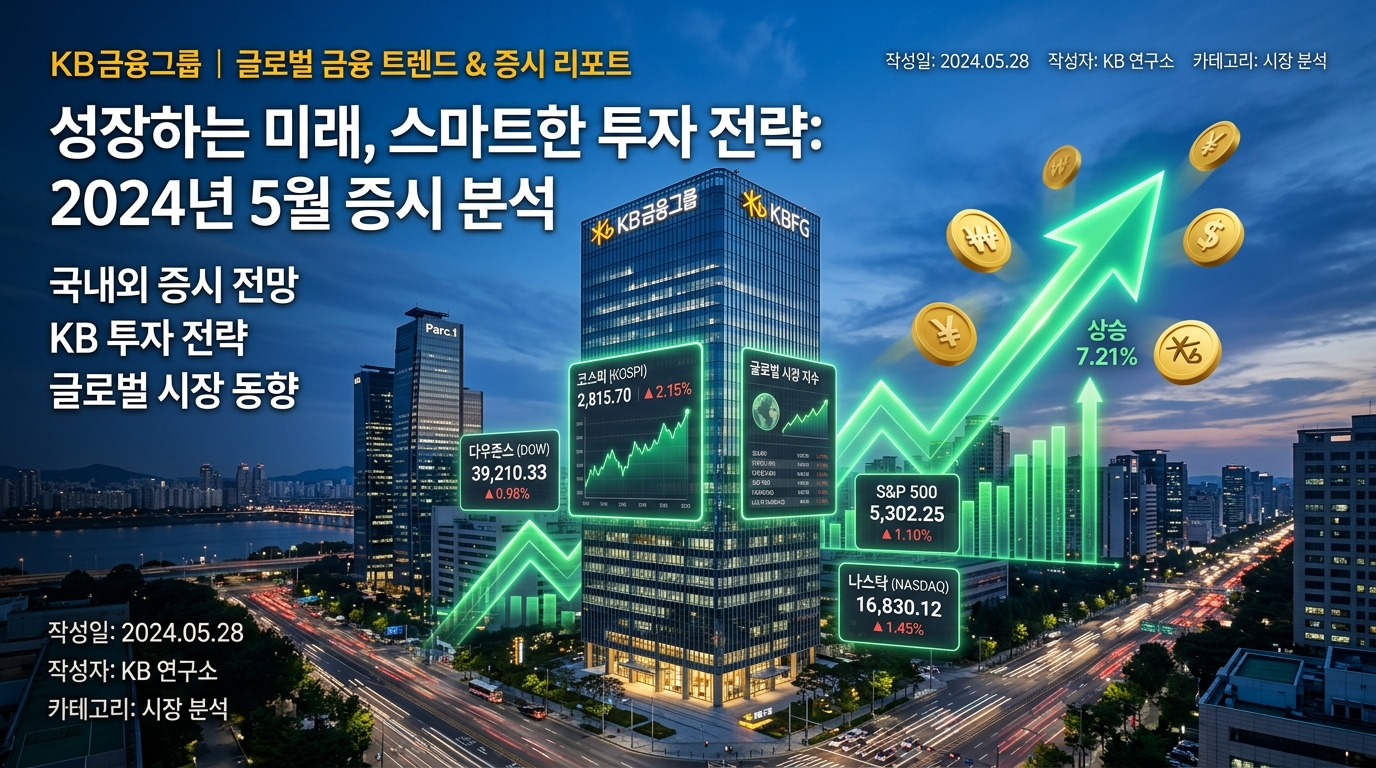
Hello, this is Daily Stock.
Today, we provide an in-depth analysis of the dividend policy and supply-demand scenarios for KB Financial Group (105560), which has been showing unprecedented shareholder return moves as a leading play in the recent Value-Up Program.
[Image: /stdaily/uploads/202608/gen_6a86a64b8da2f5.88244603.png]
Executive Summary
* Record-High Earnings and Status as Value-Up Leader: KB Financial Group proved its unshakable status as the leading financial group by recording a cumulative consolidated net profit of 3.8846 trillion KRW in the first half of 2026.
* Synergy of Quarterly Equal Dividends and Reduction in Outstanding Shares: The company uses a 'quarterly equal dividend' method, fixing the quarterly dividend pool at approximately 405.0 billion KRW. As a result, it has established a unique compounding structure where the dividend per share (DPS) automatically increases for individual shareholders as the number of outstanding shares decreases due to treasury share cancellations.
* Decision to Buy Back and Cancel 700.0 Billion KRW of Treasury Shares in H2: In accordance with the principle of actively returning capital exceeding the Common Equity Tier 1 (CET1) ratio of 13.5%, the company made a surprise decision to buy back and cancel an additional 700.0 billion KRW of treasury shares in the second half of the year.
* Introduction of Capital Reduction Dividend and ROE-Linked Shareholder Return Restructuring: A tax-free dividend policy utilizing capital reserve reduction, scheduled for implementation starting next year, is expected to boost the real after-tax returns for shareholders.
Market Overview
On August 20, 2026, the South Korean stock market closed with the KOSPI index surging 5.89% from the previous session to end at 6,852.58, driven by easing US Treasury yields and blockbuster shareholder return announcements from major large-cap stocks.
On the other hand, the financial sector, which had served as a defensive play during recent market volatility, experienced a slight correction due to profit-taking pressure.
KB Financial Group's closing price fell 3.85% from the previous day, impacted by capital shifting toward large-cap tech stocks on KOSPI. The closing price as of August 19 was 161,800 KRW.
The USD/KRW exchange rate stabilized around 1,392.20 KRW amid easing macroeconomic concerns, such as the US Treasury's expansion of bond buybacks, providing solid fundamental support for foreign inflows.
According to Daily Stock's proprietary Fear & Greed Index, the KOSPI Fear & Greed Index is currently in the "Neutral" zone (56.6), recovering from "Fear" (34.8) a week ago and "Extreme Fear" (13.3) a month ago.
Financial Analysis
KB Financial Group's cumulative net profit for the first half of 2026 reached 3.8846 trillion KRW, recording a solid 13.1% increase compared to the same period last year (3.4360 trillion KRW).
In particular, the Q2 net profit reached 1.9922 trillion KRW, marking its highest quarterly earnings ever, driven by balanced growth across bank and non-bank (securities, insurance, etc.) portfolios.
Notably, the growth rate of Earnings Per Share (EPS) is much steeper than the net profit growth rate.
First-half EPS surged 18.1% year-on-year to 10,669 KRW (from 9,032 KRW), primarily because the cancellation of all 14.26 million treasury shares (3.8% of outstanding shares) in April and aggressive share buybacks significantly reduced the number of outstanding shares.
[Image: /stdaily/uploads/202608/gen_6a86a658b9de04.31135283.png]
| Key Financial & Shareholder Return Indicators | H1 2026 | H1 2025 | YoY Change |
|---|---|---|---|
| **Consolidated Net Profit** | 3.8846T KRW | 3.4360T KRW | +13.1% |
| **Earnings Per Share (EPS)** | 10,669 KRW | 9,032 KRW | +18.1% |
| **CET1 Ratio** | Around 13.6% - 13.7% | Around 13.5% | Improved/Maintained |
| **Outstanding Shares at Period-End** | 353.39M shares | 364.15M shares | -3.0% |
Valuation
KB Financial Group is shedding the stigma of a traditional low-PBR financial stock, recovering to a PBR of around 1.0x and accelerating its global rerating.
With Return on Equity (ROE) improving significantly to 14.09%, valuation rerating continues based on the harmony of a strong capital adequacy ratio (CET1).
The annual total shareholder return rate for 2026 is projected to reach approximately 53% to 55%, including share buybacks and cancellations.
The expected dividend yield is expected to remain around the 3% range due to the rising stock price, but from the perspective of total shareholder return—including treasury share cancellations—it exceeds 7%, highlighting its attractiveness as an alternative asset class to bonds.
Analyst and Institutional Views
Financial investment professionals consistently recommend KB Financial Group as their top pick among banking stocks.
Hanwha Investment & Securities maintained its "Top Pick" rating with a target price of 226,000 KRW, while LS Securities suggested a target price of 205,000 KRW based on robust underlying earnings power and the positive impact of the 700.0 billion KRW treasury share cancellation in the second half.
The most highly anticipated momentum among institutional experts is the full-scale implementation of "capital reduction dividends" next year.
If tax-free dividends using capital reserve reductions are implemented, the dividend income tax (15.4%) will be waived and excluded from the global financial income tax.
Accordingly, a scenario in which passive capital inflows accelerate from tax-sensitive high-net-worth individuals (HNWIs) and large pension funds is highly favored.
Risk Factors
* Exchange Rate Volatility and Risk-Weighted Asset (RWA) Management: The CET1 ratio, which serves as the core benchmark for shareholder returns, is highly sensitive to macroeconomic variables such as the USD/KRW exchange rate. A sharp rise in the exchange rate could increase RWAs due to higher foreign-currency asset valuations, potentially restricting shareholder return capacity in the short term.
* Adjusting Shareholder Return Mix Near PBR 1x: Management has hinted that as the PBR approaches 1x, they may flexibly adjust the balance between cash dividends and the existing buyback-and-cancellation-centric policy. Volatility could arise if this shift in the shareholder return mix fails to meet short-term market expectations.
* Bank of Korea Interest Rate Policy: If the Bank of Korea begins cutting interest rates amid economic slowdown concerns, pressure on Net Interest Margin (NIM) could intensify, which may slow down interest income growth.
Investment Outlook
KB Financial Group is successfully proving itself as a global-standard shareholder return model that maximizes shareholder value through treasury share cancellations rather than being a simple high-dividend play.
In the short term, capital rotation to exporting large-caps, such as semiconductors, during the KOSPI's technical rebound might cause stock price volatility, but the fundamentals defending against macroeconomic uncertainties remain robust.
In the mid-to-long term, the company possesses over 11 trillion KRW in capital reserves for potential tax-free dividends, and the appeal of steadily rising quarterly dividends is expected to form a strong bottom support line.
Investor FAQ
Q1. What is the dividend per share for KB Financial Group in Q2 2026?
* A1. The Q2 dividend per common share was determined at 1,155 KRW. The ex-dividend date was August 6, and the payment date is August 21.
Q2. Why does canceling treasury shares increase the dividend received by individual shareholders?
* A2. KB Financial Group uses a formula that keeps the total quarterly dividend pool constant (at around 405.0 billion KRW). Therefore, when the number of outstanding shares eligible for dividends decreases due to share cancellations, the Dividend Per Share (DPS) mathematically increases.
Q3. What is the difference between a 'tax-free capital reduction dividend' and a regular dividend?
* A3. It is a method of paying dividends by reducing capital reserves rather than retained earnings. Under tax law, the dividend income tax (15.4%) is not applied. Since it is also excluded from the global financial income tax bracket, it significantly enhances the incentive for high-net-worth individuals to hold shares long-term.
Q4. What exactly is the CET1 ratio, which serves as the benchmark for shareholder returns?
* A4. The Common Equity Tier 1 (CET1) ratio is a core capital adequacy metric indicating a financial institution's actual loss-absorption capacity. KB Financial Group uses surplus capital exceeding a CET1 ratio of 13.5% as funding for shareholder returns.
Q5. Was there a specific reason why the stock price corrected on August 20, 2026?
* A5. As the KOSPI market surged 5.89% in a single day thanks to stabilizing US Treasury yields and block-buster share buyback announcements, buying pressure concentrated on tech stocks such as semiconductors. Consequently, short-term profit-taking and portfolio rebalancing outflows temporarily affected large financial stocks that had previously acted as market defensives.