Hello. This is Daily Stock.
Summary
- Amid a gradual recovery in the core steel business, a clear turnaround is being detected in the secondary battery materials sector, highlighted by the Argentina brine lithium plant 1 turning a profit.
- In Q2 2026, the company posted consolidated revenue of KRW 19.259 trillion and an operating profit of KRW 819 billion, visualizing a clear trend of performance improvement.
- The company is focusing on building long-term growth momentum through strong value-up policies (such as treasury stock retirement) and a global resource diversification ('Triple Core') strategy.
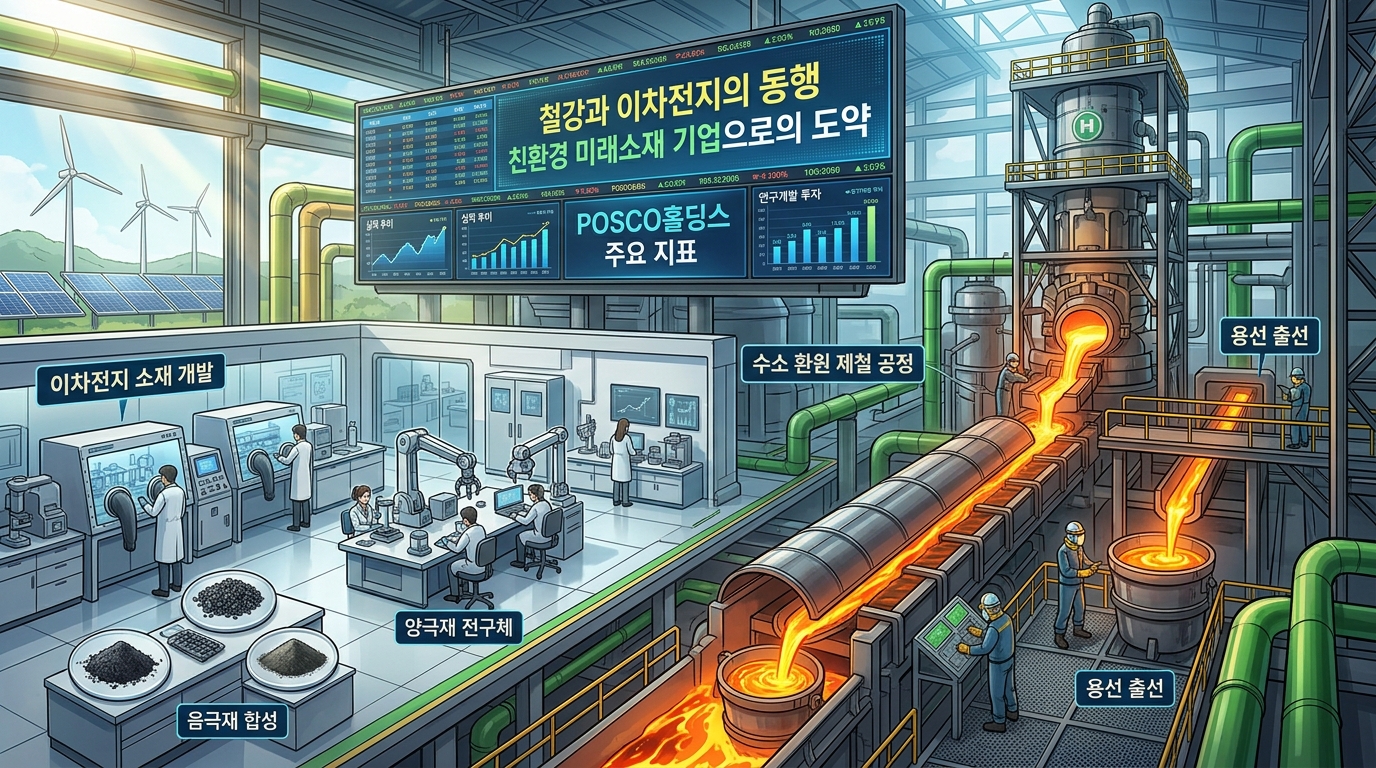
[Image: /stdaily/uploads/202608/gen_6a8554c41044a4.55973860.png]
Market Overview
As of August 19, 2026, the KOSPI market closed at 6,471.17 points, and POSCO Holdings (005490) ended the trading day at KRW 319,500, down 1.54% from the previous day.
In the foreign exchange market, the USD/KRW exchange rate remained somewhat high at 1,398.00, adding to the burden of raw material import costs for large manufacturers overall.
The KOSPI Fear & Greed Index stood at 38.3 (currently Fear; 21.7 a week ago, 12.4 Extreme Fear a month ago, 57.9 Neutral three months ago), indicating subdued investor sentiment.
Conversely, the Nasdaq Fear & Greed Index was at 54.3 (currently Neutral; 62.9 Greed a week ago, 37.2 Fear a month ago, 59.9 Neutral three months ago), displaying a contrasting trend.
While the steel sector is currently attempting a gradual bottoming out, the volatility of lithium prices and the re-rating of the secondary battery value chain remain key drivers for stock price recovery.
[Image: /stdaily/uploads/202608/gen_6a8554ceba8104.35288693.png]
Financial Analysis
In its Q2 2026 financial results announced on July 30, POSCO Holdings recorded consolidated revenue of KRW 19.259 trillion, operating profit of KRW 819 billion, and net profit of KRW 761 billion.
This represents a 7.7% increase in revenue and a 15.8% increase in operating profit compared to the previous quarter (Q1 revenue of KRW 17.876 trillion, operating profit of KRW 707 billion), signaling a clear recovery.
| Item | Q1 2026 | Q2 2026 | QoQ Change |
|---|---|---|---|
| Consolidated Revenue | KRW 17.876T | KRW 19.259T | +7.7% |
| Consolidated Operating Profit | KRW 707.0B | KRW 819.0B | +15.8% |
| Consolidated Net Profit | KRW 543.0B | KRW 761.0B | +40.1% |
This strong performance was driven by a recovery in steel sales prices alongside the initial quarterly profit from POSCO Argentina's brine lithium plant 1, demonstrating contributions from new business sectors.
Additionally, subsidiary POSCO International recorded historical quarterly high operating profit, supported by strong gas field operations in Myanmar and Australia, providing a solid anchor for the infrastructure division.
Valuation
POSCO Holdings' 12-month forward Price-to-Book Ratio (PBR) currently hovers around 0.45x, which indicates that it remains significantly undervalued relative to its book value.
To enhance shareholder value, the company is implementing aggressive shareholder return (Value-up) measures, such as maintaining a base dividend of KRW 10,000 per share and retiring treasury shares.
Compared to the industry average Price-to-Earnings Ratio (PER) of approximately 35.87x, POSCO Holdings' PER based on the day's close was around 31.48x, entering a relatively attractive valuation range.
Going forward, stabilization of lithium prices and expansion of the steel spread (product price minus raw material cost) could lead to an additional valuation re-rating.
Expert & Analyst Views
Securities firms and analysts maintain a "Buy" rating on POSCO Holdings, with an average target price of around KRW 460,000.
One institutional analyst noted, "The worst of the steel downturn has passed, and the restructuring of the portfolio centered on high-margin products is beginning to bear fruit."
Economic commentators also view positively the decision to reinvest approximately KRW 2.5 trillion raised from liquidating stakes in select affiliates back into core businesses.
Experts project that the 'Triple Core' business structure—comprising steel (industrial resources), lithium/rare earths (strategic resources), and LNG (energy resources)—will serve as a long-term growth driver.
[Image: /stdaily/uploads/202608/gen_6a8554d707aa14.14572213.png]
Risk Factors
Global risk factors include distortions in Asian steel prices due to excess exports of Chinese steel and a sluggish global real estate market.
If the pace of supply-demand stabilization in China remains slow, the improvement of steel spreads could be delayed, capping the profitability of the core steel business.
Additionally, if international lithium prices, a key index for the secondary battery materials division, do not rebound as expected in the second half of the year, upside potential for the stock price may be limited.
Moreover, the continued high USD/KRW exchange rate (mid-to-high 1,390s range) is exerting short-term pressure on margins by increasing raw material import costs.
Investment Outlook
POSCO Holdings is executing a structural transition into a future resource enterprise centered on lithium, built on the solid baseline earnings of its core steel business.
The key point to watch is whether the positive momentum from the secondary battery materials sector, which turned profitable in the first half of 2026, can be maintained through the second half of the year.
Considering active value-up initiatives and stable profits from the infrastructure division, a gradual upward trajectory aligned with the recovery of the industry cycle can be expected.
However, given the stock's sensitivity as a large-cap name to macroeconomic variables, a cautious approach monitoring exchange rates and raw material markets simultaneously is recommended.
Investor Checklist Q&A
Q1. What was the main driver behind the Q2 2026 earnings improvement compared to the previous quarter?
A1. It was driven by slight increases in steel sales volume and prices, the first-ever quarterly profit from POSCO Argentina's brine lithium plant 1, and robust performance from POSCO International's gas fields.
Q2. What is the current status of POSCO Holdings' Value-up policy?
A2. Along with a base dividend of KRW 10,000 per share, the company is executing a strong shareholder return program, including the retirement of treasury shares equivalent to 6% of outstanding shares over three years.
Q3. What exactly is the 'Triple Core' strategy?
A3. It is a strategy to enhance corporate value by focusing on three main pillars: industrial resources (traditional steel), strategic resources (lithium, rare earths, etc.), and energy resources (led by LNG).
Q4. What is the biggest risk hindering stock price recovery?
A4. Prolonged slowdown in global steel demand, weak international lithium prices, and rising raw material import costs due to the high USD/KRW exchange rate.
Q5. What is the current foreign ownership rate and technical standing?
A5. As of the close on August 19, 2026, the foreign exhaustion rate stood at approximately 32.47%, and the stock is trading near its historical valuation bottom at a PBR of 0.45x.