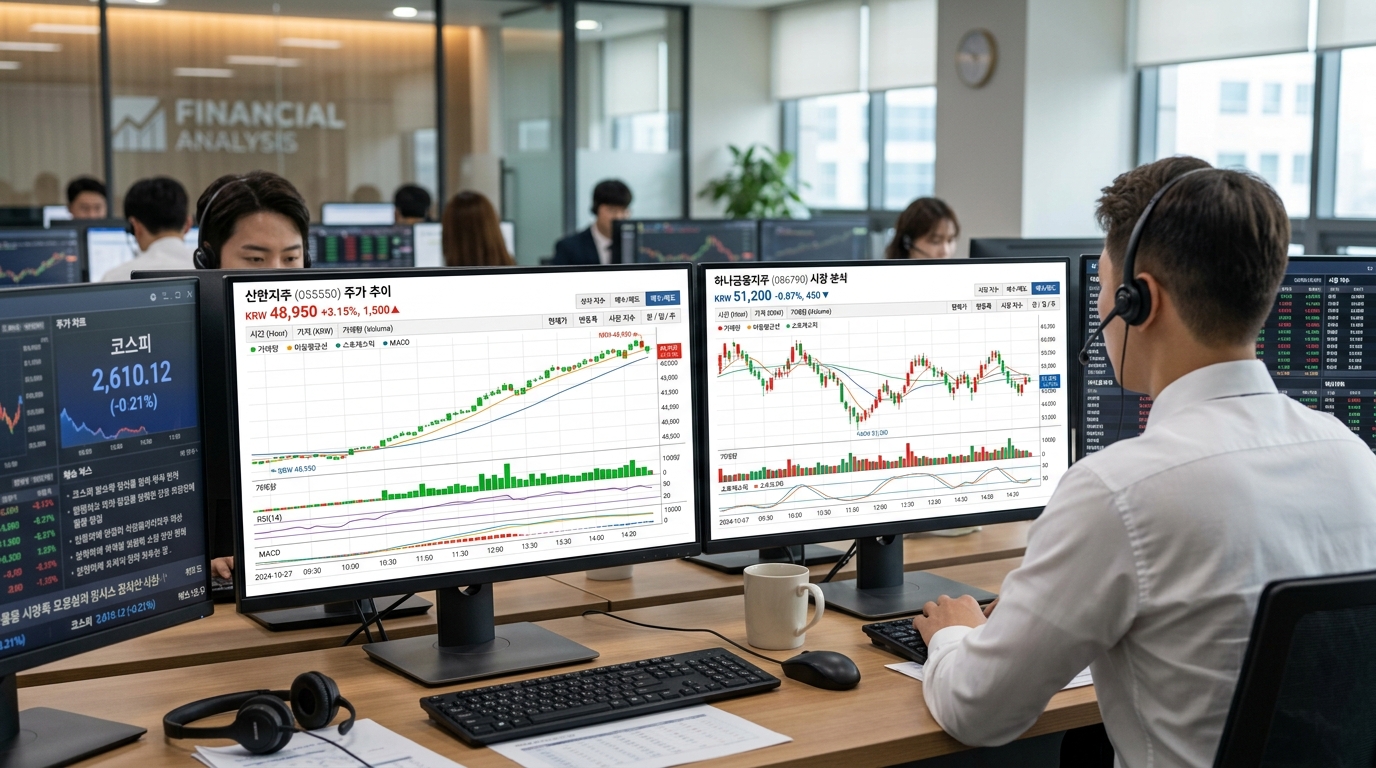
We present a detailed analysis of the record-breaking H1 2026 performance, Value-up momentum, and underlying asset quality indicators of Shinhan Financial Group and Hana Financial Group, the core financial stocks of the KOSPI market.
[Image: /stdaily/uploads/202608/gen_6a8403b5dedf84.11568089.png]
Key Summary
In the first half of 2026, major domestic financial holding companies renewed their record-high performances, standing tall as leaders of the Value-up program.
Shinhan Financial Group recorded a quarterly high with a net profit of 1.82 trillion won in Q2, while Hana Financial Group also achieved its highest performance in history, with an accumulated net profit of 2.4029 trillion won in H1.
Although both companies entered aggressive shareholder return phases by declaring share buybacks/cancellations and aiming for shareholder return rates above 50%, asset quality risks are also surfacing due to a recent surge in credit-impaired loan assets and a slowdown in bad debt provision accumulation.
Market Conditions Update
On August 18, 2026, the KOSPI index staged a strong rally, touching the 7,200 mark during the day, but closed down 108.11 points (-1.55%) from the previous session at 6,869.83 as selling pressure surged in the afternoon.
The USD/KRW exchange rate closed at 1,412.40 won, continuing high volatility in the foreign exchange market.
Financial stocks, which are sensitive to exchange rate fluctuations and foreign capital flows, also showed weakness late in the session.
As of the close of the day, Shinhan Financial Group fell 1.49% to close at 105,800 won, and Hana Financial Group fell 0.98% to close at 131,700 won.
Currently, Daily Stock's proprietary KOSPI Fear and Greed Index stands at the "Neutral" (54.8) stage, recovering from the "Extreme Fear" levels of 17.5 a week ago and 11.6 a month ago.
However, the profit-taking sales by institutional and foreign investors in the late session, combined with the Nasdaq Fear and Greed Index shifting to Neutral (59.8), suggest that a cautious approach is required for the overall market.
Financial Analysis
In Q2 2026, Shinhan Financial Group recorded an earnings surprise with a net profit attributable to controlling interests of 1.8201 trillion won, driven by improvements in its bank Net Interest Margin (NIM) and a surge in the non-interest income sector.
Its Common Equity Tier 1 (CET1) ratio also improved to 13.43%, proving its stable capital health.
To enhance shareholder value in the second half of the year, Shinhan Financial Group is pushing for a 700 billion won share buyback and cancellation program in Q3.
Hana Financial Group achieved record-high H1 cumulative net profit of 2.4029 trillion won, but its standalone Q2 net profit fell 1.4% quarter-on-quarter to 1.1928 trillion won due to one-off expenses such as foreign exchange losses and provisions.
One-off expenses in Q2 included 74.9 billion won in corporate reorganization-related provisions and 52.4 billion won due to changes in actuarial assumptions.
However, the group's NIM improved to 1.88% driven by the card division, and non-interest fee income surged 37.7% year-on-year, defending the overall performance.
| Item | Shinhan Financial Group (055550) | Hana Financial Group (086790) |
|---|---|---|
| **Q2 2026 Net Profit** | 1.8201 trillion won | 1.1928 trillion won (H1: 2.4029 trillion won) |
| **CET1 Ratio** | 13.43% | Over 13.0% (Management target) |
| **2026 Share Buyback Size** | 700 billion won (Additional Q3 plan) | 700 billion won (Cumulative annual plan) |
| **Shareholder Return Target** | Over 50% (Projected at 51-53%) | Over 50% (Projected at 51%) |
| **August 18 Closing Price** | 105,800 won | 131,700 won |
[Image: /stdaily/uploads/202608/gen_6a8403c2d47ce8.75539930.png]
Valuation
Shinhan Financial Group's PBR based on expected year-end 2026 BPS stands at around 0.8x, indicating that a significant level of rerating compared to its historical band has taken place.
Its ROE forecast was revised upward from 9.0% to 9.7%, supporting the valuation's legitimacy.
Analysts evaluate that linking the shareholder return rate directly with ROE and capital growth rate has increased transparency, leading the valuation upward.
Hana Financial Group also significantly raised its long-term ROE target from 10% to 12% through its new corporate value-up plan.
It gained market trust by introducing a shareholder return formula that links Risk-Weighted Asset (RWA) growth with ROE.
Currently, Hana Financial Group's PBR is below 0.8x, meaning its relative valuation appeal remains valid compared to its competitors.
Expert and Institutional Analysis
Securities analysts maintain "Buy" ratings for both financial holdings as they have provided clear roadmaps for shareholder return rates above 50%.
Major institutions such as Kiwoom Securities upgraded their target prices for Shinhan Financial Group, forecasting its shareholder return rate to expand to 53% by 2027.
Hana Financial Group is also solidifying its position as a strong dividend stock by introducing quarterly dividends and promising annual dividend growth of over 10%.
However, analysis of the recently released semi-annual report raises concerns that the accumulation of loan loss provisions to prepare for potential default risks is slowing down.
While provision expenses for the four major financial holding companies fell 8.7% year-on-year in H1, non-performing loans (NPL) are rising, which points to a decline in the NPL coverage ratio (which reflects loss absorption capacity).
Risk Factors
The most concerning risk is the decline in asset quality metrics.
As of H1 2026, Hana Financial Group's total loan portfolio increased by only 0.6%, but its "credit-impaired loan assets" representing actual delinquency and potential default risks jumped 29.6%.
Shinhan Financial Group also saw its credit-impaired loan assets increase by 17.1%, fueling concerns over deteriorating asset quality.
Residual risks from real estate project financing (PF) defaults and rising delinquency rates on loans to small and medium-sized enterprises (SMEs) are also burdensome.
As banks turn their eyes toward corporate finance amid household loan regulations, we cannot rule out a scenario where realized credit risks lead to higher credit costs, eating into profit stamina in H2.
Investment Outlook Summary
Shinhan Financial Group and Hana Financial Group have maintained solid stock performance as major beneficiaries of the government's Value-up program.
As their total shareholder return rates (including dividend yield and share cancellations) exceed 50%, they remain highly attractive as representative high-dividend defensive stocks in the KOSPI market.
However, the potential for an H2 economic slowdown and the surge in bad debt risks could increase short-term volatility.
Therefore, rather than aggressive buying, a strategy of buying on dips while monitoring asset quality indicators (such as NPL ratio and NPL coverage ratio) would be more favorable.
[Image: /stdaily/uploads/202608/gen_6a8403cde79288.57570074.png]
Investor Checkpoint Q&A
Q1. What is the key difference between the shareholder return policies of Shinhan Financial Group and Hana Financial Group?
A1. Shinhan Financial Group flexibly cancels shares within its target CET1 ratio range (13.0–13.4%), while Hana Financial Group introduced a formula that directly links shareholder returns to its ROE and Risk-Weighted Asset (RWA) growth rate.
Q2. Will the recent surge in non-performing loans immediately impact the earnings of these financial groups?
A2. Up until H1, bad debts could be absorbed due to excellent interest and non-interest income. However, if credit-impaired assets continue to rise in H2, the pressure to accumulate provisions will grow, which could slow down recurring net profits.
Q3. What is the impact of the USD/KRW exchange rate sitting at the 1,410 won range on Hana Financial Group?
A3. Hana Financial Group has a relatively high proportion of foreign exchange (FX) and overseas operations, giving it a structural characteristic where quarterly FX translation losses can occur in a strong USD environment.
Q4. What are the recent dividend schedules for the two stocks?
A4. Shinhan Financial Group's Q2 dividend record date was July 30, with payment scheduled for August 28. Hana Financial Group's quarterly ex-dividend date was August 7, with payment scheduled for August 21.
Q5. What is the most important indicator to check when making new entries at this point?
A5. Investors must monitor whether the CET1 ratio is maintained and check for improvements in the NPL coverage ratio, which indicates the level of provisions accumulated against non-performing loans (NPL).