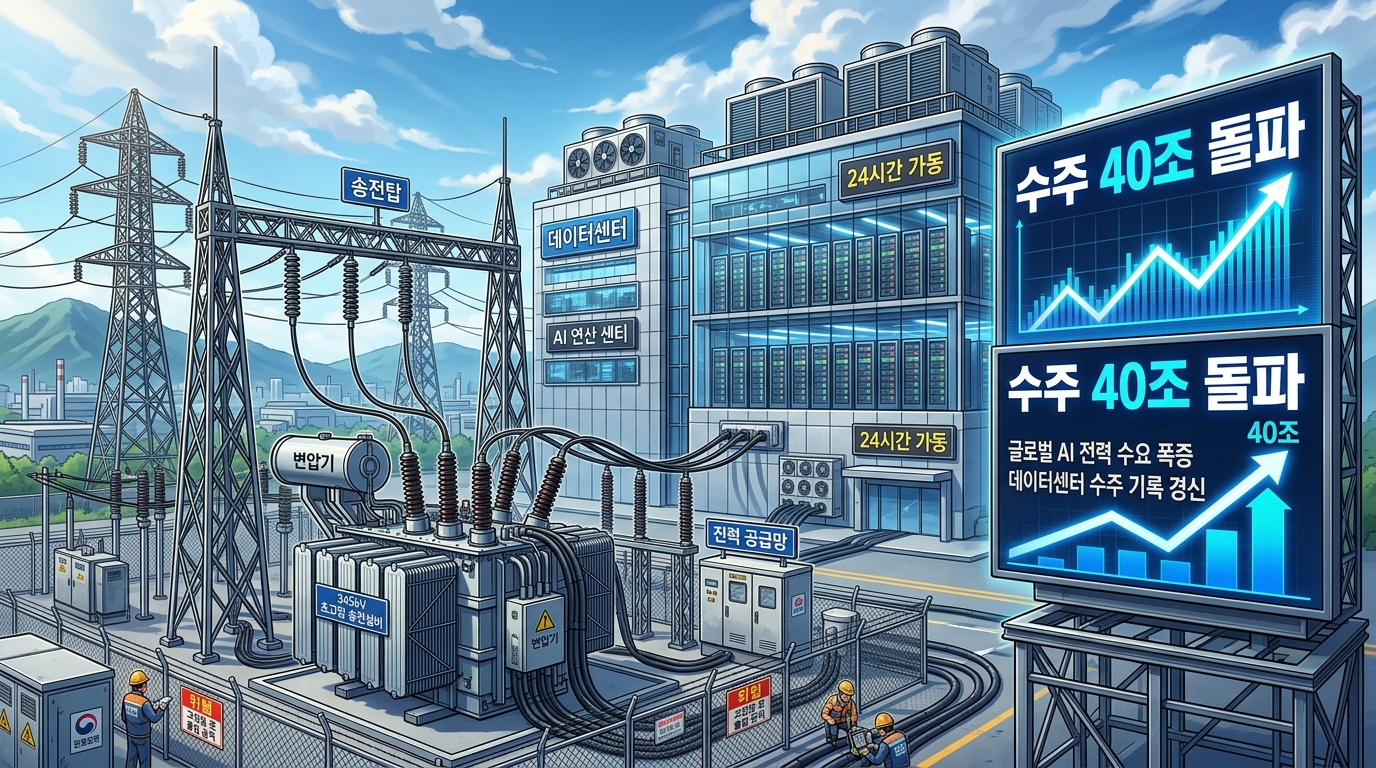
Hello. This is Daily Stock. While the KOSPI index remains in a state of extreme fear, recording 6690.62, we take a close look at the key status of the K-power equipment industry, which is forecasting long-term growth thanks to the energy boom driven by AI data centers.
[Image: /stdaily/uploads/202607/gen_6a65b108969067.82909080.png]
Executive Summary
- **Combined Backlog of the Top 3 Power Companies Nears KRW 40 Trillion**: Fueled by the rapid expansion of AI data centers and modernization projects for North America's transmission and distribution grid, the combined order backlog of the Big 3 power equipment companies (HD Hyundai Electric, Hyosung Heavy Industries, and LS ELECTRIC) is on the verge of surpassing an all-time high of KRW 40 trillion.
- **Shift in Focus from Ultra-High Voltage to 'Distribution Solutions'**: In addition to ultra-high voltage transformers, which have driven performance so far, orders for high-voltage switchboards and smart distribution systems (distribution market) that supply power inside AI data centers are surging, solidifying a long-term supercycle.
- **Record-High Earnings and Upward Guidance Revisions**: LS ELECTRIC achieved record-high earnings in Q2 2026, and HD Hyundai Electric abruptly raised its annual order target by 22.8%, proving the substantial profit growth of these enterprises.
---
Current Situation Summary
With the explosive growth of the global AI data center market coinciding with North America's aging power grid replacement cycle, K-power equipment companies are enjoying an unprecedented order boom.
While ultra-high voltage transformers have driven growth in the past, the 'distribution solutions' market, which stably supplies power to servers and cooling facilities, has recently emerged as a new core growth engine.
The North American distribution market is estimated to be two to three times—and in the long term, up to six times—larger than the transmission market centered on ultra-high voltage transformers.
Accordingly, the order backlog of domestic power equipment conglomerates is approaching KRW 40 trillion, establishing a virtuous cycle of securing work for the next four to five years in advance.
---
Financial Analysis
Recently announced earnings and upward revisions of order targets in the power equipment industry clearly prove the sustainability of this supercycle.
LS ELECTRIC recorded consolidated revenue of KRW 1.577 trillion and operating profit of KRW 178.5 billion in Q2 2026, achieving its highest-ever quarterly performance.
Reflecting robust demand, HD Hyundai Electric also officially revised its 2026 annual order target upward by 22.8%, from the previous USD 4.222 billion to USD 5.185 billion.
Hyosung Heavy Industries stably continues its high-margin selective order intake stance, securing the industry's largest order backlog of over KRW 15 trillion.
| Company | Q2 2026 Revenue (Actual/Est.) | Q2 2026 Operating Profit (Actual/Est.) | Order Backlog (Latest) | Key Drivers and Characteristics |
|---|---|---|---|---|
| **LS ELECTRIC** | KRW 1.577 tn (Actual) | KRW 178.5 bn (Actual) | Approx. KRW 7 tn | Record quarterly performance; cumulative distribution solution orders for North American Big Tech exceed KRW 1.2 tn |
| **HD Hyundai Electric** | Approx. KRW 1.1 tn (Est.) | KRW 284.0 bn - 290.0 bn (Est.) | Approx. KRW 11 tn+ | 2026 annual order target revised upward by 22.8% to USD 5.185 bn; overwhelming operating profit margin |
| **Hyosung Heavy Industries** | Approx. KRW 1.9 tn (Est.) | Approx. KRW 284.5 bn (Est.) | Approx. KRW 15 tn+ | Monopoly position in 765kV at its Memphis plant; secured long-term contracts for ultra-high voltage transformers in the US and Australia |
[Image: /stdaily/uploads/202607/gen_6a65b1129acf00.67001909.png]
---
Valuation
According to Daily Stock's proprietary Fear & Greed Index, the KOSPI Fear & Greed Index remains in the Extreme Fear (12.9) stage, with the index positioned at 6690.62. However, the earnings visibility of the power equipment sector is higher than ever.
As the order backlog is fully recognized as revenue over the next few years, the EPS (earnings per share) of the three major power companies is projected to trace an upward trajectory.
High-margin multiples are being justified, particularly for companies that have preemptively secured local production bases in the United States.
However, there is some valuation fatigue due to the short-term surge, and a phase requiring precise estimation of the break-even point according to exchange rate fluctuations is underway.
---
Analyst and Institutional Analysis
Major domestic and foreign securities firms evaluate the boom in the power equipment industry not as a short-term event, but as a long-term paradigm shift that will last until at least 2028–2030.
Because power infrastructure investment is an essential prerequisite for building AI data centers, demand for distribution panels and transformers is unlikely to decline as long as investments by Big Tech companies continue.
In particular, institutional investors are placing high value on total solution providers that can deliver direct current (DC) power solutions and microgrid systems, moving beyond simple hardware manufacturing.
An assessment dominates that the operating leverage effect will be maximized when local plant utilization rates in Utah, Texas, Alabama, and Memphis in the US are optimized.
---
Risk Factors
The biggest risk is a scenario involving unexpected tariff increases by the US government and the strengthening of nationalist protection policies (Buy American).
In addition, sharp fluctuations in the prices of key raw materials such as copper could temporarily increase the cost burden for transformer manufacturers.
Exchange rate volatility is also a variable. Currently, the USD/KRW exchange rate remains high at 1463.10, which is favorable for exporting companies, but a rapid decline in the exchange rate could slow down earnings when converted into Korean won.
---
Investment Perspective Summary
In a market environment where the KOSPI is experiencing extreme fear (12.9), the power equipment sector has secured downside resilience based on strong fundamental earnings stamina.
Rather than being shaken by short-term volatility, a split-entry approach seems valid, checking each company's capacity expansion schedule in the US and the conversion rate of high-margin orders.
Companies that successfully diversify their portfolio from transmission-centered to distribution and total solutions for AI data centers are highly likely to lead long-term stock price differentiation.
---
[Image: /stdaily/uploads/202607/gen_6a65b11e1aa896.31094681.png]
Investor Checklist Q&A
Q1. Why is the 'distribution' market gaining attention in the AI data center space?
- **A1.** AI data centers consume far more electricity than traditional centers. Therefore, facilities such as switchboards and distribution transformers that safely distribute ultra-high voltage incoming electricity to internal servers and cooling devices are essential.
Q2. What is the scale of the combined backlog of Korea's top three power equipment companies?
- **A2.** As of the first half of 2026, the combined backlog of the three companies exceeded KRW 37 trillion, and is on the verge of surpassing KRW 40 trillion due to a recent relay of additional orders. This secures roughly four to five years of future revenue.
Q3. How is the investment in local US factories progressing?
- **A3.** LS ELECTRIC is expanding its production bases in Utah and Texas; HD Hyundai Electric is pushing for the expansion of its second plant in Alabama; and Hyosung Heavy Industries has invested approximately USD 300 million to expand its Memphis plant, the only production site for 765kV ultra-high voltage transformers in the US.
Q4. What is the impact of the rising USD/KRW exchange rate (1,463.10) on performance?
- **A4.** Given that the top three power companies have a very high export share to North America, a strong dollar acts positively by providing a temporary earnings-boosting effect (foreign exchange gains) when converting revenue and operating profit into Korean won.
Q5. What are the key variables and risks to watch in the future?
- **A5.** Major variables that will determine future stock prices and earnings include whether the US government increases tariffs, the price trends of raw materials like copper, and the execution speed of infrastructure investments by Big Tech companies.
---