Hello. This is Daily Stock, analyzing key trends in the global financial market.
Summary
[Image: /stdaily/uploads/202607/gen_6a53e48d51b882.80404974.png]
Recently, the global asset market is showing a distinct "tri-polar decoupling" phenomenon, where the economic fundamentals of the US, Europe, and Asia are moving in different directions.
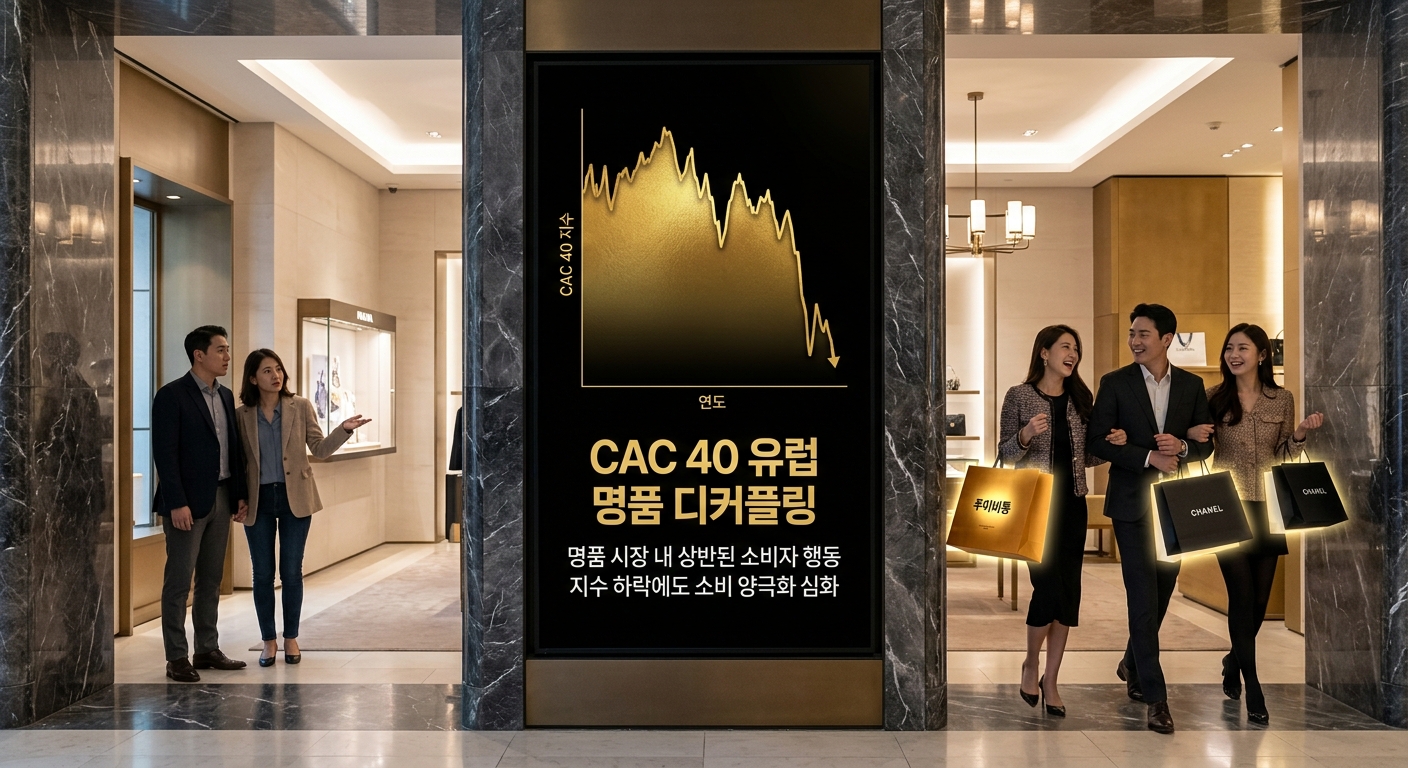
France's representative index, the CAC 40, has recently been in a consolidation phase around the 8,300 level amid a slowdown in European luxury consumption and euro exchange rate volatility.
In particular, the departure of the "aspirational luxury consumer" group, who used to buy entry-level luxury items, is accelerating, leading to a deepening polarization of performance by brand.
On the other hand, the paradigm of the luxury market is rapidly reorganizing as newly rich tech billionaires, born from the AI and tech boom in the US, emerge as new consumption drivers.
Current Status Summary
Looking at global macroeconomic indicators, differences in liquidity supply and monetary policy are dividing the fortunes of stock markets by continent.
While US stock markets maintain their upward trend led by solid employment and technology stocks, Europe's domestic demand recovery is delayed due to the ongoing Middle East geopolitical crisis and the aftermath of monetary tightening.
As a result, France's CAC 40 index has recently been trapped in a box range, testing its support level near the 8,337.29 level during intraday trading (provisional).
The domestic stock market in South Korea has also seen investor sentiment shrink significantly, with the KOSPI index at 7,475.94 and the KOSDAQ index at 837.43 today.
The USD/KRW exchange rate continues to hover around 1,503.40 won, increasing the volatility of foreign capital inflows and outflows.
In fact, according to Daily Stock's own Fear & Greed Index, the KOSPI is currently in the Extreme Fear (16.2) stage, representing very frozen sentiment following last week (19.8).
On the other hand, the Nasdaq Fear & Greed Index is currently at a Neutral (49.5) level, showing a decoupling pattern with sentiment gradually recovering compared to Fear (32.4) a week ago and Fear (26.9) a month ago.
| Indicator | Current Value (As of 2026-07-13 Intraday (Provisional)) | 1 Week Ago | 1 Month Ago |
|---|---|---|---|
| **KOSPI Index** | 7,475.94 | - | - |
| **KOSDAQ Index** | 837.43 | - | - |
| **Nasdaq Index** | 26,281.61 | - | - |
| **USD/KRW Exchange Rate** | 1,503.40 won | - | - |
| **KOSPI Fear & Greed Index** | **Extreme Fear (16.2)** | Extreme Fear (19.8) | Neutral (53.7) |
| **Nasdaq Fear & Greed Index** | **Neutral (49.5)** | Fear (32.4) | Fear (26.9) |
Financial Analysis
LVMH, the eldest brother of the European luxury industry, reported revenue of 19.1 billion euros in the first quarter of 2026, down 6% year-on-year on a reported basis.
However, excluding foreign exchange effects (strong euro), its organic growth rate was +1%, proving its basic stamina even in the worst recession.
On the other hand, the financial situation of competitors is starkly mixed depending on brand competitiveness.
Kering Group is undergoing a serious transition, with total sales falling 6.2% as sales of its core brand, Gucci, plummeted 14.3%.
Hermes was also hit directly by geopolitical risks, with sales in the Middle East falling 5.9%, sending its stock price down about 14% at one point.
| Company | Q1 2026 Revenue Performance | Key Drivers & Trends |
|---|---|---|
| **LVMH** | 19.1 billion euros (Organic Growth +1%) | External size shrank due to the strong euro, but solid fundamentals were maintained |
| **Kering** | Today's price unconfirmed (based on latest value) (Total Revenue -6.2%) | Sluggish Gucci sales (-14.3%) continue; major brand reorganization underway |
| **Hermes** | Today's price unconfirmed (based on latest value) (Middle East Revenue -5.9%) | Geopolitical conflicts impact and market cap fluctuations due to stock price adjustment |
Valuation
Valuations in the luxury sector are returning to reasonable levels as the "revenge shopping" bubble of 2024-2025 clears.
The operating margin of LVMH's Fashion & Leather Goods division, which previously reached 40%, is attempting to settle in the 33-35% range.
In the case of Prada, thanks to the overwhelming success of Miu Miu (with 2026 growth expectations exceeding 20%), it is trading at a projected 2026 price-to-earnings (P/E) ratio of 15x, entering an attractive valuation zone.
Despite the stock price decline, Hermes maintains a premium valuation thanks to its unique scarcity value, but easing tensions in the Middle East is a prerequisite for a valuation re-rating.
Analyst & Institutional Perspective
Global investment banks (IBs) such as JPMorgan expect the European luxury market to pass through volatility and enter a "stabilization phase" in 2026.
However, rather than all brands rising together, they analyze that the gap will widen between brands that have secured ultra-high-net-worth (UHNW) individuals and those that are highly sensitive to trends.
[Image: /stdaily/uploads/202607/gen_6a53e495a77fe0.00253760.png]
HSBC also pointed out that some brands that insisted only on price hikes and lacked creativity need self-reflection, advising that they can return to the growth track only when appropriate price adjustments and idea innovations come first.
In particular, attention should be paid to the phenomenon where young tech billionaires who accumulated wealth through the recent US AI boom and stock market rally are emerging as new big spenders in high-end watches and jewelry.
Risk Factors
The most immediate risks are prolonged geopolitical conflicts in the Middle East and the resulting disruptions to the global supply chain.
Indeed, tensions in the Strait of Hormuz add to the logistics cost burden of the luxury industry and constrain sales growth in local offline stores.
[Image: /stdaily/uploads/202607/gen_6a53e49ea89077.10739572.png]
In addition, China's economic slowdown and reduced wealth effect are key links delaying performance improvement for luxury brands with a high exposure to the Asian market.
Furthermore, structural headwinds cannot be ruled out, as "aspirational luxury consumers" tired of excessive price increases defect to relatively reasonable alternative brands such as Coach and Longchamp.
Investment Perspective Summary
As a result, the European luxury sector and the CAC 40 index are experiencing short-term ups and downs amid the "currency and economic decoupling" with the US.
However, despite the departure of casual consumers, the loyalty of the ultra-high-end lineup and the influx of newly rich individuals are expected to form a support line for the industry.
Investors should approach by thoroughly dividing brands rather than simply investing in index-tracking instruments.
It seems appropriate to check fractional purchase scenarios while confirming the recovery speed of individual companies, such as LVMH, which has secured its own turnaround momentum, or Hermes, which endures with scarcity as a weapon, along with the stabilization of macroeconomic indicators.
Investor Checklist Q&A
Q1. LVMH's first-quarter sales fell 6%, is this a real crisis?
A1. Although reported sales decreased by 6%, organic growth excluding exchange rate effects maintained a growth trend of +1%. Rather than a crisis of the company itself, this is closer to an accounting illusion caused by the strong euro.
Q2. What is the specific reason Hermes' stock price has adjusted recently?
A2. This is the result of short-term performance concerns reflecting a 5.9% drop in sales in the Middle East due to ongoing geopolitical risks. However, many evaluate that its unique scarcity-based business model remains solid.
Q3. When is the turnaround for Kering Group, which owns Gucci, expected to improve?
A3. Gucci's sales plummeted 14.3%, and a major turnaround operation is underway. The specific rebound timing can only be gauged after confirming the market response when the new collections are sequentially released in stores after the second half of this year.
Q4. How does the global 'tri-polar decoupling' affect the luxury market?
A4. While Asian markets such as China are struggling due to macro slowdowns, the US market is showing relative strength due to high consumer confidence and the emergence of AI tech billionaires, resulting in different performance contributions by region.
Q5. What is the most critical risk to consider when investing in luxury stocks?
A5. Investors must watch out for the risk of structural demand shrinkage, where aspirational consumers who left due to excessive price hikes do not return. In addition, exchange rate volatility and supply chain risks like the Strait of Hormuz are variables that must be monitored at all times.