Hello, this is Daily Stock, delivering fast and accurate information by deeply analyzing the macro trends of major global stock markets and the fundamentals of core companies.
[Image: /stdaily/uploads/202607/gen_6a4ff01b6824a6.41647025.png]
Executive Summary
Global food and beverage giant PepsiCo (PEP) announced its Q2 2026 earnings, reporting net revenue of $24.18 billion, which beat market expectations. However, Core EPS (adjusted earnings per share) came in at $2.20, slightly missing the Wall Street consensus of $2.21, showing mixed results.
The core takeaway from this performance is that domestic growth in North America has entered a stagnation phase. High inflationary pressures within the US mainland and a "gasoline price surge" triggered by conflicts in the Middle East have led to a contraction in impulse buying across convenience store channels.
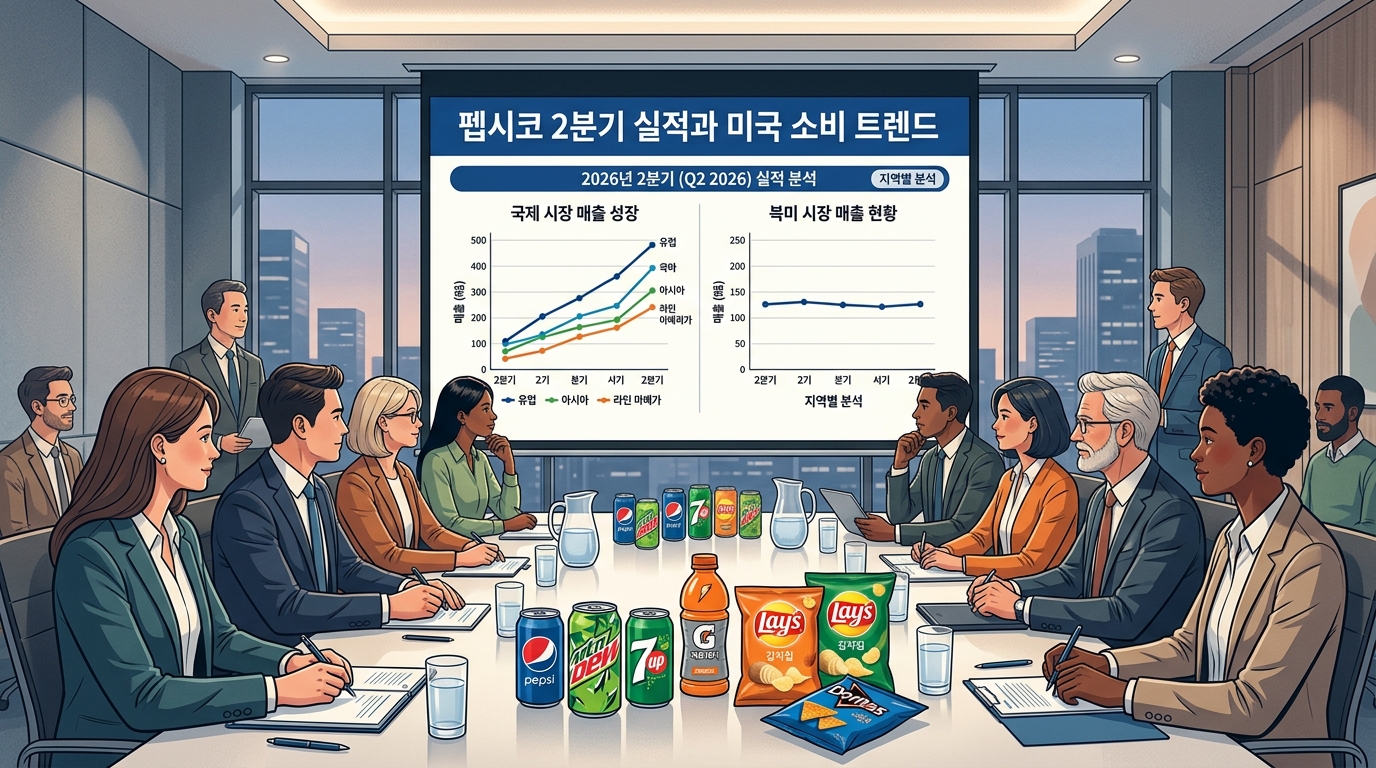
Conversely, international markets, including Asia and Europe, delivered robust organic revenue growth of 7%, demonstrating strong decoupling growth and serving as a critical pillar for global volume expansion.
---
Market Update
As of intraday trading (preliminary) on July 10, 2026, PepsiCo's (PEP) stock price is trading down 3.04% at around $138.17 on the New York Stock Exchange, reflecting heightened concerns over US household belt-tightening immediately following the earnings release.
Amid the recent tri-polar decoupling trend across the US, Europe, and Asia, the US Nasdaq index stands at 26,095.86, maintaining a "Neutral (41.5)" level on our proprietary Fear and Greed Index. However, the consumer staples sector is bearing the direct brunt of inflation fatigue.
In particular, PepsiCo attempted to revive demand in the North American region during the first quarter by cutting prices of major snacks like Lay's and Doritos by up to 15%. However, the improvement momentum was halted in the second quarter due to rising energy costs.
[Image: /stdaily/uploads/202607/gen_6a4ff0234573f9.17522399.png]
---
Financial Analysis
A comparison of PepsiCo's primary Q2 2026 financial metrics (for the 12-week fiscal period) with the same period last year is as follows:
| Category | Q2 2026 | Q2 2025 | YoY Change |
|---|---|---|---|
| **Net Revenue** | $24,181 million | $22,726 million | +6.4% |
| **Operating Profit** | $4,023 million | $1,789 million | +125% |
| **Operating Margin** | 16.6% | 7.9% | +875 bps |
| **Core EPS** | $2.20 | $2.12 | +4.0% |
| **Organic Revenue Growth** | 2.4% | 2.5% | -0.1%p |
Despite discounting strategies, the PepsiCo Foods North America (PFNA) division saw volume growth flatline at 0% due to the impact of rising gasoline prices.
The PepsiCo Beverages North America (PBNA) division also failed to break out of its slump since 2022, with volume declining 4% year-over-year as inflation-weary households cut back on consumption.
---
Valuation
PepsiCo is currently trading at a 12-month forward price-to-earnings (Forward P/E) ratio of approximately 16.3x, trading at a valuation discount relative to its historical historical band average and its competitor, Coca-Cola (KO).
The annualized dividend is set at approximately $5.75 per share, yielding 4.03% at current price levels. This solidifies its status as a high-yielding defensive stock supported by strong cash flow generation capabilities.
While the market is slightly lowering target prices to reflect short-term demand stagnation risks in North America, the fact that global organic volume growth (food +3%, beverages +2%) is at its steepest pace since 2022 is expected to provide strong downside support.
---
Expert and Institutional Analysis
Through these earnings, global investment banks (IBs) confirmed that the accumulated fatigue of US consumers is translating into a sharp decline in foot traffic at offline impulse-buying channels, such as gas stations and convenience stores.
Analysts at RBC Capital Markets pointed out, "Despite snack price reduction efforts, consumers have become extremely sensitive to value equations as everyday macro indicators like gasoline prices deteriorate."
On the other hand, Morgan Stanley and JPMorgan positively evaluated that the global diversification structure is cleverly buffering the temporary limitations of the US mainland, and that margin improvements and pricing power in emerging markets and Europe remain solid.
---
Risk Factors
The most immediate risk is a scenario where energy costs rise further due to the prolonged geopolitical conflict in the Middle East, which could simultaneously accelerate distribution costs and contract demand in gasoline-linked channels.
Additionally, if slowdowns in global physical economic indicators, such as manufacturing PMIs in the Eurozone and major Asian countries, materialize, the growth engine of international markets (7% organic growth), which is currently driving PepsiCo's performance, could also weaken.
Furthermore, there is a risk of rising brand-defense costs for traditional products during a portfolio transition phase, as younger consumers rapidly shift from processed snacks to low-sugar, high-protein, and functional food and beverage alternatives.
---
Investment Perspective Summary
Amid the US-Europe-Asia tri-polar decoupling phase, PepsiCo's Q2 report card, a barometer of US consumption, presented both warnings and opportunities to the market.
With the USD/KRW exchange rate fluctuating around 1,509.40 won, exposing the Korean stock market (KOSPI Fear and Greed Index: Extreme Fear at 12.2) to external macro volatility, whether large-cap US consumer staples companies are globally diversified is a key metric determining the sustainability of shareholder returns.
Whether the conditional scenario of international performance making up for domestic US sluggishness remains valid in Q3, and whether North American channels recover as gasoline prices stabilize, are trends worth tracking closely to adjust defensive portfolio allocations.
---
Investment Checklist
* Q1. Can PepsiCo's North American snack (PFNA) division volume rebound back to positive territory in Q3?
* A gradual recovery is highly likely to depend on the secondary effects of affordability promotions and market reception to new product launches.
* Q2. Will the gasoline price surge ease in the second half, leading to a recovery in gas station/convenience store foot traffic?
* US impulse buying sentiment will fluctuate significantly depending on international oil price trends, which are closely linked to how geopolitical conflicts in the Middle East play out.
* Q3. Is the high 7% organic revenue growth in international markets (EMEA and Asia) sustainable?
* The structure is fully defensible if new market penetration in emerging countries and local portion-controlled small-packaging strategies successfully take root.
* Q4. Are synergies with PepsiCo’s recently acquired brands (Poppi, Siete, etc.) materializing?
* As distribution network integration issues for the wellness beverage brand Poppi resolve, it is expected to contribute to defending wellness beverage market share starting in the second half of the year.
* Q5. Can the current dividend yield (approx. 4.03%) and valuation (Forward P/E 16.3x) act as a margin of safety?
* Given its business model characterized by highly resilient cash flows, it can serve as a sturdy shield to firmly support the stock's downside during phases of intensifying market-wide panic.