Hello, this is Daily Stock, analyzing the core value chain of the US stock market and Big Tech.
[Image: /stdaily/uploads/202607/gen_6a499f7cbbfbf6.83032104.png]
Summary
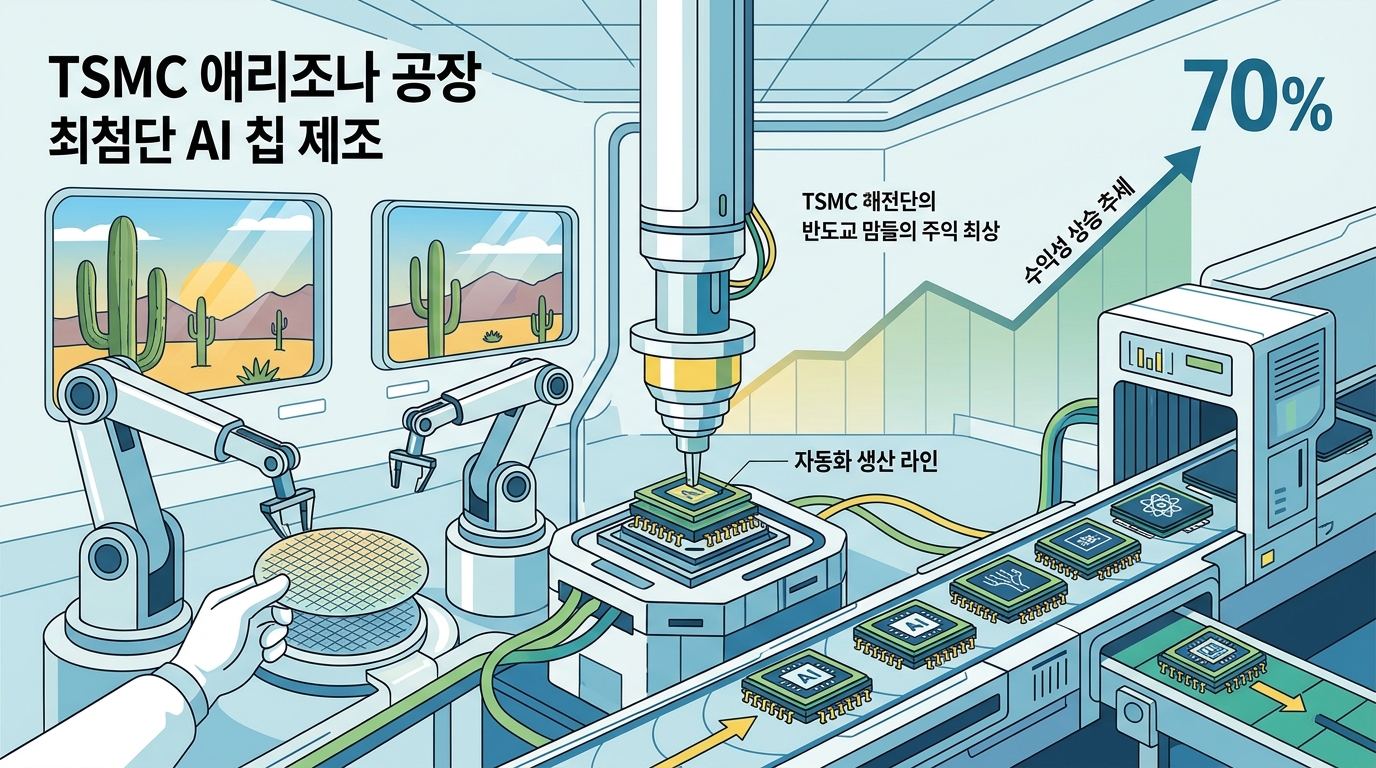
TSMC (TSM) officially announced a 10-year partnership in Arizona with Amkor, a global leader in semiconductor packaging. This partnership provides a strong momentum to resolve bottlenecks in localized US advanced outsourced semiconductor assembly and test (OSAT) services.
In addition, S&P Global upgraded TSMC's long-term credit rating (AA-) outlook to 'Positive', citing its unrivaled dominance in the high-performance computing (HPC) AI chip supply chain and its strong cash flow generation capabilities.
Ahead of its Q2 earnings release scheduled for July 16, 2026, some cautious market analyses suggest that its gross margin could approach the 70% threshold, driven by maximized utilization rates of 3nm and 5nm nodes.
Market Status
As of July 5, 2026, the monopoly in core high-performance computing chips remains unbroken, driven by continuous global investments in AI infrastructure.
On July 2, Taiwan's Ministry of Economic Affairs officially approved a new $20 billion capital injection into TSMC's Arizona subsidiary, raising its total US investment limit to $440 billion. However, the prevailing view is that replacing Taiwan's overwhelming domestic advanced process and CoWoS production capacity in the short term remains a challenge.
To proactively overcome these limitations, TSMC chose a detour strategy by establishing a 10-year advanced packaging alliance in Arizona with Amkor. This successfully establishes an onshoring structure where wafers manufactured in the US can be packaged locally and delivered immediately to US Big Tech clients.
Meanwhile, the proprietary Nasdaq Fear and Greed Index currently points to the "Fear" level (31.9). While this is an improvement from last week's "Fear" level (25.1), it is significantly lower than the "Neutral" level (53) from a month ago and the "Greed" level (77.6) from three months ago, indicating that resistance from macro factors remains firm.
Financial Analysis
TSMC's Q1 2026 revenue surged 40.6% year-on-year to $35.9 billion, and net profit skyrocketed 58.3% year-on-year, posting strong results.
Most notably, its Q1 net profit margin reached an impressive 50.5%. This demonstrates an exceptional level of efficiency in the foundry industry, with more than half of its revenue turning into pure profit.
Furthermore, monthly revenue for May 2026 increased 30.1% year-on-year to NT$416.98 billion (approximately $13.17 billion), marking its highest monthly record ever.
Table 1. TSMC Key Financial Metrics & Performance Trends (First Half of 2026)
| Metric | Q1 2026 Results | May 2026 Results | Q2 2026 Guidance (Upper Limit) | 2026 Full-Year Outlook |
|---|---|---|---|---|
| **Revenue (USD)** | $35.9 billion | Approx. $13.17 billion | $40.2 billion | Over 30% YoY growth |
| **Gross Margin** | 66.2% | - | Expected to exceed 67.5% (approaching up to 70%) | Sustained peak utilization rates |
| **Net Margin** | 50.5% | - | - | Leverage centered on HPC |
[Image: /stdaily/uploads/202607/gen_6a499f85cf9b92.10817844.png]
Valuation
TSMC's stock price on the New York stock exchange has recently hovered between $434.70 and $455.10, establishing a market capitalization of approximately $2.24 trillion to $2.3 trillion.
This scale suggests that a valuation re-rating is underway, making TSMC a strong candidate to join the $3 trillion club alongside Microsoft, Apple, NVIDIA, and Alphabet.
However, the high yield of the US 10-year Treasury bond (US10Y) and the elevated cost of capital remain burdensome. Given the foundry business model's high reliance on large fixed CAPEX, valuation multiples can exhibit extreme volatility depending on shifts in macro interest rate policies.
Nevertheless, the share of HPC in its total portfolio has expanded to 61%, providing a much stronger downside support level compared to Nasdaq 100 growth stocks in general and other semiconductor competitors.
Analyst and Institutional Insights
Based on TSMC's firm grip on advanced nodes, local Taiwanese and global research institutions suggest that the company's Q2 gross margin may break past the upper limit of its guidance (67.5%) to challenge the 70% threshold.
This rosy outlook is backed by increasing high-end wafer orders for next-generation application processors using advanced nodes and next-generation AI accelerators like NVIDIA's Vera Rubin.
Credit rating agency S&P Global also expressed strong confidence in TSMC's capital expenditure recovery, noting that the company's substantial pricing power in the high-end HPC market remains highly robust.
The 2nm (N2P) nanosheet-based advanced process, scheduled for operation starting in the second half of 2026, is highly likely to dominate Apple's next-generation mobile chips, suggesting that TSMC's next-generation roadmap dominance will likely continue for the foreseeable future.
Risk Factors
Fixed-Cost Pressure from US-Centric CAPEX: With capital expenditures for 2026 projected at $52 billion to $56 billion, there are concerns that depreciation burdens could increase while massive capital is invested in overseas fabs, potentially hurting margins.
Geopolitical Structural Limits and Price Resistance: Despite expanding investments in Arizona, reliance on Taiwanese domestic production remains high. Furthermore, because operating costs at US plants are higher than in Taiwan, TSMC may face pushback during pricing negotiations with clients.
Big Tech AI Monetization Skepticism and Regulations: If the payback period for AI infrastructure expansion to turn into actual profits is prolonged, major Big Tech clients may implement budget cuts, potentially leading to a gap in orders.
[Image: /stdaily/uploads/202607/gen_6a499f8e3f43a6.67415962.png]
Investment Perspective Summary
TSMC's upcoming Q2 conference call on July 16, 2026, will be the first milestone to objectively verify its market dominance through its gross margin figures.
The establishment of the advanced packaging partnership in Arizona with Amkor acts as a wise breakthrough to offset onshoring risks, boosting the company's long-term investment appeal.
Considering the risk-averse sentiment lingering across global markets—with the KOSPI Fear and Greed Index at 21.2 (Fear) and the Nasdaq Fear and Greed Index at 31.9 (Fear)—investors may need a strategic approach, monitoring macroeconomic correlations and accumulating positions in tranches.
Investor Checklist Q&A
Q1. What direct impact does the 10-year partnership in Arizona with Amkor have on enterprise value?
- It eliminates the redundant process of shipping wafers back to Taiwan for packaging by handling the entire process locally. This prevents transportation delays and dramatically improves the reliability of the supply chain for finished products.
Q2. What is the primary driver behind the potential to challenge a 70% gross margin?
- It is driven by unprecedented full-capacity utilization of 3nm and 5nm nodes, fueled by continuous orders for advanced nodes from high-end AI chip designers like NVIDIA.
Q3. What does S&P's upgrade of the long-term credit outlook to "Positive" mean for the capital markets?
- It is a symbolic acknowledgment from the market that TSMC generates robust EBITDA margins and solid operating cash flows that are more than sufficient to cover the financial risks arising from astronomical capital expenditures (CAPEX).
Q4. How clear is the roadmap for the 2nm advanced process in the second half of the year?
- The next-generation N2P process appears to have reached a stable mass production phase. Competition is heating up to secure capacity for Apple's next-generation A20 family and other major fabless AP clients.
Q5. What is an appropriate investment tactic under the current macroeconomic environment?
- With the Nasdaq Fear and Greed Index pointing to a "Fear" level of 31.9, rather than buying aggressively all at once, a prudent approach would be to wait for earnings results and monitor the stability of the VIX and the US Dollar Index before allocating capital in installments.