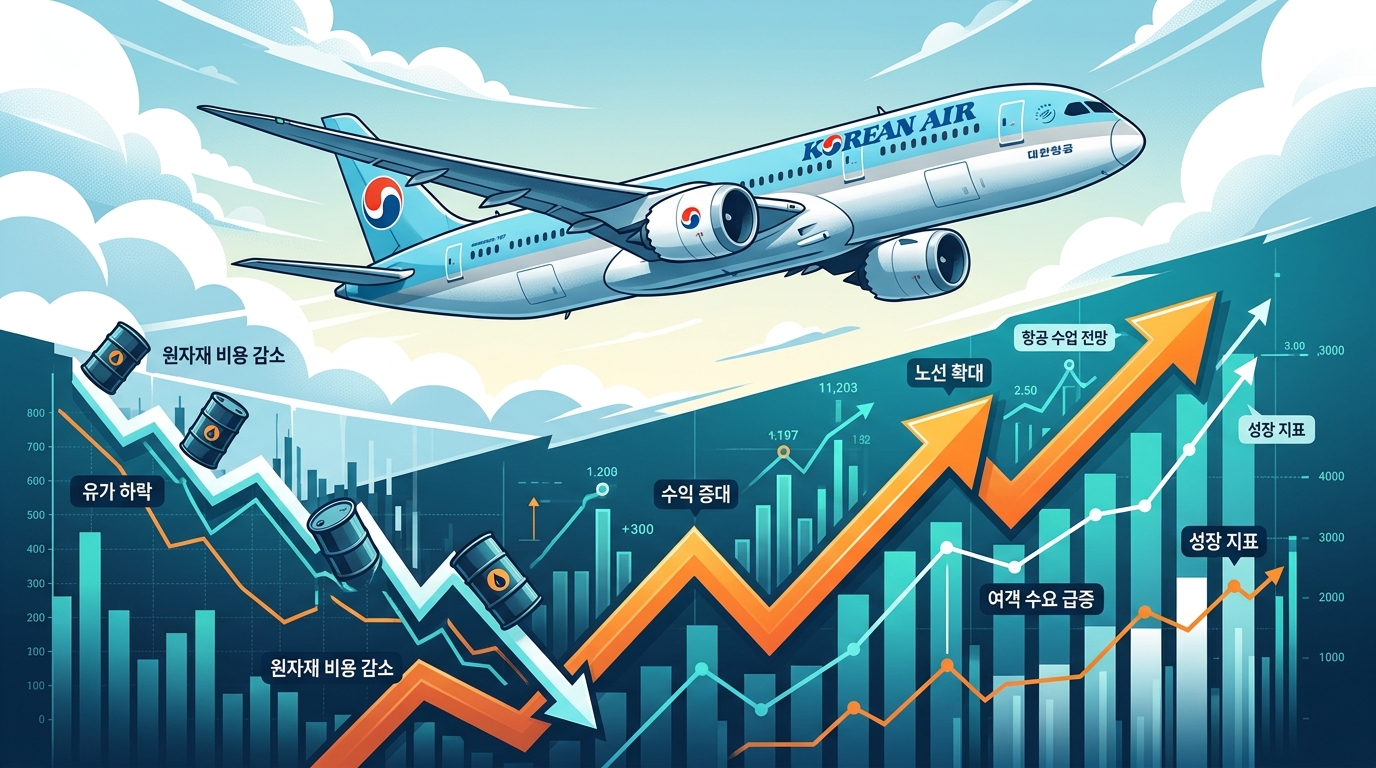
As international oil prices stabilize following easing geopolitical risks in the Middle East, along with robust passenger and cargo demand, market attention is focused on Korean Air's earnings recovery.
[Image: /stdaily/uploads/202607/gen_6a460cbdaefd61.01944829.png]
Key Summary
[Image: /stdaily/uploads/202607/gen_6a460cc67fa9a7.39027877.png]
- **Stabilization of International Oil Prices**: With news of peace negotiations between the US and Iran and the reopening of the Strait of Hormuz, international oil prices have stabilized around $70 per barrel, raising expectations that the cost burden of high oil prices will ease significantly.
- **Successful Q2 Earnings Defense**: Although a decline in operating profit is inevitable due to the impact of high oil prices and high exchange rates in April and May, earnings are projected to beat market consensus. This is driven by high-yield cargo revenues centered on global AI semiconductor demand and absorbing transit passenger demand.
- **Synergy from the Mega-Carrier Merger**: If the merger with Asiana Airlines, scheduled for the end of this year, is completed smoothly, profit synergies of over 300 billion KRW annually are expected starting in 2027 through fleet integration and cost optimization.
Current Status Summary
In the global energy market, the war premium is rapidly diminishing as the US and Iran reached a 60-day temporary agreement and the Strait of Hormuz returned to normal operations.
As of late June, WTI fell to $69.5 per barrel and Brent crude fell to $72.92 per barrel, returning to levels seen before the geopolitical crisis in March.
The average price of international jet fuel also plummeted by about 44.5% from around $209 per barrel in early April to $116.63 per barrel in the final week of June.
Since fuel costs account for approximately 25% to 30% of an airline's operating expenses, this sharp drop in oil prices is expected to act as a direct catalyst for improving Korean Air's profitability starting in Q3.
The domestic stock market closed with the KOSPI at 7,648.09 and the USD/KRW exchange rate at 1,552.20, creating an environment where the strong dollar remains somewhat of a burden.
According to Daily Stock's proprietary Fear & Greed Index, the KOSPI is in the "Extreme Fear (18.1)" phase, indicating that overall market investment sentiment is relatively subdued.
Financial Analysis
[Image: /stdaily/uploads/202607/gen_6a460ccfb24a46.24052768.png]
Korean Air's non-consolidated revenue for Q2 2026 is estimated to range between 4.8952 trillion KRW and 4.9903 trillion KRW, representing a 23% to 25% year-on-year increase.
While operating profit is inevitably expected to decline compared to the same period last year due to the high oil prices and weak won, it is projected to surpass consensus by maintaining a solid surplus in the range of 57.9 billion KRW to 126.3 billion KRW, defying market worries.
| Classification (Non-consolidated) | Q2 2026 Forecast (Recent Estimate) | Year-on-Year (YoY) | Key Drivers and Features |
|---|---|---|---|
| **Revenue** | 4.8952T ~ 4.9903T KRW | +22.8% ~ +25% | Passenger fare hikes & surge in AI cargo demand |
| **Operating Profit** | 57.9B ~ 126.3B KRW | -68% ~ -86% | Reflects high oil prices and weak KRW costs in Apr-May |
| **International Passenger Revenue** | Approx. 2.6730T KRW | +18% | Increase in transit passengers and yield growth |
| **Cargo Revenue** | Approx. 1.4917T KRW | +41% | Expansion of high-margin semiconductor volumes, USD benefit |
The key to defending the bottom line lay in the "cargo segment" and "transit demand."
Fares rose as high-value-added IT cargo demand (such as AI semiconductor equipment) remained strong, and the carrier successfully captured transit passenger demand left by the reduced capacity of Middle Eastern local carriers.
Valuation
Korean Air's stock price is seeking a rebound alongside increasing trading volume, bolstered by news of stabilizing oil prices and hopes for peace talks.
As of the previous trading day, the stock closed around 28,350 KRW. Major brokerages are raising their target prices to between 35,000 KRW and up to 40,000 KRW, reflecting the company's strengthening fundamentals.
Particularly, once the downward stabilization of oil prices takes full effect in the second half of 2026, passenger profitability could normalize rapidly starting from Q3 due to reduced fuel expenses.
Furthermore, from the moment the merger with Asiana Airlines is finalized in December, a re-rating scenario remains highly viable, driven by enhanced profit capabilities from fleet integration.
Expert & Institutional Analysis
Financial investment industry experts analyze that Korean Air has strengthened its resilience against cost shocks by hedging oil price fluctuations and introducing highly efficient aircraft.
An analyst at Shinhan Securities projected that Q3 passenger profitability will show remarkable improvement due to the lag effect, where fuel surcharges decrease more slowly than actual jet fuel prices.
Sangsangin Investment & Securities' research center also upgraded Korean Air's future earnings outlook as jet fuel prices stabilized amid easing tensions in the Middle East.
They analyzed that while structurally strong cargo demand driven by AI semiconductors continues, achieving economies of scale through the Asiana merger will significantly lower procurement and maintenance costs.
Risk Factors
The biggest variable is whether the US and Iran comply with the temporary agreement and how fast the Strait of Hormuz achieves complete physical stabilization.
If geopolitical conflicts flare up again, causing jet fuel prices to spike or shipping lanes to close, a scenario involving renewed short-term cost burdens cannot be ruled out.
The second risk is the prolonged nature of the weak Korean Won, with the USD/KRW exchange rate remaining above 1,550 KRW.
Since airlines pay for fuel and aircraft leases primarily in USD, a prolonged weak won could negatively impact net income by triggering non-operating losses and foreign currency translation losses.
Investment Outlook Summary
[Image: /stdaily/uploads/202607/gen_6a460cda2fdac5.49387080.png]
Korean Air is evaluated as having moved past the stage of simple exposure to cost shocks (oil, exchange rates) and is now proving strong top-line (passenger and cargo revenue) growth alongside industry normalization.
Particularly, as long as global AI capital expenditure (CapEx) continues, the firm support from the cargo division is highly likely to persist.
Therefore, rather than focusing on the short-term decline in Q2 figures, a strategy centered on the gradual recovery of profitability from Q3 onward—where falling oil prices will be fully reflected—is deemed effective.
Additionally, the smooth integration of Asiana Airlines at the end of the year will be the most critical milestone for enhancing medium-to-long-term corporate value.
Investor Checklist Q&A
Q1. International oil prices have fallen significantly. When will Korean Air start seeing fuel cost savings?
A1. Due to the lag in refining processes and supply agreements, the cost-reduction benefits from lower oil prices are expected to be fully reflected in Q3 earnings, typically with a 1 to 2-month time lag.
Q2. The USD/KRW exchange rate is very high at over 1,550 KRW. How does this impact earnings?
A2. A weak won increases the cost burden for lease payments and fuel expenses, which are heavily transacted in USD. However, since Korean Air receives its cargo revenue in USD, it acts as a natural hedge, making it more resilient than other domestic carriers.
Q3. What is the reason behind the sharp decline in Q2 operating profit?
A3. It is primarily due to a temporary surge in costs in April and May, when jet fuel prices spiked above $200 per barrel due to the escalating conflict in the Middle East. This represents a temporary cost shock rather than a drop in demand.
Q4. Is the merger with Asiana Airlines progressing as planned?
A4. Yes, preparations are underway for a combined launch targeting December 2026. Annual cost savings and profit synergies of over 300 billion KRW are expected through fleet integration, route optimization, and maintenance cost reductions.
Q5. Can the strong performance of the cargo business be sustained?
A5. Since demand for transporting AI semiconductors and high-value equipment from global tech companies is experiencing structural growth, high yields and shipping volumes are highly likely to persist for the time being.