Hello, this is Daily Stock, delivering key global financial trends with precise data.
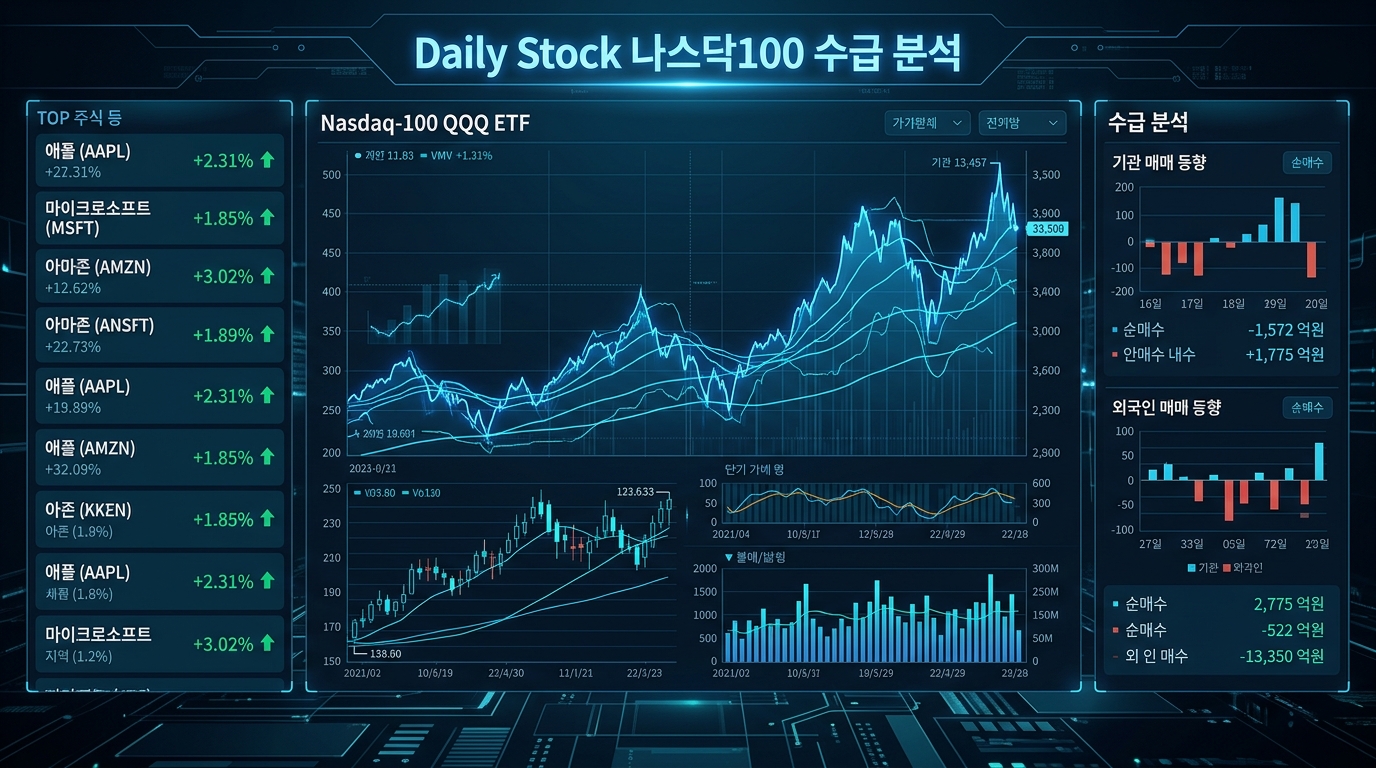
[Image: /stdaily/uploads/202606/gen_6a3dc1796106a7.36300708.png]
Executive Summary
- **Sustained QQQ Inflows**: During May 2026, Invesco QQQ, the representative Nasdaq-100 ETF, attracted approximately $5.924 billion in net inflows, proving strong buying demand focused on tech stocks.
- **Decoupling from Bitcoin ETFs**: While the cryptocurrency market underwent a correction this year with funds flowing out of Bitcoin ETPs, QQQ has expanded its capital absorption capacity backed by robust AI earnings momentum.
- **Shifts in AI Value Chain Capital**: Following the Nasdaq-100 rebalancing effective June 22, AI hardware infrastructure and peripheral players such as Astera Labs (ALAB) and Rocket Lab (RKLB) were newly added, driving portfolio diversification.
- **Intensifying Low-Cost ETF Competition**: With State Street launching QNDX—an ultra-low-cost Nasdaq-100 ETF—on June 15, a significant shake-up in the flow of funds tracking the Nasdaq-100 is expected.
Market Overview
As of intraday June 26, 2026 (tentative), the global macro environment is experiencing volatility driven by movements in the U.S. 10-year Treasury yield (US10Y) and the Federal Reserve's hawkish stance regarding the timing of monetary easing.
Notably, Daily Stock's Nasdaq Fear and Greed Index currently stands at 'Fear (25.5),' indicating weakened market sentiment compared to 'Fear (37.6)' a week ago and 'Neutral (59)' a month ago.
Despite this, the assets under management (AUM) of QQQ, which tracks the Nasdaq-100 Index, reached approximately $492.25 billion, firmly securing its position as the world's fifth-largest ETF.
In contrast to the stagnant capital flow in the cryptocurrency ETP market, global institutional and retail investors maintain a clear preference for Big Tech and AI infrastructure companies that offer highly visible earnings prospects.
[Image: /stdaily/uploads/202606/gen_6a3dc1863354d4.79474102.png]
Financial Analysis
Looking at QQQ's recent financial and operational data, its Net Asset Value (NAV) return in May recorded 10.56%, nearly doubling the S&P 500's 5.26% gain.
This performance also significantly outperformed both the Russell 1000 Growth Index (7.20%) and the Russell 1000 Value Index (2.95%).
| Indicator | QQQ (Invesco Nasdaq 100) | S&P 500 Index | Russell 1000 Growth |
|---|---|---|---|
| **May Monthly NAV Return** | 10.56% | 5.26% | 7.20% |
| **May Net Inflows** | Approx. $5.924B | - | - |
| **AUM (Assets Under Management)** | Approx. $492.25B | - | - |
| **5-Year Cumulative Return (NAV)** | +127.98% | - | - |
This stellar performance of QQQ is attributed to the strong earnings and guidance of key technology sectors that carry high weightings in the portfolio.
Furthermore, looking at the fund flow trend, a massive single-week inflow of about $6 billion was observed in April, demonstrating a persistent pattern of dip-buying whenever the index undergoes a correction.
Valuation
With the Nasdaq currently pointing at 25,358.60, the valuation of Nasdaq-100 companies continues to be tested by multiple compression linked to the U.S. 10-year Treasury yield (US10Y).
Whether the massive capital expenditures (CAPEX) of Big Tech companies can immediately translate into R&D outcomes and revenue growth remains a key metric for sustaining current valuations.
Particularly, the new stocks added in the June 22 rebalancing are concentrated in sub-sectors of the AI infrastructure periphery (such as connectivity and testing) that directly benefit from the spillover effects of GPU giants like Nvidia.
With the inclusion of high-speed connectivity solution companies like Astera Labs (ALAB) and semiconductor automatic testing equipment leader Teradyne (TER), the valuation structure of the Nasdaq-100 is diversifying away from a software and platform focus toward the broader hardware value chain.
Expert & Institutional Analysis
Despite the prevailing 'Fear (25.5)' sentiment in the broader market, investment banks and major asset management experts attribute the continuous inflows into QQQ to "earnings resilience."
Analysts suggest that during periods of global economic uncertainty, Nasdaq-100 companies—with their abundant cash flows and high R&D investment ratios—serve as the ideal safe haven.
Additionally, State Street's launch of the ultra-low-cost Nasdaq-100 ETF 'QNDX' on June 15 provides institutional investors with a new cost-efficient alternative for capital deployment.
Experts predict that the fee competition between the existing QQQ and the new ultra-low-cost ETF will serve as a catalyst for redistributing passive fund flows in the future.
[Image: /stdaily/uploads/202606/gen_6a3dc18fd35f21.83728427.png]
Risk Factors
- **Delayed AI Profitability Verification**: If the massive CAPEX spending of Nasdaq-100 companies fails to yield short-term revenue growth, there is a risk that expanded multiples could rapidly contract.
- **Pushback on Rate Cut Expectations**: If the U.S. Core PCE index exceeds expectations or hawkish remarks from Fed officials continue, Treasury yields could surge, raising the discount rate for growth and tech stocks.
- **Market Concentration Risk**: Because the index remains heavily dominated by a handful of mega-cap tech stocks, any negative shock to a single specific ticker poses a risk of triggering sharp volatility across the entire index.
Investment Perspective Summary
The Nasdaq-100 ETF ecosystem, led by QQQ, is proving its defensive resilience with strong capital inflows even during periods of spreading market fear.
The phenomenon of liquidity leaving the cryptocurrency market and returning to tech stocks with high earnings visibility shows that the index remains a solid alternative amid macroeconomic uncertainties.
However, it would be prudent to carefully monitor changes in macroeconomic data, the potential for prolonged high interest rates, and the market share expansion of new low-cost Nasdaq-100 tracking ETFs (such as QNDX) to plan phased dollar-cost averaging scenarios.
Investor Checklist Q&A
Q1. What are the key characteristics of QQQ's recent inflows compared to cryptocurrency ETFs?
A1. Unlike early-year projections, the cryptocurrency ETP market is stagnating alongside Bitcoin price corrections. Meanwhile, QQQ is establishing a dominant run of steady inflows backed by high confidence in AI earnings.
Q2. What are some of the key stocks newly added to the Nasdaq-100 in the June rebalancing?
A2. Through the rebalancing effective June 22, companies like Astera Labs (ALAB), Rocket Lab (RKLB), and Teradyne (TER) were newly added to the index, driving diversification centered on AI hardware and infrastructure.
Q3. How will State Street's newly launched QNDX ETF affect QQQ's supply and demand?
A3. Since QNDX is designed as an ultra-low-cost Nasdaq-100 ETF, it may attract long-term institutional capital or retail investors seeking cost efficiency, thereby diversifying the supply and demand dynamics.
Q4. What is the current status of the Nasdaq Fear and Greed Index?
A4. According to Daily Stock's proprietary calculation, the Nasdaq Fear and Greed Index is currently in the 'Fear (25.5)' zone, reflecting dampened investor sentiment due to short-term price volatility.
Q5. What is the most important macroeconomic indicator to monitor when investing in Nasdaq-100 ETFs?
A5. Along with the trajectory of the U.S. 10-year Treasury yield (US10Y), which shapes the Fed's monetary policy path, investors should closely watch the Core Personal Consumption Expenditures (Core PCE) index to gauge inflation trends.