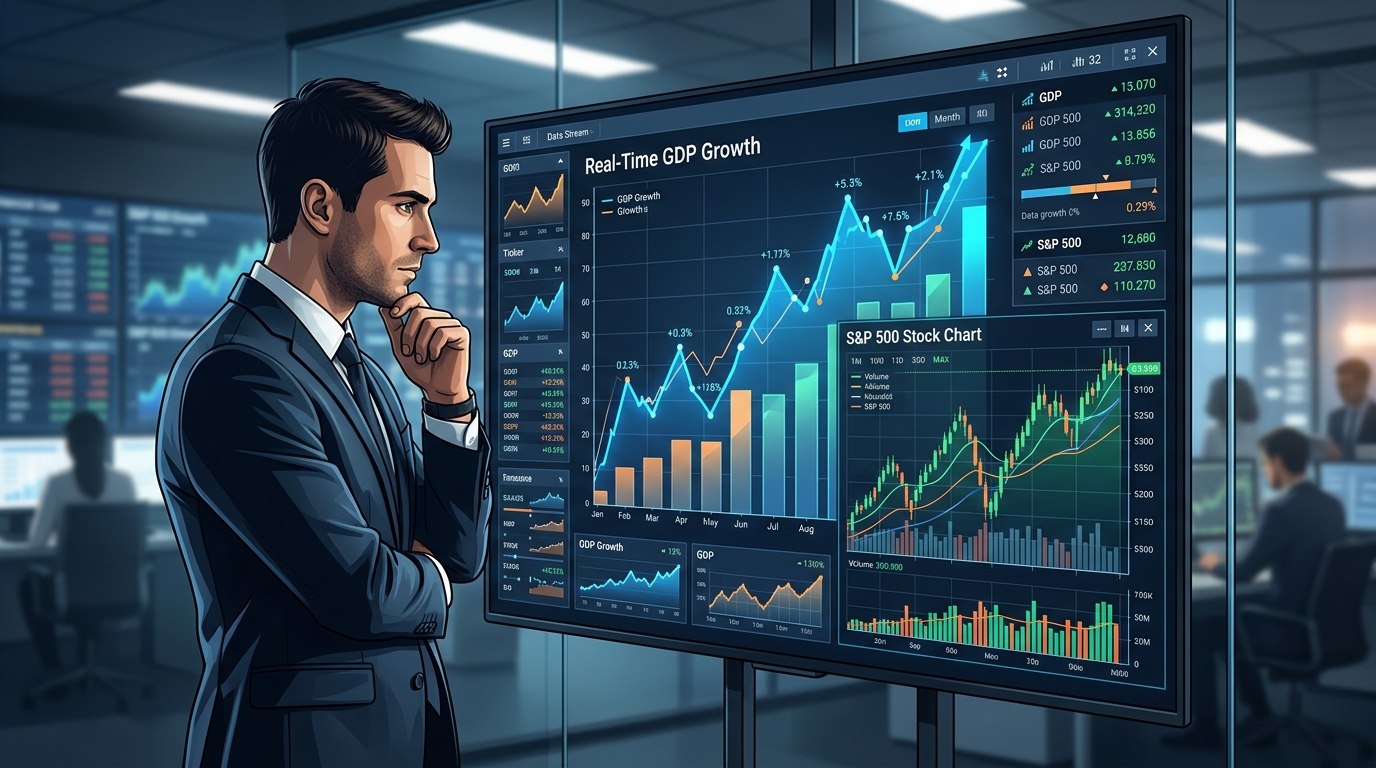
Hello, Daily Stock readers. Today, we will take a deep dive into the Atlanta Fed's 'GDPNow' estimate, which serves as a real-time compass for the US economy, and the S&P 500 market's reaction to it.
Key Summary
- The Atlanta Fed's Q2 2026 GDPNow estimate stands at 3.04% (approx. 3.0%), proving the strong fundamental health of the US real economy.
- Strong economic growth is fueling scenarios of additional interest rate hikes beyond concerns of prolonged high rates by the Fed, putting profit-taking pressure on the Nasdaq and S&P 500.
- Wall Street, led by JPMorgan, raised its year-end S&P 500 target based on robust earnings outlooks, but at the same time warned of a tech-led flash crash risk.
[Image: /stdaily/uploads/202606/gen_6a3c7deed17796.88276084.png]
Market Overview
The Atlanta Fed's GDPNow estimate, reflecting the real-time flow of the US economy, recorded 3.04% for the second quarter of 2026, drawing keen market attention.
The estimate, which once surged to 4.3% in late May, has settled into a stable growth path of around 3.0% following moderate adjustments in consumption and manufacturing indicators.
However, this resilience of the real economy has created a "paradox of a strong economy," erasing rate cut expectations in terms of monetary policy and instead raising the possibility of additional rate hikes.
In fact, according to CME FedWatch, the market has begun pricing in the possibility of the Fed raising interest rates twice more—in September and December.
Consequently, as of intraday on June 25, 2026, domestic and international market indicators and fear & greed indices showed high volatility and mixed trends.
| Indicator | Current Value (as of 2026-06-25) | Market Sentiment & Features |
|---|---|---|
| **KOSPI Index** | 8,848.62 (Intraday) | Maintained Neutral (53.5) on its own Fear & Greed Index |
| **KOSDAQ Index** | 906.42 (Intraday) | Breather taken due to caution over external volatility |
| **Nasdaq Composite** | 25,476.64 | Entered Fear (25.9) territory due to deepening rate worries |
| **USD/KRW Exchange Rate** | 1,547.70 KRW | Upward pressure on the exchange rate due to persistent global strong dollar |
| **Q2 GDPNow Estimate** | 3.04% (as of June 17) | Robust growth continues on the back of favorable consumption and investment data |
Financial Analysis
The fundamentals of S&P 500 companies are experiencing an unprecedented upward revision in earnings outlooks, backed by the strong expansion of the real economy.
According to Wall Street research, the 2026 EPS (earnings per share) estimate for S&P 500 companies jumped about 10% from the beginning of the year to around $350.
In particular, massive capital expenditure (CapEx) expansions in AI data centers by cloud hyperscalers such as Microsoft, Amazon, and Meta are driving revenue growth in the technology sector.
In addition, stabilizing oil prices due to easing geopolitical tensions in the Middle East have helped economically sensitive sectors such as airlines and travel gradually recover their financial resilience.
However, with high interest rates persisting longer, marginal companies with high debt loads or Russell 2000 small-cap stocks face the challenge of overcoming direct financial pressure from rising interest expenses.
Valuation
The current forward price-to-earnings (P/E) ratio of the S&P 500 stands at around 20.7x, remaining somewhat high compared to its historical average.
Some optimists analyze that under a "blue sky" scenario based on the conclusion of US-Iran peace talks and normalization of geopolitical supply chains, the forward P/E could expand up to 23x.
However, the recent upward trend in the stock market shows the limitations of a "narrow market" that relies excessively on a few mega-cap tech stocks at the top rather than an even rise across the index.
Indeed, the performance divergence between the S&P 500 market-cap-weighted index and the equal-weighted index has deepened, acting as a source of volatility.
The contraction of the Nasdaq Fear & Greed Index to 25.9 (Fear) suggests that the market has set a very high bar for the earnings performance that companies must deliver to justify current high multiples.
[Image: /stdaily/uploads/202606/gen_6a3c7dfc279191.55508028.png]
Expert and Institutional Analysis
JPMorgan, a leading global investment bank, raised its year-end target for the S&P 500 index from 7,600 to 7,800, reflecting the unusual upward trend in corporate earnings.
BCA Research also aggressively raised its year-end target for the S&P 500 to 8,100, citing evidence that the US real economy is moving into a full expansion phase.
However, behind this index optimism, warnings of a sudden crash due to short-term overheating are louder than ever.
Dubravko Lakos-Bujas, equity strategist at JPMorgan, pointed out that "speculative momentum trading has reached extreme levels, particularly around secondary AI theme stocks."
He warned that under highly concentrated liquidity conditions, if algorithmic or program selling is triggered in a chain reaction, a 'flash crash'—where stock prices plunge in an instant and then quickly recover—could occur, recommending thorough diversification.
Risk Factors
The most fundamental risk is the boomerang effect of tightening: robust economic growth prolongs the Fed's monetary tightening, which in turn increases capital borrowing costs.
A high GDPNow figure exceeding 3% could solidify downward rigidity in inflation, providing justification for the Fed to consider additional rate hikes.
In response, the 2-year US Treasury yield surpassed 4.2%, continuing to exert rate pressure that shrinks overall liquidity in the financial market.
In addition, as high inflation and high interest rates accumulate over a long period, if the spending power of lower-income households reaches its limit, the risk of an economic slowdown due to weakening domestic demand cannot be ruled out.
Furthermore, the extreme vulnerability of market concentration remains a threat, where the overall market could shake uncontrollably if the earnings of just a few leading tech stocks fall even slightly short of expectations.
Investment Perspective Summary
A contradictory phase continues where strong economic data triggers tightening concerns, and prolonged tightening in turn depresses valuation multiples.
Under this scenario, rather than aggressive investing that tracks the entire index, portfolio diversification that combines large-cap value stocks with proven cash-generation capabilities or traditional defensive blue chips seems desirable.
As market expectations for the interest rate path are frequently recalibrated, the rotation cycle between tech stocks and sidelined sectors is highly likely to proceed very rapidly.
In the long term, the upward earnings power of US corporations remains valid, but a flexible approach—retaining a portion of assets in cash-equivalent assets to prepare for short-term volatility and systemic crash risks—is recommended.
Investor Checklist Q&A
- **Q. Is the Atlanta Fed's GDPNow estimate the same as the Fed's official economic forecast?**
- **A.** No. GDPNow excludes any subjective views or assumptions of Fed officials. It is simply a real-time 'current quarter estimate' derived solely by inputting the latest released real indicators into a mathematical formula.
- **Q. Why is the Nasdaq Fear & Greed Index in the Fear (25.9) zone when the real economy is growing so strongly?**
- **A.** Because sustained solid economic growth eliminates the incentive for the Fed to cut rates early and instead opens up the possibility of additional tightening, putting downward pressure on highly-valued big tech stocks due to discount rate burdens.
- **Q. What is the main reason for the recent sharp upward revision in S&P 500 earnings outlooks?**
- **A.** Big tech companies have significantly increased their capital expenditure (CapEx) plans, such as data centers, to secure an edge in AI competition, and consumers' spending capacity is holding up well based on solid employment.
- **Q. What exactly is the 'flash crash' that Wall Street is warning about?**
- **A.** It is an extreme volatility phenomenon where stock prices plunge momentarily and then quickly recover to their starting point due to chain-reaction selling by AI algorithms when bad news occurs in a situation where speculative short-term funds are excessively concentrated in secondary AI beneficiaries or small-cap tech theme stocks.
- **Q. What do the high exchange rate and Treasury yield levels imply for domestic and foreign stock market investors?**
- **A.** Based on strong US growth, the US 2-year Treasury yield surpassing 4.2% and the USD/KRW exchange rate surging to 1,547.70 KRW can trigger capital outflows by foreign investors and act as a direct hurdle limiting the upside of the domestic stock market.