Hello. This is Daily Stock, delivering clear insights on key global financial market trends.
Key Summary
- **Commodity Index Surge Outlook:** According to S&P Global Market Intelligence, the Commodity Price Index (MPI) is projected to skyrocket by approximately 35% by the third quarter of 2026 compared to the end of 2025 due to geopolitical factors.
- **The Double-Sided PMI:** While the preliminary US Manufacturing PMI for June 2026 hit a 49-month high of 55.7, concerns are rising that this might be an illusion driven by 'preemptive stockpiling' rather than a recovery in underlying demand.
- **Severe Sector Polarization:** Within the S&P 500 Materials Sector (XLB), a stark divergence continues. Chemical and fertilizer companies have surged on supply chain bottleneck benefits, while packaging and construction materials companies remain sluggish.
[Image: /stdaily/uploads/202606/gen_6a3b2d48c3cc23.51858446.png]
Current Status Overview
Currently, the global financial markets are experiencing heightened volatility amid a tightrope walk between geopolitical uncertainties and inflation data.
As of intraday on June 24, 2026 (tentative), the domestic KOSPI index stands at 8,530.77, while the KOSDAQ index remains at 914.32.
At the same time, the NASDAQ index is recording the 25,587.04 level, and the USD/KRW exchange rate is at 1,536.40 KRW, maintaining high tension in the foreign exchange market.
According to Daily Stock's proprietary Fear & Greed Index, the KOSPI Fear & Greed Index is currently at 42.7 (53.4 a week ago, 58.1 a month ago, 23 three months ago), indicating a neutral stage.
On the other hand, the NASDAQ Fear & Greed Index has dropped to 27.5 (39.1 a week ago, 59 a month ago, 56.6 three months ago), showing that market sentiment has entered 'fear' territory.
At the root of this fear lies prolonged geopolitical risks and the resulting upward pressure on commodity prices.
Indeed, according to S&P Global's June preliminary Purchasing Managers' Index (PMI) announcement, the US Manufacturing PMI reached 55.7, hitting a 49-month high. However, serious warning signs are being detected in the sub-indices. Due to skyrocketing raw material costs, the pace of job cuts in the manufacturing sector has been the steepest since the 2009 financial crisis, excluding the pandemic.
Financial Analysis
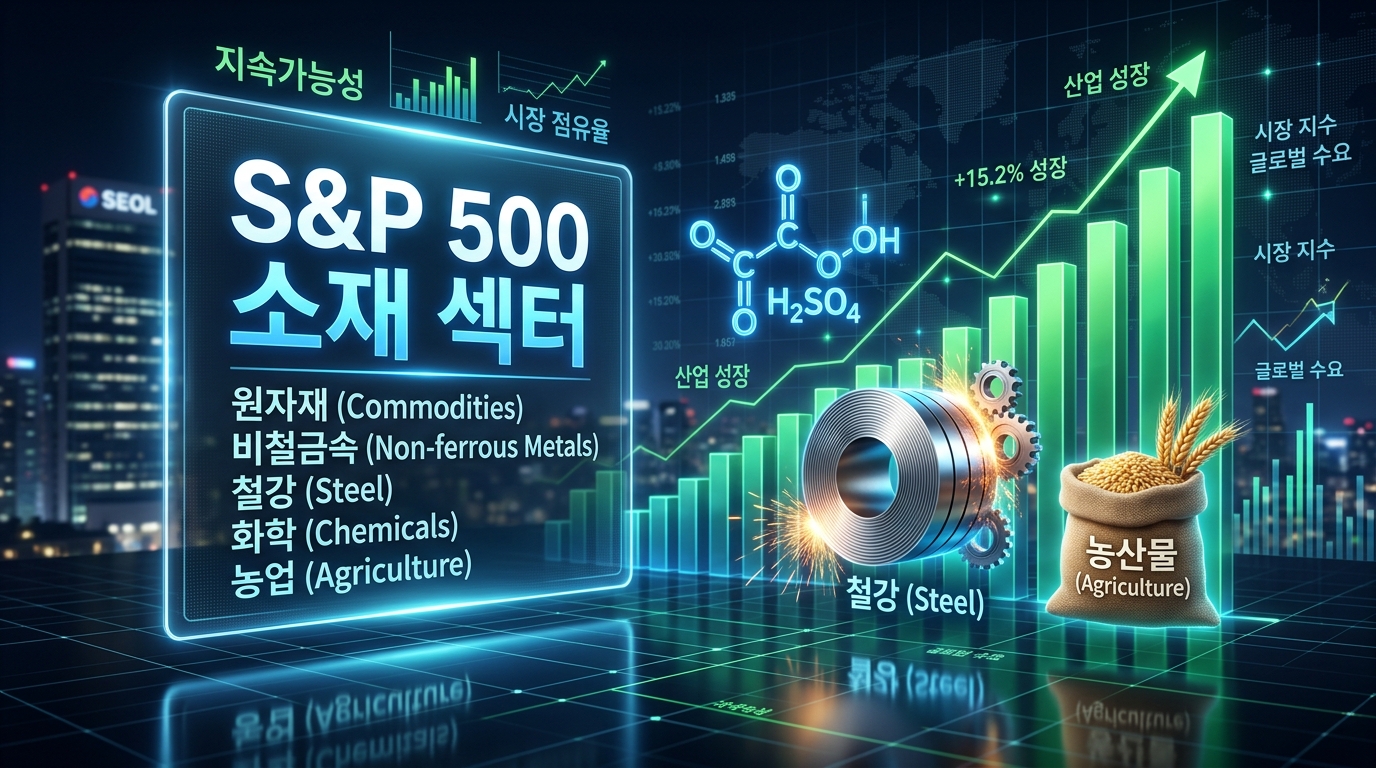
The portfolio of the Materials Select Sector SPDR Fund (XLB), a representative exchange-traded fund (ETF) tracking the S&P 500 Materials sector, is structured to be extremely sensitive to supply and demand fluctuations of raw materials.
Chemicals hold the largest share at approximately 51-53%, followed by metals & mining (approx. 20-21%), construction materials (approx. 13-14%), and containers & packaging (approx. 13-15%).
In the first half of this year, the financial performance of companies in the materials sector showed clear contrasts depending on the type of commodity.
As chemical and fertilizer prices rose due to intensifying Middle East conflicts and concerns over disruptions in the Strait of Hormuz, companies like LyondellBasell (LYB), Dow (DOW), and CF Industries (CF) achieved strong results due to higher selling prices from supply shortages.
In contrast, International Paper (IP), a global packaging specialist, and CRH, a multinational construction materials company, experienced sluggish financial trends as they bore the brunt of slowing demand.
| Company (Ticker) | Major Business Area | H1 2026 Key Trends & Performance |
|---|---|---|
| **Linde (LIN)** | Industrial Gases & Chemicals | Maintained defensive resilience backed by stable long-term contracts as the top stock in the chemical segment |
| **Newmont (NEM)** | Precious Metals & Gold Mining | Strengthened financial stability in tandem with the strong gold price trend due to geopolitical unrest |
| **Freeport-McMoRan (FCX)** | Copper & Mining | Directly correlated with copper price volatility driven by global power grid and infrastructure demand |
| **LyondellBasell (LYB)** | Petrochemicals & Plastics | Surged due to strong petrochemical product prices resulting from geopolitical supply chain disruptions |
| **International Paper (IP)** | Containers & Packaging | Recorded weak stock price trends on concerns over slowing global logistics and consumer goods demand |
Valuation
As of June 23, 2026, the S&P 500 Materials Sector ETF (XLB) is trading around $51.29, recording a year-to-date (YTD) gain of approximately 14.03%.
Currently, the sector's Forward Price-to-Earnings (P/E) ratio is valued at approximately 23.12x.
This multiple, slightly premium compared to the historical average, can be interpreted as pricing in expectations for future profit growth due to raw material shortages.
However, this is largely influenced by high-valuation large-cap chemical stocks within the sector, reflecting an asymmetrical structure where construction materials and packaging industries remain at relatively lower multiples.
In terms of dividends, XLB's trailing 12-month (TTM) dividend yield has maintained around 1.64% to 1.69%, providing a level of downside support to portfolios.
[Image: /stdaily/uploads/202606/gen_6a3b2d54d372c7.20219683.png]
Expert and Institutional Analysis
Global investment banks (IBs) and institutional experts analyze the current upward trend in the materials sector as being driven by 'geopolitical risk-induced supply chain bottlenecks' rather than 'fundamental improvement in structural health.'
Chris Williamson, Chief Business Economist at S&P Global, pointed out that the recent strength in the manufacturing PMI was not driven by an actual increase in final consumption.
He noted it is highly likely a temporary 'PMI illusion' caused by companies engaging in precautionary inventory hoarding to cope with raw material procurement delays and rising costs.
Portfolio managers at the Fidelity Advisor Materials Fund anticipate that copper and precious metal mining companies will show sustainable growth amid supply constraints.
However, they warn that while short-term profit margin spreads have widened for pure cyclicals like chemicals and plastics, a rapid reversal could occur once supply chains normalize.
Risk Factors
The biggest risk factor in investing in the materials sector is the scenario of a 'sharp reversal in commodity prices' if geopolitical tensions ease.
If tensions in the Middle East subside or the normalization of maritime shipping routes accelerates, the inflation premium could quickly dissipate, potentially causing chemical and commodity futures prices to turn downward.
Furthermore, the risk of a real economy slowdown due to prolonged high-interest rates cannot be ignored.
As manufacturers are already applying stagflation-type pressure by cutting jobs to control costs, any significant contraction in future infrastructure and construction demand could intensify margin pressures for construction and packaging materials companies.
Investment Perspective Summary
The S&P 500 Materials Sector (XLB) serves as a classic inflation hedge and a defensive sector in sector rotations benefiting from supply chain bottlenecks.
However, as the June manufacturing PMI suggests, the current strength relies heavily on companies' temporary inventory hoarding trends.
Therefore, investors need to monitor the direction of commodity price indices and manufacturing employment trends closely.
Rather than simply tracking the index, a differentiated strategy that separates the earnings of large-cap chemical and mining stocks, which are highly correlated with raw material prices, from packaging and construction material companies, which are dependent on economic cycles, is considered advantageous.
Investor Checklist Q&A
Q1. What is the weight of major sub-sectors within the S&P 500 Materials Sector (XLB)?
A1. Chemicals account for more than half at around 51-53%, followed by metals & mining (approx. 20%), construction materials (approx. 13%), and containers & packaging (approx. 13%).
Q2. The recent US Manufacturing PMI hit a 49-month high (55.7). Why might this be an illusion?
A2. Although the index itself was high, the driving force was not an increase in actual end demand, but rather 'preemptive inventory building' by companies concerned about raw material procurement delays due to conflicts in the Middle East.
Q3. Which stocks stood out the most and which lagged within the materials sector in the first half of 2026?
A3. Chemical and fertilizer stocks like LyondellBasell (LYB, +86.1%) and Dow (DOW, +78.1%) surged as product prices spiked amid supply chain concerns, while International Paper (IP, -9.4%) underperformed due to slowing packaging demand.
Q4. Is the current valuation (P/E) of the Materials Sector (XLB) reasonable?
A4. As of June 23, 2026, the Forward P/E of XLB is around 23.12x. This is slightly elevated compared to the historical average, meaning that profit growth prospects from raw material supply anxieties are already priced in.
Q5. What are the key macroeconomic indicators that investors should pay closest attention to?
A5. The fluctuations of the S&P Global Commodity Price Index (MPI), global ocean freight indices, and whether employment indicators in US manufacturing are recovering should be monitored with the highest priority.