Hello, this is Daily Stock.
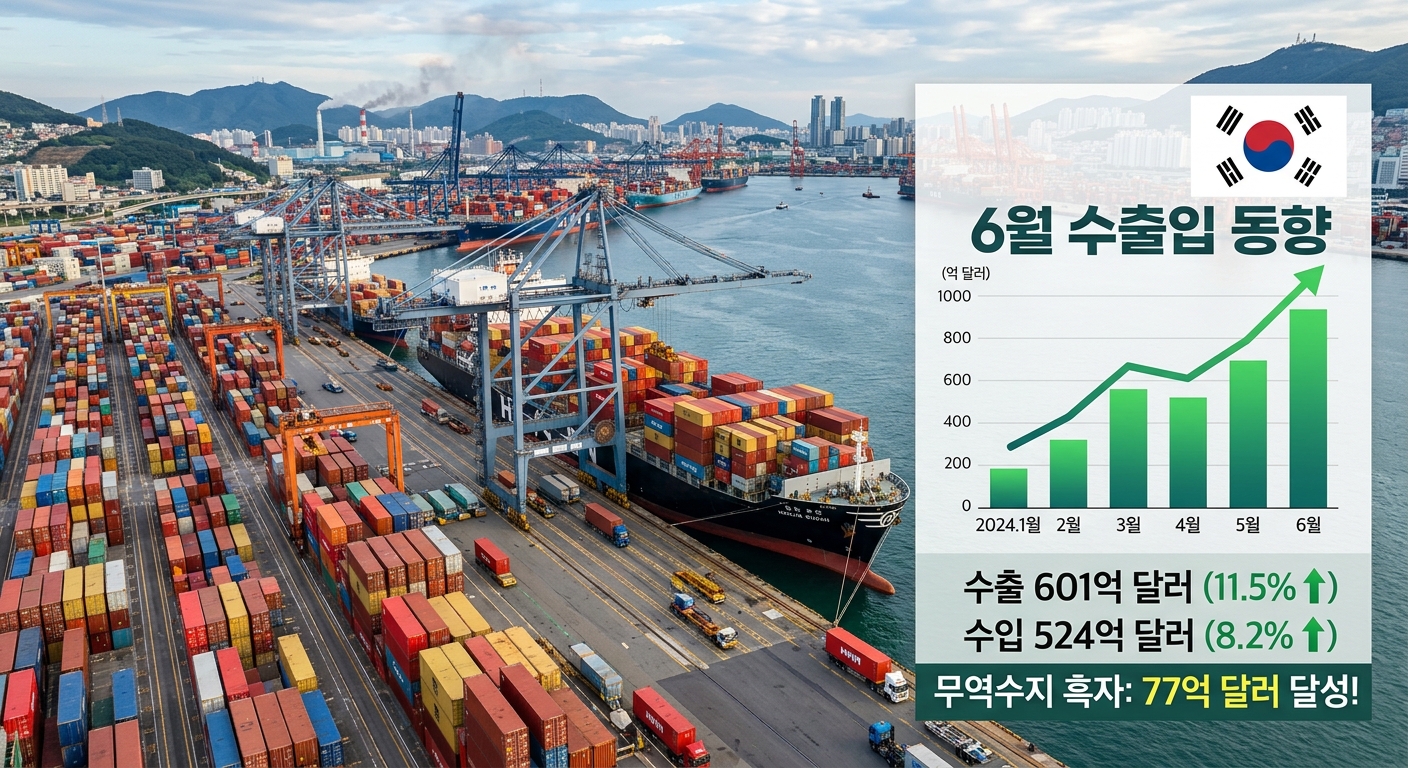
Today, the domestic stock market showed a highly volatile session as record-high export performance and a high exchange rate of 1546 KRW/USD intersected.
[Image: /stdaily/uploads/202606/gen_6a3b80cc919747.83743180.png]
Key Summary
Exports from June 1 to 20, 2026, surpassed $62 billion, breaking the record for the same period in history.
In particular, semiconductor exports surged by 188.4% year-on-year, accounting for 41.2% of total exports, showcasing a booming industry.
Supported by strong exports, the trade balance recorded a solid surplus of $17.5 billion.
Amid the high exchange rate phase where the USD/KRW reached 1,546.00 KRW, the KRW-denominated earnings momentum centering on large-cap exporters is strengthening.
Current Status Summary
The KOSPI index closed at 8471.02 on June 24 amid a tug-of-war between foreign and institutional investors.
The USD/KRW exchange rate closed at 1,546.00 KRW, higher than the previous session, continuing the strong dollar trend.
According to Daily Stock's proprietary Fear & Greed Index, the KOSPI is currently in the Neutral (40.2) stage.
This shows a slight contraction in market sentiment compared to Neutral (53.4) one week ago and Neutral (58.1) one month ago, but it is a clearly stabilized figure compared to Fear (23) three months ago.
Meanwhile, the Nasdaq Index, a barometer of the global financial market, recorded 25587.04 today, and the Nasdaq Fear & Greed Index remains at the Fear (27.7) level.
Even as the contraction of sentiment in the US stock market continues, Korea's robust import and export fundamentals are acting as the underlying strength defending the KOSPI from further declines.
Financial Analysis
According to the import and export status for June 1–20 (tentative customs clearance basis) announced by the Korea Customs Service, exports rose 60.4% year-on-year to $61.991 billion.
Imports increased by 23.2% to $44.495 billion, leading to a robust trade surplus of $17.496 billion during this period.
The cumulative trade balance for this year from January 1 to June 20 recorded a surplus of $119.667 billion, showing historic performance.
Considering the number of working days (15 days), the average daily export value also surged 49.7% year-on-year to $4.13 billion.
| Category | Performance (June 1–20, 2026) | YoY Growth Rate | Characteristic Analysis |
|---|---|---|---|
| **Exports** | $61.991 Billion | +60.4% | Renewed historic record for the same period |
| **Imports** | $44.495 Billion | +23.2% | Inflow centered on semiconductor equipment and energy resources |
| **Trade Balance** | $17.496 Billion Surplus | Surplus significantly expanded | Sharp increase compared to the same period last year ($2.5B surplus) |
| **Daily Avg Exports** | $4.130 Billion | +49.7% | Reflects one additional working day (14.0 days -> 15.0 days) |
| **Semiconductor Exports** | $25.509 Billion | +188.4% | Share of total exports expanded to 41.2% |
By item, computer peripheral exports skyrocketed by 293.3% as demand for high-performance SSDs for artificial intelligence (AI) servers continued.
Petroleum products (39.0%) and ships (39.9%) also maintained steady growth, while auto parts decreased slightly by 9.5%, showing divergence by sector.
[Image: /stdaily/uploads/202606/gen_6a3b80d6b31541.81505363.png]
Valuation
The surge in the USD/KRW exchange rate to 1,546.00 KRW is a variable that further inflates the earnings capacity of KOSPI large-caps, which report earnings in KRW.
In particular, the annual earnings consensus for major tech stocks such as Samsung Electronics and SK Hynix is being continuously revised upward.
Currently, the KOSPI index (8471.02) is in a phase of receiving a relatively low valuation compared to the solid trade surplus.
Due to global interest rate uncertainties and foreign capital inflows stagnating in connection with the fear sentiment of the US stock market, the Price-to-Earnings Ratio (PER) is kept low.
In addition to the accounting effect of the rising exchange rate, real growth is emerging with the rapid expansion of export volume itself on a pure dollar basis.
Accordingly, the forward Price-to-Book Ratio (PBR) of KOSPI large-caps, which represents stock price attractiveness relative to performance, is also evaluated to have entered an attractive range.
Expert & Institutional Analysis
According to government ministries, expectations are spreading that total annual exports could surpass $900 billion for the first time in history this year.
If annual exports of $900 billion materialize, Korea's global export ranking will leap into the top 5, surpassing Hong Kong, Japan, and Italy.
Market analysts are particularly paying attention to the overwhelming technological dominance, with semiconductor exports accounting for over 40% of the total.
Backed by the expansion of AI infrastructure, a scenario where the strong earnings of Korean semiconductor companies lead the entire stock market for the time being is considered highly likely.
Institutional investors are narrowing their purchases to large-cap IT stocks benefiting from the high exchange rate and the shipbuilding sector linked to the global economic recovery.
Foreigners are also focusing on taking profits through short-term futures trading while maintaining their long-term spot positions based on the solid fundamentals of large-cap exporters.
Risk Factors
However, the Korean trade structure's excessive reliance on semiconductors is a risk factor that increases long-term volatility.
With the share of semiconductors reaching 41.2%, a downturn in global memory prices could lead to a sharp decline in the overall trade balance.
Small- and medium-cap stocks and domestic consumption-oriented sectors closely linked to the domestic market are taking the full impact of the high exchange rate and prolonged high interest rates.
The exchange rate of 1,546.00 KRW has a negative downside, as it increases the burden of raw material import prices, shrinking household consumption and the margins of domestic companies.
At the same time, subtle slowdowns in key manufacturing sectors other than semiconductors, such as auto parts (-9.5%), are also areas to watch.
Strengthening tariff barriers by the US and global logistics risks due to conflicts in the Middle East remain constant threats to the export front.
Investment Perspective Summary
The KOSPI market is in a tug-of-war between the strong fundamentals of robust export performance and macroeconomic pressures from the high exchange rate and global tightening sentiment.
In times of high macroeconomic volatility, a strategy focusing thoroughly on high-quality, large-cap stocks centered on earnings seems effective.
Selected high-growth sectors such as semiconductors and shipbuilding, which expand global market share while enjoying the benefits of the high exchange rate, can serve as short-term shelters.
However, conservative weight adjustment is required for domestic-oriented industries with a high proportion of raw material imports and a heavy debt burden.
To determine whether the strong export trend can continue until the end of the year, it is necessary to continuously track changes in import demand from major countries like the US and China.
FAQ
Q1. What led to the record-high export performance for June 1–20?
A1. Semiconductor exports, which surged 188.4% year-on-year, and computer peripherals (SSDs), which jumped 293.3% on the back of expanding AI server demand, strongly led overall export growth.
Q2. What is the status of the trade surplus and the cumulative annual performance for this year?
A2. The trade balance for June 1–20 recorded a surplus of $17.496 billion, and the cumulative trade balance for this year shows a solid trend with a surplus of $119.667 billion.
Q3. How does the USD/KRW exchange rate rising to 1,546.00 KRW affect the KOSPI?
A3. It has a positive effect of inflating the KRW-denominated revenue and profit of large exporting companies with high dollar settlement ratios. Conversely, it puts upward pressure on import prices, negatively affecting domestic consumption sectors and expectations for interest rate cuts.
Q4. What is the implication of the criticism regarding excessive semiconductor export concentration?
A4. As semiconductors account for up to 41.2% of total exports, it represents a single-industry dependency risk where the entire trade balance could fluctuate if global semiconductor prices fall or a slowdown in the industry occurs in the future.
Q5. What is the key indicator that individual investors should pay the most attention to at this point?
A5. Investors should monitor both the USD/KRW exchange rate trend, which will determine whether the high exchange rate phase eases, as well as the earnings trends and facility investment paths of US tech companies, which dictate the direction of large-cap exporters.