Hello. This is Daily Stock, delivering key market trends and precise analyses of domestic and global financial markets.
[Image: /stdaily/uploads/202606/gen_6a378c59772e78.79122692.png]
Key Summary
- After breaking above the 9,000 level for the first time in history, the KOSPI has entered a cooling-off phase, triggering serious discussions about reaching the dream 10,000-point mark in the second half of the year.
- The overwhelming earnings growth of the semiconductor duo (Samsung Electronics, SK Hynix) drove the index surge, but a stark market polarization is evident, with declining stocks vastly outnumbering advancing ones.
- Under a high exchange rate of 1,533 KRW and hawkish monetary policies at home and abroad, investors must thoroughly prepare for volatility risks and signs of overheating, such as the surge in outstanding margin loan balances.
Market Overview
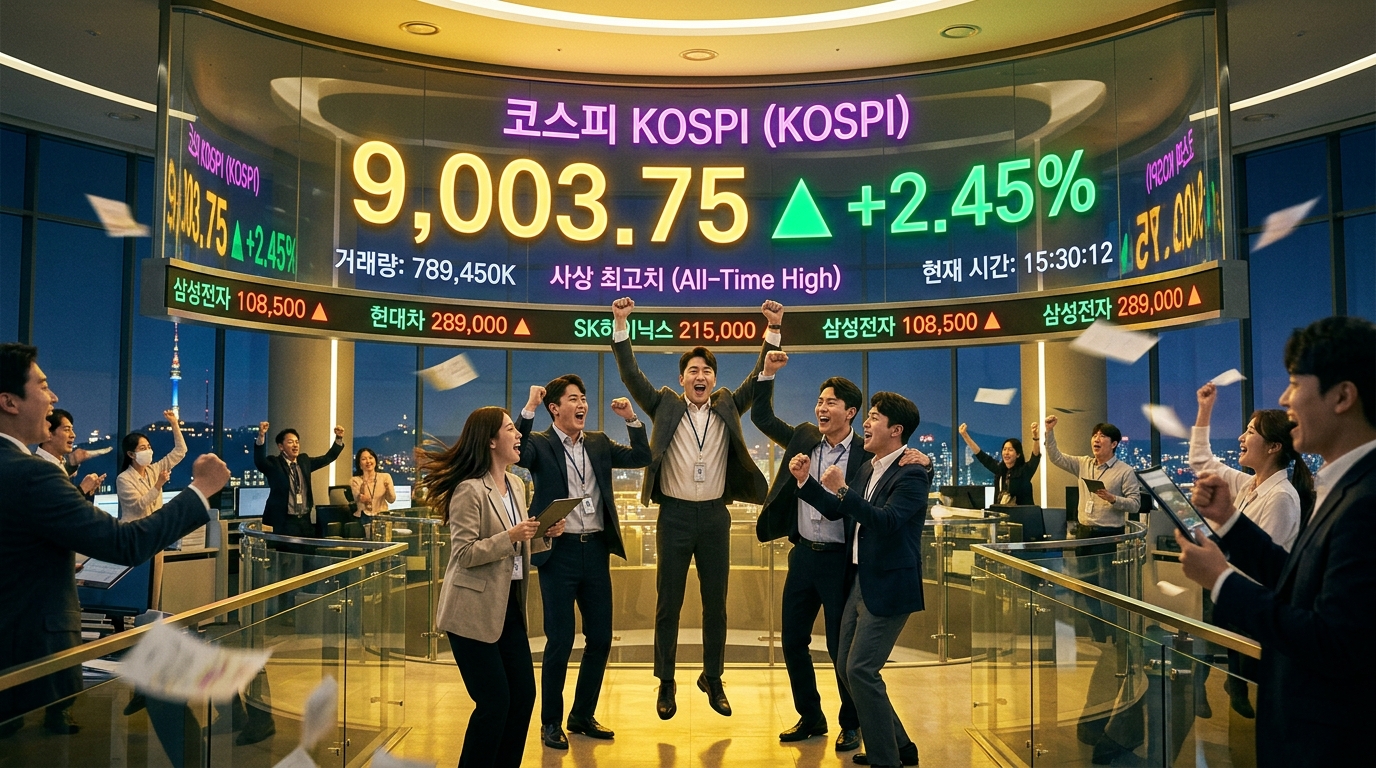
As of June 21, 2026, the KOSPI index closed at 9,052.42, successfully solidifying its position above the historic 9,000 mark.
Following its historic breakout above 9,000 on both an intraday and closing basis on June 18, the index has experienced a short-term consolidation as profit-taking orders emerged.
During the same period, the KOSDAQ index stood at 966.59, while the USD/KRW exchange rate remained elevated at 1,533.00 KRW.
In the global macro environment, oil prices stabilized following a memorandum of understanding (MOU) to end hostilities between the US and Iran. However, the hawkish interest rate outlook of the new Federal Reserve Chair, Kevin Warsh, continues to loom over the market.
According to Daily Stock’s proprietary Fear & Greed Index, KOSPI Fear & Greed is currently in the Neutral (51.9) zone, showing that investor sentiment remains calm despite the index's explosive run, due to heightened volatility.
In contrast, the Nasdaq Fear & Greed Index is indicating Fear (37.3), reflecting short-term correction pressures across global tech stocks.
| Indicator | Current Value (As of June 21, 2026 Close) | Change vs. 1 Week Ago | Key Features & Market Reaction |
|---|---|---|---|
| **KOSPI Index** | 9,052.42 | Upward trend maintained | Attempting to consolidate after breaking 9,000 for the first time |
| **KOSDAQ Index** | 966.59 | Relatively weak | Laggard performance due to market concentration in large-cap semiconductors |
| **USD/KRW Rate** | 1,533.00 KRW | High exchange rate persists | Concerns over import costs and foreign exchange losses for offshore investors |
| **KOSPI Fear & Greed** | Neutral (51.9) | Slight decrease | Maintained neutral stance despite the index surge due to overvaluation alerts |
Financial Analysis
The prime driver behind the KOSPI’s surge past 9,000 is the explosive fundamental improvement of mega-cap semiconductor companies, which account for more than half of the domestic stock market's total market capitalization.
Samsung Electronics recently touched 362,500 KRW, while SK Hynix's earnings outlook was revised upward significantly as it began supplying HBM4E (7th generation High Bandwidth Memory) samples to major customers.
According to the financial investment industry, the estimated operating profit of KOSPI-listed companies for 2026 is projected to approach approximately 410 trillion KRW, demonstrating a robust fundamental backdrop completely different from the historical "Box-pi" range-bound years.
Furthermore, the combination of sustained AI infrastructure demand and tight supply for commodity DRAM has created a structure where the semiconductor sector's solo run is driving a comprehensive re-rating of the entire index.
[Image: /stdaily/uploads/202606/gen_6a378c651be5b7.37632125.png]
Valuation
Applying the KOSPI’s historical average price-to-earnings (P/R) multiple of 9.96x to the projected net profits for 2026–2027 suggests that the current 9,000 level is a fair reflection of corporate earnings.
Some analysts calculate that if earnings growth through 2027 is priced in ahead of schedule by the end of this year, the total market capitalization of the index could exceed 8,400 trillion KRW.
However, the steep rise of the KOSPI raises the barrier for entry in the short term, and critics point out that rapid increases in PER and PBR (price-to-book ratio) could cap the index's upside.
For the KOSPI to reach the dream 10,000-point milestone in the second half, a sector-wide re-rating must occur, spreading the valuation premium currently concentrated in semiconductors to other sectors such as automotive, finance, and biotechnology.
Expert & Institutional Analysis
Some domestic brokerages have released aggressive forecasts for the second half, suggesting that the KOSPI's ceiling could open up to as high as 10,380 points, considering the market's typical cycle of pricing in future earnings ahead of time.
Global investment banks (IBs) also note that further structural upside is possible if Korea’s capital market reforms lead to improved corporate governance and higher shareholder return ratios.
However, domestic research centers urge caution regarding short-term overshooting.
With technical signs of overheating emerging after a cumulative rise of over 16% over six consecutive trading sessions, the consensus is that a continuous upward trajectory without corrections is unsustainable.
Risk Factors
The most pressing risk factor is the severe "semiconductor concentration" issue. Even on the day the KOSPI crossed 9,000, declining stocks (791) outnumbered advancing stocks (109) by more than seven times.
This indicates that the broader market's fundamentals may appear distorted, as small-and-medium caps and non-semiconductor sectors held by the majority of retail investors continue to lag.
In addition, margin loan balances—representing debt-fueled trading—have surged to nearly 37.9 trillion KRW, triggering warning lights for market overheating, while the volatility index (VKOSPI) is also rebounding.
Macroeconomic headwinds, such as the hawkish stance of the Bank of Korea and the 1,533 KRW exchange rate that fuels import inflation and heightens foreign capital volatility, could also drag down the index in the second half of the year.
[Image: /stdaily/uploads/202606/gen_6a378c6ea22558.59811850.png]
Investment Outlook
The current KOSPI 9,000 era is positive because it is supported by structural earnings growth driven by the semiconductor mega-cycle, rather than being a mere liquidity-driven rally.
While the path to 10,000 points in the second half remains open, it can only be achieved if the positive sentiment surrounding semiconductors successfully trickles down to sidelined small-and-medium caps and other large export-driven sectors.
Therefore, rather than chasing the index's upward momentum blindly, investors should adopt a diversified portfolio strategy, accumulating solid, earnings-backed sectors during phases of increased volatility.
Rather than engaging in aggressive chase-buying, a prudent approach would involve monitoring key indicators, such as the decision on whether South Korea will be added to the MSCI Developed Markets watch list scheduled for June 24, alongside monthly import and export trends.
Investor Checklist Q&A
Q1. What is the core driver behind the KOSPI surpassing 9,000?
A1. The primary engines driving the index are the massive earnings surge in large-cap semiconductor companies like Samsung Electronics and SK Hynix, combined with explosive global demand for AI memory (HBM).
Q2. Is breaking above the 10,000 level in the second half a realistic scenario?
A2. While some brokerages suggest targets above 10,000 by pricing in future earnings early, this is a conditional scenario that requires a synchronized rise in other industries and a comprehensive valuation re-rating across the board.
Q3. The index has surged, so why is my account balance in the red?
A3. The breakout past 9,000 is the result of extreme "semiconductor polarization." Because the rally was concentrated in a few mega-caps—with over 790 stocks declining on the day KOSPI crossed 9,000—individual investors holding broader portfolios may not feel the index's gains.
Q4. What are the short-term macro risks to watch out for?
A4. Investors should closely monitor the high exchange rate in the 1,530 KRW range, the hawkish interest rate stances of the Bank of Korea and the Federal Reserve, and the potential for a margin call squeeze given the outstanding margin loan balances of over 37 trillion KRW.
Q5. What strategy should investors adopt for a successful second half?
A5. Instead of chasing already overextended semiconductor stocks, a rotation strategy targeting defensive or alternative sectors with strong earnings backing and attractive valuations—such as shipbuilding, defense, and nuclear energy—is highly recommended.