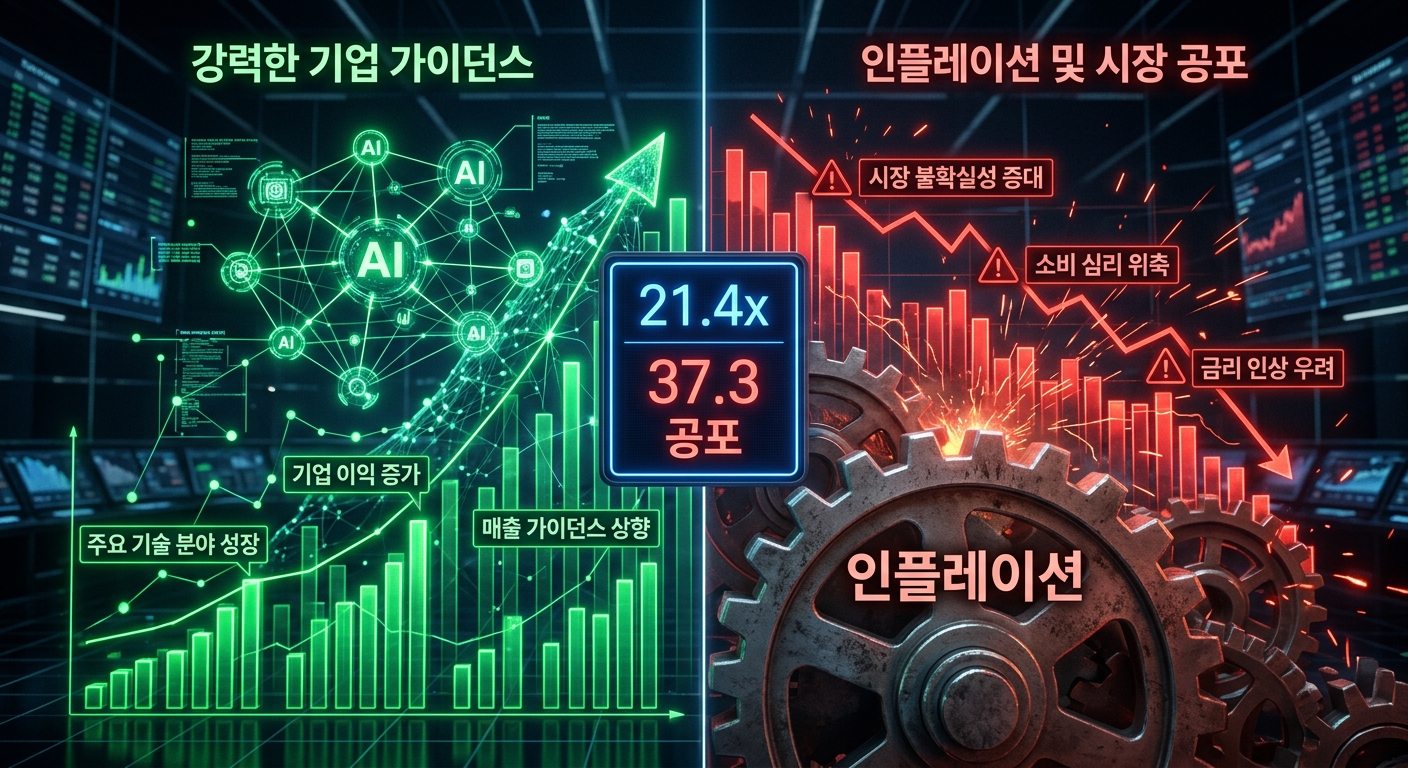
While the US stock market shows robust corporate earnings strength, subtle shifts in the macro environment are weighing on investor sentiment.
Executive Summary
- **Favorable Guidance Ratio**: Among S&P 500 companies that provided Q2 2026 earnings guidance, the proportion of negative outlooks stood at 49%, significantly below historical averages, reflecting corporate confidence in earnings.
- **Reignited Inflation Concerns**: The number of companies mentioning 'inflation' in their earnings conference calls increased for the third consecutive quarter, indicating persistent cost pressures.
- **Elevated Valuation and Market Fear**: The 12-month forward P/E ratio for the S&P 500 soared to 21.4x, raising valuation burdens. Meanwhile, the Nasdaq Fear & Greed Index remains in the 'Fear (37.3)' zone, deepening the divergence between rising indices and shrinking investor sentiment.
[Image: /stdaily/uploads/202606/gen_6a373805b38f28.50741576.png]
Current Market Summary
As of June 21, 2026, the US Nasdaq index reached 26,517.93, while the USD/KRW exchange rate remained elevated at 1,533.00 KRW.
South Korea's KOSPI index pointed to 9,052.42 and the KOSDAQ stood at 966.59, reacting sensitively to the direction of global monetary tightening and macro indicators.
According to the Fear & Greed Index compiled by Daily Stock, the Nasdaq Fear & Greed Index recorded 'Fear (37.3)'.
This is similar to 'Fear (35.5)' a week ago, showing a clear freeze in investor sentiment compared to 'Neutral (59.4)' a month ago.
Conversely, the KOSPI Fear & Greed Index currently remains 'Neutral (51.9)', showing that market anxiety centered on US tech stocks is relatively more pronounced.
Financial Analysis
Out of 77 S&P 500 companies that presented Q2 2026 EPS guidance, 39 posted positive guidance and 38 issued negative guidance.
Consequently, the percentage of companies presenting negative guidance was just 49%.
This is significantly lower than the 5-year average of 58% and the 10-year average of 60%, proving that corporations are not taking a historically conservative stance on their future performance.
However, a deeper look into the earnings calls reveals another layer of tension.
In earnings calls conducted from mid-March to mid-June, 220 companies mentioned 'inflation', marking a third consecutive quarterly increase.
At the same time, a record 337 companies mentioned 'AI (Artificial Intelligence)', the highest level in the past 10 years, proving once again that the market's core growth engine is concentrated in AI.
| Category | Q2 2026 Guidance Value | Comparison with 5-Year Average | Comparison with 10-Year Average |
|---|---|---|---|
| Negative EPS Guidance Ratio | 49% | Below 58% | Below 60% |
| Companies Mentioning Inflation | 220 companies (up for 3 consecutive quarters) | N/A | N/A |
| Companies Mentioning AI | 337 companies (All-time high) | Significantly Above Average | Significantly Above Average |
Valuation
Despite the solid guidance from corporations, the biggest reason the market cannot easily find relief lies in 'multiple pressure'.
Currently, the 12-month forward price-to-earnings (P/E) ratio of the S&P 500 stands at 21.4x.
This easily surpasses both the 5-year average of 19.9x and the 10-year average of 18.9x.
With the forward P/E hovering near historical highs, caution is operating that multiples could quickly contract even on minor negative news or interest rate uncertainty.
Indeed, despite high earnings strength being maintained, the entry of the Nasdaq Fear & Greed Index into the 'Fear' territory of 37.3 is not unrelated to this overvaluation debate. The rotation trend trying to bridge the gap between value and growth stocks also stems from this valuation burden.
[Image: /stdaily/uploads/202606/gen_6a373813360e44.36047968.png]
Expert & Institutional Analysis
Global financial institutions analyze that the market is entering the late phase of an 'earnings-driven market'.
Major institutions, including Fisher Investments, point out that although S&P 500 companies recorded an earnings surprise of 28.8% year-on-year in Q1, this has already been largely priced into the market.
In particular, while the technology sector led the market with an explosive earnings growth rate of 54.8%, warnings are emerging that it will be difficult to avoid multiple adjustments if this growth slope flattens in the future.
John Butters, Senior Earnings Analyst at FactSet, analyzed that while a low negative guidance ratio is certainly positive, companies remain exposed to high labor and commodity costs.
The number of 'inflation' mentions, which has increased for three consecutive quarters, acts as a factor making the Federal Reserve's rate cut path even more opaque. Institutions are reviewing scenarios where corporate financing costs increase if the Fed's higher-for-longer stance is maintained, which could lead to a decline in guidance starting in the second half of the year.
Risk Factors
- **Realization of Margin Pressure**: The increase in inflation mentions during conference calls means that companies are starting to hit limits by relying solely on passing costs to consumers. If wage growth or commodity price pressures continue, record-high net profit margins risk being compromised.
- **Disruption of Soft-Landing Scenario**: Unlike the robust growth shown by US GDPNow, if employment indicators slow faster than expected, or conversely, if PCE and CPI inflation indices spike again, recession and stagflation fears could arise simultaneously.
- **AI Momentum Fatigue**: Although the number of companies mentioning AI reached a record high of 337, disappointment selling could flood software and traditional industries where actual AI investment does not immediately translate into revenue and profit.
Investment Perspective Summary
Currently, the S&P 500 holds a double-edged sword: 'very high earnings strength (solid Q2 guidance)' and 'historically expensive valuations (forward P/E of 21.4x)'.
Since the corporate earnings outlook itself is favorable, a sharp collapse is unlikely, but the fact that the Nasdaq Fear & Greed Index remains in 'Fear' at 37.3 suggests that the market has become extremely vulnerable to unexpected macro variables.
Therefore, at this point, rather than unconditionally chasing growth stocks, a strategy of diversifying portfolios into high-quality value stocks or defensive sectors that generate stable free cash flow (FCF) with less valuation burden seems effective.
Recalling the fact that inflation warning bells have rung for three consecutive quarters, a conservative approach is required, closely monitoring changes in the Fed's monetary policy stance and the release cycles of inflation indicators.
Frequently Asked Questions
Q1. Is the overall Q2 2026 guidance for S&P 500 companies positive?
Yes, the percentage of companies presenting negative outlooks among those that provided Q2 EPS guidance was 49%, which is significantly below the 5-year average of 58% and the 10-year average of 60%, showing strong earnings confidence among companies.
Q2. Why is the Nasdaq Fear & Greed Index in 'Fear (37.3)' when market guidance is good?
This is because the S&P 500 forward P/E of 21.4x greatly exceeds its historical average, adding to valuation burdens, combined with fears of delayed interest rate cuts as corporate mentions of inflation concerns increased for three consecutive quarters.
Q3. What does the increase in inflation mentions during earnings conference calls mean?
It shows that companies are facing ongoing inflationary pressures, such as supply chain costs and high wages. This could act as a risk factor that eats into corporate operating margins in the future.
Q4. Is the record-high number of AI mentions positive news?
While it is an indicator confirming strong AI demand centered on the IT and communication sectors, it is also a factor that can fuel market polarization and bubble debates. Companies that do not show actual earnings contributions are highly likely to face differentiation.
Q5. What indicators should investors pay attention to going forward?
Investors must continuously check whether the real economy is achieving a soft landing through inflation indicators such as the Consumer Price Index (CPI) and Personal Consumption Expenditures (PCE), which will determine the Fed's monetary policy path, and the Atlanta Fed's GDPNow estimates.