Welcome to Daily Stock, where we closely analyze key trends and promising sectors of the KOSDAQ market.
[Image: /stdaily/uploads/202606/gen_6a3648c97f0432.56160830.png]
Core Summary
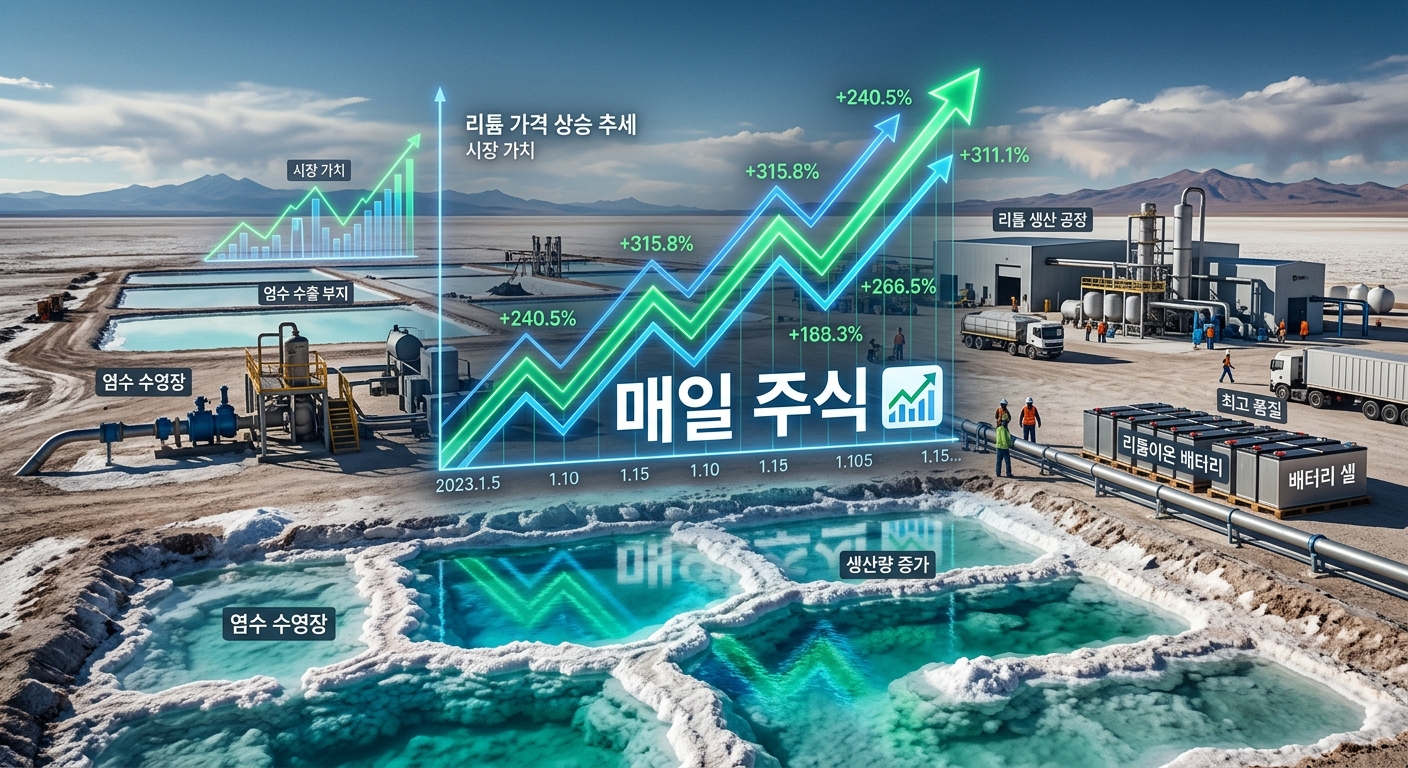
The biggest talking point in the secondary battery market in the first half of 2026 is undoubtedly the long-awaited price rebound of lithium, often referred to as "white gold."
Shaking off long-term oversupply concerns, lithium prices have surged by nearly 45% since the beginning of 2026, directly driving profitability improvements for KOSDAQ battery material companies.
As a result, market attention is focused on the margin spread recovery scenarios of EcoPro (035650), a holding company with high raw material price sensitivity, and Enchem (348370), a leading electrolyte player.
---
Current Status Summary
Leaving behind several years of oversupply, the global lithium market is entering a structural material deficit phase in 2026.
Indeed, as of June 18, 2026, the price of battery-grade lithium carbonate (99.5%) on Chinese exchanges hovered around CNY 167,250 per ton.
This represents a roughly 45% increase from the start of the year, driven by supply chain geopolitical risks, including the shutdown of some mines in China and Zimbabwe's ban on raw lithium ore exports.
Furthermore, an explosive increase in ESS (Energy Storage System) battery demand—driven by the construction of power grids for AI data centers—is exacerbating the lithium supply deficit.
Global investment banks (IBs) such as Morgan Stanley and UBS forecast that lithium supply in 2026 will face a deficit of 80,000 tons and 22,000 tons, respectively, on a lithium carbonate equivalent (LCE) basis.
This rebound in lithium prices is creating a "lagging effect," allowing materials companies to write back previous valuation losses on raw materials purchased at higher costs as profit.
---
Financial Analysis
The trickle-down effect of the lithium price rebound was clearly demonstrated in the Q1 2026 earnings of KOSDAQ's representative materials stocks.
| Classification | EcoPro (035650) | Enchem (348370) |
|---|---|---|
| **Q1 2026 Revenue** | KRW 822.0 billion (+2% YoY) | Unconfirmed on the day (Based on the latest checked value) |
| **Q1 2026 Operating Profit** | KRW 60.2 billion (42x increase YoY) | Unconfirmed on the day (Based on the latest checked value) |
| **Key Growth Driver** | Improved hydroxide lithium selling price & consolidation of Indonesia Green Eco Nickel (GEN) | Projected 300% increase in LFP electrolyte supply for Chinese ESS & mass production entry for CATL |
EcoPro posted an earnings surprise, with its operating profit skyrocketing from KRW 1.4 billion a year earlier to KRW 60.2 billion, driven by the turnaround of its lithium processing subsidiary EcoPro Innovation and rising cathode materials prices.
[Image: /stdaily/uploads/202606/gen_6a3648d3418be9.95453045.png]
In the case of Enchem, despite the upward trend of lithium salt (LiPF6) prices—a key raw material for electrolytes—the company is guiding a 300% year-on-year increase in electrolyte shipments by securing a lead in the Chinese local BESS (Battery Energy Storage System) market.
---
Valuation
Beyond acting as a simple holding company, EcoPro possesses a unique valuation structure that reflects not only the earnings of its sister companies like EcoPro Materials and EcoPro HN but also the value of its direct lithium processing business.
With lithium hydroxide prices recovering from the low $10s per kg to around $18, the revaluation of EcoPro Innovation's equity value is helping dilute the holding company discount.
Enchem commands a high premium as a dominant electrolyte company with pass-through pricing power against fluctuations in lithium salt prices.
In particular, its strategy of expanding its large-scale, long-term supply chain contracts with global "Top 10" battery makers, including the top-tier global battery company CATL, supports long-term upward momentum for its PSR (Price-to-Sales Ratio) valuation.
---
Expert & Institutional Analysis
Global market research firm CRU expects lithium carbonate prices to rise up to $33,900 per ton (approx. KRW 52 million) in Q3 of this year, surging 48.6% compared to the Q2 average.
Citigroup also predicted that lithium prices could touch up to $37,000 during the peak season in the second half of the year, advising investors to prepare for the start of a raw materials supercycle.
A domestic securities analyst noted, "Considering the time lag for raw material price rebounds to be reflected in product selling prices, the benefits of rising lithium prices will translate into maximized operating profits starting in Q2 of this year."
They also projected that the normalization of European utilization rates and large-scale power grid infrastructure investments centered in the US during the second half of the year would serve as major catalysts raising the multiples of secondary battery materials stocks.
---
Risk Factors
The factors that require the most vigilance are the rise of technological substitutes and the timing of China's supply resumption.
If the commercialization of alternative batteries that do not rely on expensive lithium, such as sodium-ion (Na-ion) batteries, accelerates, there is a risk that lithium demand projections in the large-scale energy storage market could be undermined.
In addition, institutions like Benchmark Mineral Intelligence warn that the current supply deficit could turn back into an oversupply next year due to a sudden resumption of operations at global mines, warranting caution.
---
Investment Perspective Summary
As of June 20, 2026, the KOSDAQ index stood at 966.59, continuing moderate volatility.
With the USD/KRW exchange rate reaching 1,533.00, secondary battery materials companies—which have a high portion of USD-denominated settlements and a large share of raw material import processing—may benefit from favorable exchange rate effects.
However, according to the Daily Stock Fear & Greed Index, the KOSPI Fear & Greed Index is currently neutral (51.9), while the US Nasdaq Fear & Greed Index points to fear (37.3).
Since global financial market sentiment is somewhat subdued, rather than indiscriminate FOMO buying based on rising lithium prices, a calm approach is required to check individual companies' Q2 earnings spread trends and localization progress in North American and European supply chains.
---
Investment Checklist
* Q1. How does the price of lithium affect the performance of secondary battery material companies?
* The selling prices of key materials such as cathode materials and electrolytes are linked to the market price of lithium. When lithium prices rise, companies produce products using raw materials purchased earlier at lower costs and sell them at higher prices. This simultaneously widens spread margins and writes back inventory valuation losses, leading to a rapid improvement in earnings.
* Q2. Why is EcoPro uniquely positioned compared to EcoPro BM to benefit from rising lithium prices?
* Although EcoPro is a holding company, it holds shares in its unlisted subsidiary EcoPro Innovation, which specializes in lithium hydroxide processing. Therefore, the operating profit turnaround in the lithium ore refining and processing segment is immediately reflected in its consolidated earnings.
* Q3. Why is Enchem's performance closely linked to lithium prices?
* The electrolyte produced by Enchem is a key material that serves as a pathway for lithium ions. Since the price of lithium salt (LiPF6), which accounts for a significant portion of electrolyte manufacturing costs, moves in tandem with lithium prices, raw material sourcing capability and price pass-through power are core indicators for maintaining profit margins.
* Q4. What is the specific outlook for lithium prices in the second half of 2026?
* Market research firms such as CRU and Citigroup have sent positive signals, forecasting that lithium carbonate prices in Q3 could surge by an additional 50% to between $33,900 and $37,000 per ton.
* Q5. What are the key risk factors that investors should watch out for?
* Investors must continuously monitor whether suspended mines in China resume operations, the penetration rate of alternative battery technologies using cheap sodium, and the recovery speed of the global electric vehicle (EV) market.
---